






Religious Importance and Mysteries of Mount Kailash
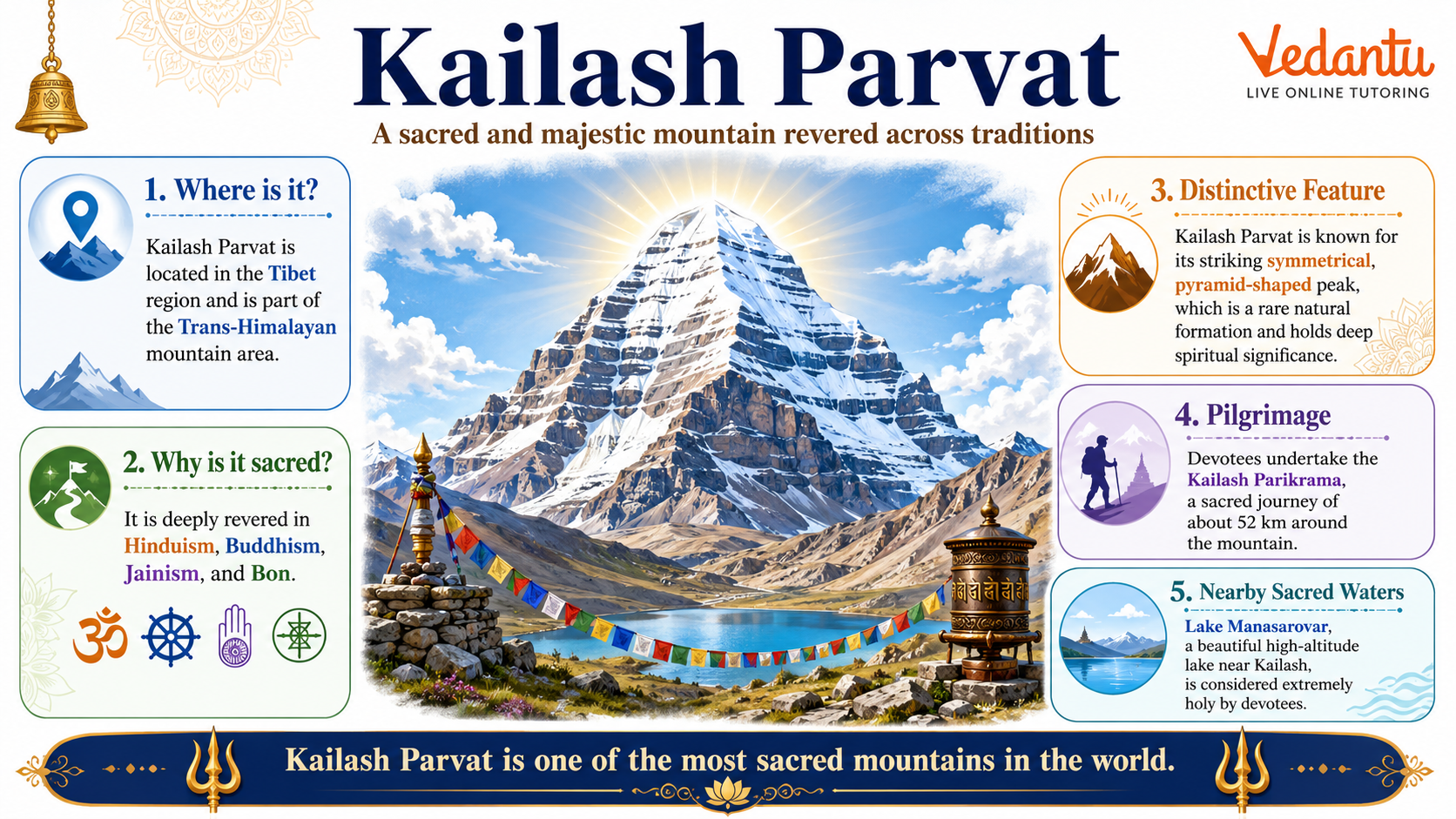
Kailash Parvat, also known as Mount Kailash, is one of the most sacred mountains in the world. Located in the Tibet Autonomous Region of China, it holds immense religious, cultural, and geographical importance. Revered in Hinduism, Buddhism, Jainism, and Bon religion, Kailash Parvat is considered a divine abode rather than just a physical mountain. Due to its spiritual value, it remains unclimbed and is a major pilgrimage destination for devotees from across the globe.
Geographical Location and Physical Features
Kailash Parvat is situated in the Trans-Himalayan region of Tibet, near Lake Manasarovar and Lake Rakshastal. It stands isolated with a distinctive pyramid shape and snow-capped peak, making it visually unique among surrounding mountains.
Key Geographical Facts
- Height - Approximately 6,638 meters above sea level
- Mountain Range - Gangdise Range, part of the Trans-Himalaya
- Nearby Lakes - Lake Manasarovar and Lake Rakshastal
- Source of Rivers - Indus, Sutlej, Brahmaputra, and Karnali rivers originate near this region
Despite being lower than Mount Everest, Kailash Parvat has never been climbed due to religious beliefs and restrictions imposed by the Chinese government.
Religious Significance of Kailash Parvat
Kailash Parvat is regarded as the spiritual center of the universe in several religions. It is considered a sacred site and a place of divine energy.
Importance in Hinduism
- Believed to be the abode of Lord Shiva and Goddess Parvati
- Considered the center of the cosmic axis or Mount Meru
- Pilgrimage known as Kailash Mansarovar Yatra is highly sacred
Importance in Buddhism
- Associated with Demchok, a representation of supreme bliss
- Regarded as the center of the universe in Buddhist cosmology
Importance in Jainism
- Believed to be the place where the first Tirthankara, Rishabhdev, attained liberation
Importance in Bon Religion
- Considered the spiritual seat of power
- Central to Bon rituals and traditions
Kailash Mansarovar Yatra
The Kailash Mansarovar Yatra is an annual pilgrimage undertaken by thousands of devotees. The journey involves trekking around Mount Kailash, known as Parikrama or Kora.
Parikrama Details
- Total Distance - Around 52 kilometers
- Duration - Approximately 3 days
- Highest Point - Dolma La Pass at about 5,630 meters
- Belief - Completing one Parikrama washes away sins
The pilgrimage is physically demanding due to high altitude and extreme weather conditions.
Quick Facts about Kailash Parvat
| Feature | Details | Significance |
|---|---|---|
| Height | 6,638 meters | One of the highest sacred peaks |
| Location | Tibet, China | Near Lake Manasarovar |
| Religious Value | Sacred in 4 religions | Major pilgrimage center |
These features make Kailash Parvat not only geographically important but also spiritually unique across different cultures and religions.
Why Kailash Parvat Remains Unclimbed
Unlike other major mountains, Kailash Parvat has never been summited. This is due to religious sentiments and respect shown by mountaineers worldwide.
- Strong religious belief that the peak is sacred
- Local traditions prohibit climbing
- Chinese authorities have not permitted expeditions
Many mountaineers consider it a matter of spiritual respect not to attempt climbing this sacred mountain.
Importance for General Knowledge and Competitive Exams
Kailash Parvat is an important topic in geography, religious studies, and current affairs. Questions related to its location, religious significance, and associated rivers are commonly asked in competitive exams.
Key Points to Remember
- Located in Tibet Autonomous Region of China
- Height is 6,638 meters
- Sacred to Hinduism, Buddhism, Jainism, and Bon
- Near the origin of four major rivers
- Remains unclimbed due to religious beliefs
Conclusion
Kailash Parvat is much more than a mountain. It represents faith, spirituality, and cultural unity across multiple religions. Its geographical uniqueness, sacred status, and historical importance make it one of the most respected peaks in the world. For students and general readers, understanding Kailash Parvat provides valuable insight into geography, religion, and global heritage.
FAQs on Kailash Parvat: The Sacred Himalayan Peak
1. What is Kailash Parvat and why is it important?
Kailash Parvat is a sacred mountain in the Himalayas, revered as a holy site in multiple religions.
• Located in the Tibet Autonomous Region of China
• Considered the abode of Lord Shiva in Hinduism
• Sacred to Buddhists, Jains, and Bon followers
• Known for its spiritual significance and pilgrimage called Kailash Mansarovar Yatra
• Often searched as: Mount Kailash facts, Kailash Parvat significance, holy mountain in Asia
2. Where is Kailash Parvat located?
Kailash Parvat is located in the remote southwestern part of the Tibet Autonomous Region in China.
• Situated near Lake Mansarovar and Rakshastal Lake
• Lies in the Trans-Himalayan mountain range
• Close to the source of major rivers like the Indus, Sutlej, Brahmaputra, and Karnali
• Frequently searched as: location of Mount Kailash, Kailash Parvat country, Himalayas sacred mountain
3. Why is Kailash Parvat sacred in Hinduism?
Kailash Parvat is sacred in Hinduism because it is believed to be the divine home of Lord Shiva and Goddess Parvati.
• Mentioned in ancient texts like the Puranas and Ramayana
• Considered the center of the universe or Mount Meru
• Pilgrims perform the Kailash Parikrama (circumambulation)
• Associated with moksha (liberation) and spiritual awakening
• Also searched as: Shiva home mountain, Hindu pilgrimage Kailash
4. What is the height of Kailash Parvat?
Kailash Parvat stands at an elevation of approximately 6,638 meters (21,778 feet) above sea level.
• Lower than Mount Everest but spiritually more significant
• Known for its unique pyramid-shaped peak
• Remains unclimbed due to religious beliefs
• Common searches: height of Mount Kailash, Kailash Parvat elevation, tallest sacred mountain
5. Has anyone climbed Kailash Parvat?
Kailash Parvat has never been climbed due to its immense religious significance and respect for spiritual traditions.
• Climbing is prohibited by the Chinese government
• Devotees believe climbing would disrespect Lord Shiva
• Some mountaineers attempted but withdrew for spiritual reasons
• Often searched as: why Mount Kailash is unclimbed, mystery of Kailash Parvat
6. What is Kailash Mansarovar Yatra?
Kailash Mansarovar Yatra is a sacred pilgrimage to Mount Kailash and Lake Mansarovar undertaken by devotees.
• Organized by the Government of India annually
• Includes trekking around Mount Kailash (Parikrama)
• Pilgrims take a holy dip in Lake Mansarovar
• Believed to cleanse sins and bring spiritual merit
• Also searched as: Kailash Yatra route, Mansarovar pilgrimage details
7. Which rivers originate near Kailash Parvat?
Kailash Parvat is the source region of four major Asian rivers, making it geographically significant.
• Indus River
• Sutlej River
• Brahmaputra River (Tsangpo)
• Karnali River (a tributary of the Ganga)
• Frequently searched as: rivers originating from Mount Kailash, source of Indus and Brahmaputra
8. What is the religious importance of Kailash Parvat in Buddhism and Jainism?
Kailash Parvat holds sacred value in Buddhism and Jainism beyond Hindu beliefs.
• In Buddhism, it is associated with Demchok (Chakrasamvara)
• In Jainism, it is where Rishabhadeva (first Tirthankara) attained liberation
• Sacred to the ancient Bon religion of Tibet
• Also searched as: Kailash in Jainism, Buddhist belief about Mount Kailash
9. What is the mystery behind Kailash Parvat?
Kailash Parvat is often called mysterious due to its unique shape, unclimbed status, and spiritual legends.
• Perfect pyramid-like structure
• Believed to be a spiritual energy center
• Legends claim time moves differently near the mountain
• No successful summit expedition recorded
• Common searches: Mount Kailash mystery, secrets of Kailash Parvat
10. How is Kailash Parvat different from Mount Everest?
Kailash Parvat differs from Mount Everest in terms of religious importance rather than height.
• Everest is the highest mountain (8,848.86 m) in the world
• Kailash is lower but spiritually sacred
• Everest has been climbed thousands of times
• Kailash remains unclimbed due to religious respect
• Frequently searched as: Kailash vs Everest comparison, sacred mountain vs highest peak
