






Impact of the Jallianwala Bagh Incident on India’s Freedom Struggle
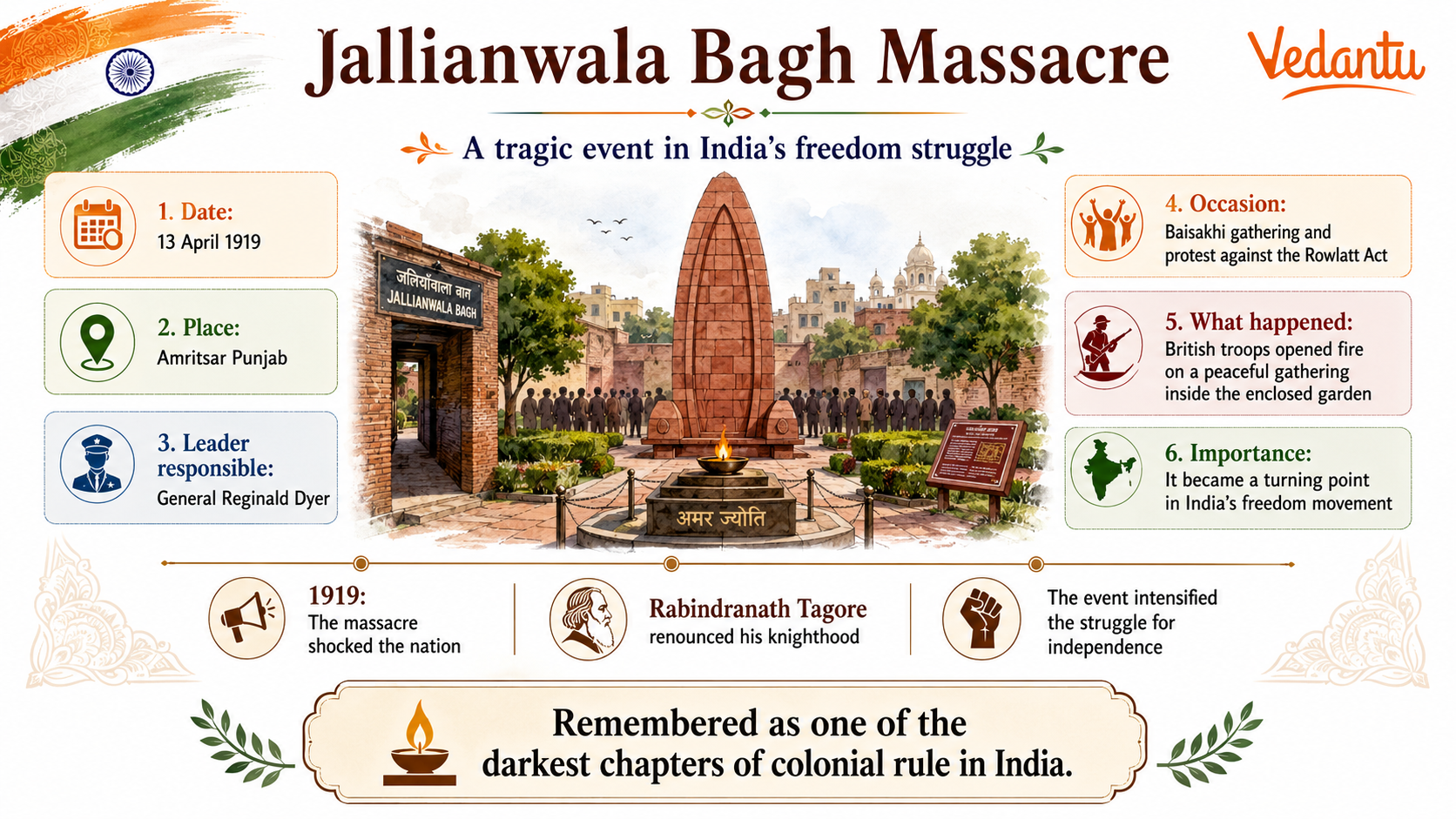
The Jallianwala Bagh Massacre was one of the most tragic and turning points in the history of India’s freedom struggle. It took place on 13 April 1919 in Amritsar, Punjab, when British troops opened fire on a peaceful gathering of Indians. The incident exposed the brutal nature of British colonial rule and deeply shocked the entire nation. It intensified the Indian freedom movement and led to widespread protests against British policies. The massacre remains a powerful symbol of sacrifice and resistance in Indian history.
Background of the Jallianwala Bagh Massacre
The massacre occurred during a period of political unrest in India. After World War I, the British government passed the Rowlatt Act in 1919. This Act allowed the British authorities to arrest and detain people without trial. Indians strongly opposed this Act as it violated civil liberties.
- The Rowlatt Act was passed in March 1919.
- Nationwide protests were organized against the Act.
- In Punjab, two popular leaders - Dr. Saifuddin Kitchlew and Dr. Satyapal - were arrested.
- People gathered at Jallianwala Bagh on 13 April 1919 to protest peacefully and celebrate Baisakhi.
Jallianwala Bagh was an open ground surrounded by walls with only a few narrow entrances, making escape difficult.
What Happened on 13 April 1919?
On the afternoon of 13 April 1919, thousands of men, women, and children gathered at Jallianwala Bagh. Brigadier General Reginald Dyer arrived at the site with armed troops. Without issuing any warning to disperse, he ordered his soldiers to fire at the unarmed crowd.
- The firing lasted for about 10 minutes.
- Approximately 1650 rounds of ammunition were fired.
- Official British records reported 379 deaths.
- Indian sources estimated over 1000 people were killed and many more injured.
The troops blocked the main exit, and many people jumped into a well inside the Bagh to save themselves from bullets. The well later became a symbol of the tragedy.
Causes of the Jallianwala Bagh Massacre
- Opposition to the Rowlatt Act.
- Arrest of nationalist leaders in Punjab.
- Growing nationalist movements demanding self-rule.
- Strict martial law imposed by British authorities in Punjab.
Consequences and Impact
The massacre had a deep and lasting impact on the Indian freedom movement. It marked a shift from moderate political methods to more intense national resistance.
- Rabindranath Tagore renounced his knighthood in protest.
- Mahatma Gandhi launched the Non Cooperation Movement in 1920.
- The British government appointed the Hunter Commission to investigate the incident.
- General Dyer was criticized but not severely punished.
The massacre united Indians across regions and religions against British rule. It exposed the cruelty of colonial governance to the world.
Key Facts about Jallianwala Bagh Massacre
| Particular | Details | Significance |
|---|---|---|
| Date | 13 April 1919 | Baisakhi festival day |
| Location | Jallianwala Bagh, Amritsar | Punjab, India |
| Officer in Charge | General Reginald Dyer | Ordered troops to fire |
The Jallianwala Bagh Massacre remains one of the darkest chapters of British rule in India. Today, a national memorial stands at the site to honor the victims. The event strengthened India’s resolve for independence and became a major milestone in the struggle against colonial oppression.
Jallianwala Bagh Memorial
After independence, the Government of India established a memorial at Jallianwala Bagh to remember those who lost their lives. The memorial includes:
- A flame shaped memorial structure.
- The Martyrs Well where many jumped to escape bullets.
- Bullet marks preserved on the walls.
The site is now a place of historical importance and national remembrance.
Why Jallianwala Bagh Massacre is Important for Exams
- Frequently asked in competitive exams and General Knowledge sections.
- Important event in the Indian National Movement timeline.
- Connected with Rowlatt Act, Non Cooperation Movement, and Hunter Commission.
- Helps in understanding the shift in Indian political strategy.
In conclusion, the Jallianwala Bagh Massacre was not just a tragic incident but a catalyst that transformed India’s freedom struggle. It awakened national consciousness and strengthened the demand for complete independence from British rule.
FAQs on Jallianwala Bagh Tragedy of 1919 Explained for Students
1. What was the Jallianwala Bagh Massacre?
The Jallianwala Bagh Massacre was a tragic mass shooting that took place on 13 April 1919 in Amritsar, Punjab, where British troops opened fire on a peaceful gathering.
- Ordered by General Reginald Dyer
- Hundreds of unarmed Indians were killed
- Occurred during protests against the Rowlatt Act
- Also known as the Amritsar Massacre
2. Why did the Jallianwala Bagh Massacre happen?
The massacre happened due to rising tensions after the passing of the Rowlatt Act (1919), which allowed arrest without trial.
- People gathered to protest British repression
- Meeting was held on Baisakhi festival
- General Dyer imposed martial restrictions
- Troops blocked the only exit and fired without warning
3. Who was responsible for the Jallianwala Bagh Massacre?
The massacre was ordered by Brigadier-General Reginald Edward Harry Dyer, a British officer.
- He commanded soldiers to fire on the crowd
- No warning was given before shooting
- Later investigated by the Hunter Commission
- Faced criticism but was not severely punished
4. How many people died in the Jallianwala Bagh Massacre?
The exact number of deaths in the Jallianwala Bagh Massacre remains disputed.
- British official record: around 379 deaths
- Indian sources estimate over 1,000 deaths
- More than 1,500 injured
5. What was the impact of the Jallianwala Bagh Massacre on India’s freedom movement?
The massacre significantly intensified the Indian National Movement against British rule.
- Mahatma Gandhi launched the Non-Cooperation Movement
- Increased demand for Swaraj (self-rule)
- Strengthened nationalist unity
- Exposed brutality of British administration
6. What was the Hunter Commission?
The Hunter Commission was a British inquiry committee set up in 1919 to investigate the Jallianwala Bagh incident.
- Examined actions of General Dyer
- Declared his action unjustified
- Dyer was relieved of duty
- No severe punishment was imposed
7. Where is Jallianwala Bagh located today?
Today, Jallianwala Bagh is a national memorial located in Amritsar, Punjab, near the Golden Temple.
- Preserves bullet marks on walls
- Contains the Martyrs’ Well
- Managed as a public memorial site
- Commemorates victims of 13 April 1919
8. What was the Rowlatt Act?
The Rowlatt Act (1919) was a repressive British law that allowed detention without trial.
- Passed despite Indian opposition
- Suspended civil liberties
- Triggered nationwide protests
- Led directly to the Amritsar gathering
9. How is Jallianwala Bagh Massacre remembered in India?
The massacre is remembered as a symbol of colonial oppression and national sacrifice.
- Observed annually on 13 April
- Tributes paid at the memorial site
- Included in school textbooks and GK exams
- Recognized as a key event in Indian history
10. Why is the Jallianwala Bagh Massacre important for competitive exams?
The Jallianwala Bagh Massacre is important for competitive exams because it is a major event in modern Indian history.
- Frequently asked in UPSC, SSC, NDA, and State PSC exams
- Linked with topics like Rowlatt Act and Non-Cooperation Movement
- Important for General Knowledge (GK) and history sections
- Helps understand British colonial policies
