






Indian Economy Growth Drivers, Major Sectors, and Economic Reforms Explained
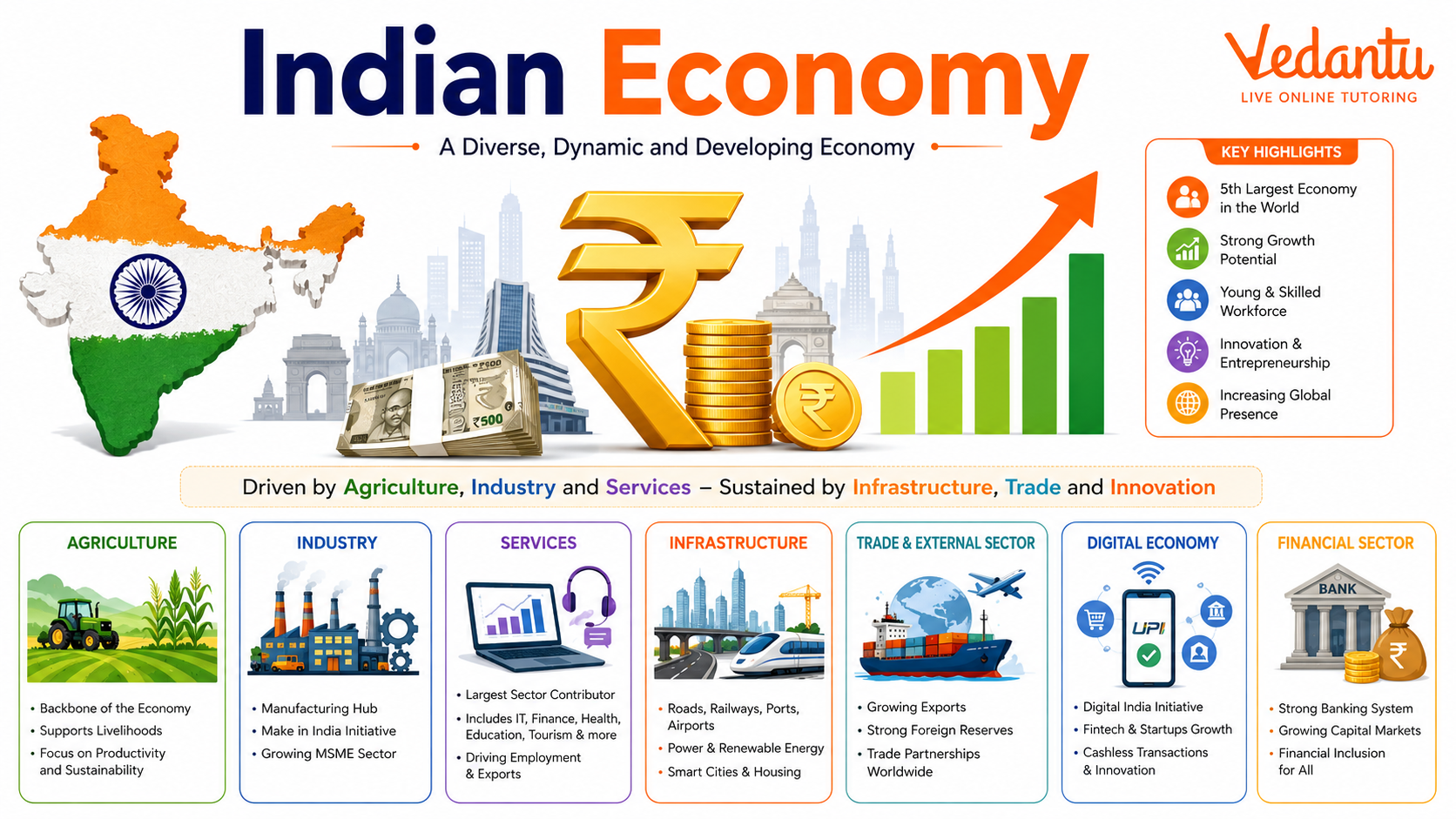
The Indian Economy refers to the system of production, distribution, and consumption of goods and services in India. It is one of the fastest-growing major economies in the world and plays a significant role in global economic activities. The economy of India is characterized as a mixed economy, where both the government and private sector participate in economic activities. Understanding the Indian Economy is important for students, competitive exam aspirants, and general readers as it covers key areas such as economic planning, sectors of the economy, national income, banking, and economic reforms.
Nature of the Indian Economy
India follows a mixed economic model, which combines features of both capitalism and socialism. The government regulates and controls key sectors while private enterprises operate in other areas to promote growth and competition.
- Mixed Economy - Presence of both public and private sectors.
- Developing Economy - Rapid industrialization and modernization.
- Agriculture-based - A significant population depends on agriculture.
- Service-oriented - Growing contribution of the service sector to GDP.
Sectors of the Indian Economy
The Indian Economy is divided into three major sectors based on the type of economic activity performed.
Major Sectors of Indian Economy
| Sector | Main Activity | Examples |
|---|---|---|
| Primary Sector | Extraction of natural resources | Agriculture, Fishing, Mining |
| Secondary Sector | Manufacturing and industrial production | Textiles, Steel, Automobile |
| Tertiary Sector | Service-based activities | Banking, IT, Education |
In recent years, the tertiary sector has become the largest contributor to India's Gross Domestic Product, reflecting the growth of services such as information technology, finance, and telecommunications.
National Income and GDP
National Income refers to the total value of goods and services produced in a country during a financial year. Gross Domestic Product or GDP is one of the most important indicators used to measure economic performance.
Key Concepts
- GDP - Total value of goods and services produced within India.
- GNP - GDP plus income earned from abroad.
- Per Capita Income - National income divided by population.
- Economic Growth - Increase in real GDP over time.
Economic Planning in India
After independence, India adopted planned economic development. The Planning Commission was established in 1950 to formulate Five Year Plans. In 2015, it was replaced by NITI Aayog to promote cooperative federalism and policy innovation.
- Five Year Plans focused on agriculture, industry, and poverty reduction.
- Green Revolution improved agricultural productivity.
- Liberalization in 1991 opened the economy to global markets.
Economic Reforms of 1991
In 1991, India introduced major economic reforms to overcome a balance of payments crisis. These reforms aimed at making the economy more market-oriented and globally competitive.
Main Features of LPG Reforms
- Liberalization - Reduction of government controls and licenses.
- Privatization - Transfer of ownership from public to private sector.
- Globalization - Integration with the world economy.
Banking and Financial System
The banking system in India plays a vital role in economic development by mobilizing savings and providing credit. The Reserve Bank of India or RBI is the central bank that regulates the monetary system.
- RBI controls inflation and monetary policy.
- Commercial banks provide loans and accept deposits.
- Digital banking and UPI have transformed financial transactions.
Major Challenges of the Indian Economy
Despite significant progress, the Indian Economy faces several structural and developmental challenges.
- Unemployment and underemployment.
- Income inequality and poverty.
- Inflation and price instability.
- Infrastructure gaps.
Importance of Indian Economy in Competitive Exams
The Indian Economy is an important section in various competitive examinations such as UPSC, SSC, Banking, State PSC, and other government exams. Questions are frequently asked about GDP, economic reforms, sectors of the economy, banking system, and government schemes.
- Understand basic economic terms and concepts clearly.
- Focus on current economic developments and government policies.
- Revise important data related to GDP, inflation, and banking.
Conclusion
The Indian Economy is dynamic and continuously evolving with reforms, technological advancement, and policy changes. From agriculture to services, every sector contributes to national development. A clear understanding of its structure, policies, and challenges helps students build strong conceptual knowledge and perform well in competitive examinations. Studying the Indian Economy not only enhances general awareness but also provides insight into the country's growth and future prospects.
FAQs on Indian Economic System – Structure, Growth, and Development Overview
1. What is the Indian Economy?
The Indian Economy refers to the economic system of India that manages the production, distribution, and consumption of goods and services.
• It is a mixed economy combining both public sector and private sector enterprises.
• It is one of the world’s fastest-growing emerging economies.
• Major sectors include agriculture, industry, and services.
• India follows economic planning through institutions like NITI Aayog.
Keywords: economic system, mixed economy, developing economy, GDP of India.
2. What are the main sectors of the Indian Economy?
The Indian Economy is divided into three major sectors based on economic activities.
• Primary Sector – Agriculture, fishing, mining (raw material extraction).
• Secondary Sector – Manufacturing, industries, construction.
• Tertiary Sector – Services like banking, IT, tourism, education.
• The service sector contributes the highest to India’s GDP.
Keywords: economic sectors, agriculture sector, industrial sector, service sector contribution.
3. What is GDP and why is it important for the Indian Economy?
Gross Domestic Product (GDP) measures the total value of goods and services produced in India in a year.
• It indicates the economic growth of the country.
• Higher GDP means better income levels and development.
• Calculated by National Statistical Office (NSO).
• Types include Nominal GDP and Real GDP.
Keywords: GDP growth rate, economic development, national income, per capita income.
4. What is a Mixed Economy?
A mixed economy is an economic system where both government and private enterprises operate together.
• The public sector controls essential industries like defense and railways.
• The private sector runs businesses for profit.
• Ensures economic welfare and competition.
• India adopted this model after Independence in 1947.
Keywords: public and private sector, economic model, Indian economic system.
5. What was the New Economic Policy of 1991?
The New Economic Policy (NEP) 1991 introduced major economic reforms to liberalize the Indian Economy.
• Based on LPG reforms – Liberalization, Privatization, Globalization.
• Reduced government control over industries.
• Encouraged foreign direct investment (FDI).
• Initiated under Dr. Manmohan Singh.
Keywords: economic reforms 1991, LPG policy, globalization in India, balance of payments crisis.
6. What is the role of the Reserve Bank of India (RBI)?
The Reserve Bank of India (RBI) is the central bank that regulates India’s monetary system.
• Controls inflation and money supply.
• Issues currency notes.
• Acts as banker to the government.
• Regulates commercial banks through monetary policy tools like Repo Rate and CRR.
Keywords: central bank of India, monetary policy, inflation control, banking regulation.
7. What is Inflation and how does it affect the Indian Economy?
Inflation refers to the rise in prices of goods and services over time in the Indian Economy.
• Reduces purchasing power of money.
• Measured by Consumer Price Index (CPI) and Wholesale Price Index (WPI).
• Controlled by RBI through interest rates.
• Moderate inflation supports growth, but high inflation harms the economy.
Keywords: price rise, cost of living, CPI, WPI, economic stability.
8. What is the Planning Commission and NITI Aayog?
The Planning Commission was replaced by NITI Aayog in 2015 to promote cooperative federalism and policy planning.
• Planning Commission was established in 1950.
• NITI Aayog focuses on sustainable development and innovation.
• Encourages participation of states in economic planning.
• Works towards achieving SDGs (Sustainable Development Goals).
Keywords: economic planning in India, five-year plans, policy think tank.
9. What is Fiscal Policy in the Indian Economy?
Fiscal policy refers to government decisions regarding taxation and public expenditure.
• Managed by the Ministry of Finance.
• Includes Budget, taxes, subsidies, and government spending.
• Aims to control economic growth and inflation.
• Helps reduce fiscal deficit and public debt.
Keywords: Union Budget, taxation policy, government revenue, fiscal deficit.
10. What are the major challenges faced by the Indian Economy?
The Indian Economy faces several structural and developmental challenges.
• Unemployment and underemployment.
• Poverty and income inequality.
• Agricultural dependency and rural distress.
• Inflation and fiscal deficit issues.
• Infrastructure and skill development gaps.
Keywords: economic problems in India, unemployment rate, poverty line, inclusive growth.
