






Key Features and Security Elements of Indian Paper Currency Notes
Indian Currency Notes are the official paper money issued by the Reserve Bank of India - RBI - and used as legal tender across the country. These notes represent the monetary system of India and play a vital role in the nation’s economy. Indian currency notes reflect the cultural heritage, historical legacy, and technological advancement of the country. For students and competitive exam aspirants, understanding Indian currency notes is important for General Knowledge, Banking, SSC, UPSC, Railways, and other government examinations.
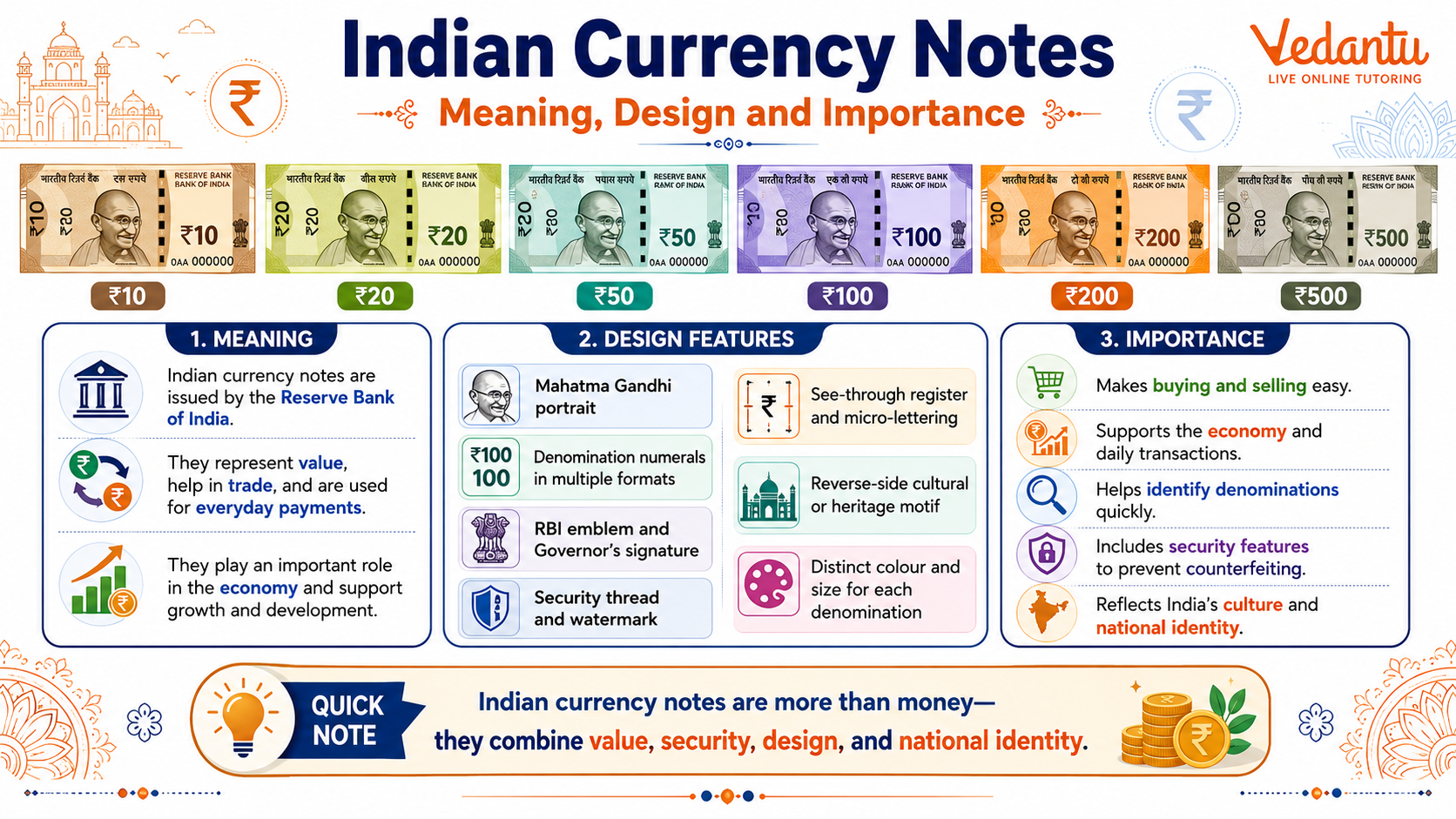
Introduction to Indian Currency
The official currency of India is the Indian Rupee, denoted by the symbol Rs or the sign ₹. The issuance and management of currency notes in India are regulated by the Reserve Bank of India under the RBI Act, 1934. The Government of India issues only one rupee notes and coins, while all other currency notes are issued by the RBI.
- Currency Name - Indian Rupee
- Currency Code - INR
- Currency Symbol - ₹
- Regulatory Authority - Reserve Bank of India
History of Indian Currency Notes
The history of Indian currency notes dates back to the 18th century when private banks issued paper currency. After independence in 1947, India introduced new designs of currency notes featuring national symbols. Over time, currency notes evolved with improved security features to prevent counterfeiting.
Major Phases of Development
- Pre Independence currency issued by Presidency Banks
- Post Independence notes featuring the Lion Capital of Ashoka
- Mahatma Gandhi Series introduced in 1996
- Mahatma Gandhi New Series introduced after 2016
Denominations of Indian Currency Notes
At present, Indian currency notes are available in different denominations for daily transactions. Each denomination has a distinct color, size, and design theme representing India’s heritage sites.
Current Indian Currency Note Denominations
| Denomination | Dominant Color | Theme on Reverse Side |
|---|---|---|
| ₹10 | Chocolate Brown | Konark Sun Temple |
| ₹20 | Greenish Yellow | Ellora Caves |
| ₹50 | Fluorescent Blue | Hampi with Chariot |
| ₹100 | Lavender | Rani ki Vav |
| ₹200 | Bright Yellow | Sanchi Stupa |
| ₹500 | Stone Grey | Red Fort |
| ₹2000 | Magenta | Mangalyaan |
Note that the ₹2000 note was introduced in 2016 and later withdrawn from circulation in 2023, though it remains legal tender as per RBI guidelines at the time of withdrawal.
Features of Indian Currency Notes
Indian currency notes include advanced security features to prevent forgery and ensure authenticity. These features are important from both economic and examination perspectives.
Security Features
- Watermark of Mahatma Gandhi portrait
- Security thread with inscriptions
- Latent image of denomination
- Micro lettering
- Intaglio printing for visually impaired persons
- Color changing ink in higher denominations
Language Panel on Indian Currency Notes
Indian currency notes display the denomination in multiple languages to reflect India’s linguistic diversity. The language panel includes 15 languages on the reverse side, apart from Hindi and English on the front side.
Languages on the Panel
The panel includes Assamese, Bengali, Gujarati, Kannada, Kashmiri, Konkani, Malayalam, Marathi, Nepali, Odia, Punjabi, Sanskrit, Tamil, Telugu, and Urdu.
Importance of Indian Currency Notes in GK Exams
Questions related to Indian currency notes are frequently asked in competitive examinations. Candidates should remember important facts such as issuing authority, security features, denominations, themes, and historical developments.
Common Exam Questions
- Who issues Indian currency notes?
- Which monument is featured on a specific denomination?
- What are the security features of Indian notes?
- When was the Mahatma Gandhi New Series introduced?
Conclusion
Indian Currency Notes are more than just a medium of exchange. They represent the economic strength, cultural heritage, and unity of India. From their historical evolution to modern security features, each note carries significance. For students and exam aspirants, having a clear understanding of Indian currency notes helps in scoring well in General Knowledge sections and staying informed about the nation’s financial system.
FAQs on Indian Currency Notes: Meaning, Design and Importance for Students
1. What are Indian Currency Notes?
Indian Currency Notes are the official paper money issued by the Reserve Bank of India (RBI) for use as legal tender in India. • They are issued under the RBI Act, 1934 • Denominations include ₹10, ₹20, ₹50, ₹100, ₹200, ₹500, and ₹2000 (withdrawn from circulation in 2023) • Feature the Mahatma Gandhi Series and Mahatma Gandhi (New) Series • Used for daily transactions, banking, and trade across India.
2. Who issues Indian Currency Notes?
The Reserve Bank of India (RBI) is responsible for issuing Indian currency notes, except the ₹1 note. • RBI regulates currency under the RBI Act, 1934 • The ₹1 note is issued by the Ministry of Finance • The RBI Governor signs all notes except ₹1 • RBI ensures supply, security, and circulation of Indian banknotes.
3. What are the security features of Indian Currency Notes?
Indian Currency Notes contain advanced security features to prevent counterfeiting and ensure authenticity. • Watermark of Mahatma Gandhi • Security thread with inscriptions • Latent image and micro-lettering • Intaglio printing for raised effect • See-through register and color-changing ink • Identification marks for visually impaired persons.
4. What is the Mahatma Gandhi Series in Indian Currency?
The Mahatma Gandhi Series is a set of Indian banknotes featuring Mahatma Gandhi’s portrait introduced in 1996. • Replaced the earlier Lion Capital Series • Updated to Mahatma Gandhi (New) Series in 2016 • Includes vibrant colors and new themes • Highlights India’s cultural heritage and achievements.
5. What is demonetization in India?
Demonetization is the process of declaring certain currency notes invalid as legal tender. • Major demonetization occurred on 8 November 2016 • ₹500 and ₹1000 notes were withdrawn • Aimed to curb black money, corruption, and counterfeit currency • Led to the introduction of new ₹500 and ₹2000 notes.
6. Why is Mahatma Gandhi’s photo on Indian Currency Notes?
Mahatma Gandhi’s photo appears on Indian currency as a symbol of national unity and independence. • He is known as the Father of the Nation • Represents peace, truth, and non-violence • His portrait was adopted in 1996 • Recognized globally as a symbol of India.
7. What are the different denominations of Indian Currency Notes?
Indian Currency Notes are available in multiple denominations for easy transactions. • Currently in circulation: ₹10, ₹20, ₹50, ₹100, ₹200, ₹500 • ₹2000 note withdrawn from circulation in 2023 • Each denomination has distinct colors and designs • Printed at government security presses in India.
8. What is written on Indian Currency Notes?
Indian Currency Notes contain important inscriptions and legal guarantees. • “I promise to pay the bearer…” clause • Signature of the RBI Governor • Value written in 17 Indian languages • Features the National Emblem (Lion Capital of Ashoka) • Includes year of printing and RBI seal.
9. Where are Indian Currency Notes printed?
Indian Currency Notes are printed at high-security government presses across India. • Security Printing and Minting Corporation of India Limited (SPMCIL) presses • Locations include Nashik, Dewas, Mysuru, and Salboni • Follow strict security and quality standards • Managed under RBI supervision.
10. What is the importance of Indian Currency Notes in the economy?
Indian Currency Notes play a vital role in facilitating trade, commerce, and economic stability. • Act as a medium of exchange • Serve as a store of value • Help in measuring economic transactions • Support both urban and rural economies • Regulated by RBI to maintain financial stability and control inflation.
