






Features, Objectives and Impact of the 1909 Indian Council Reforms
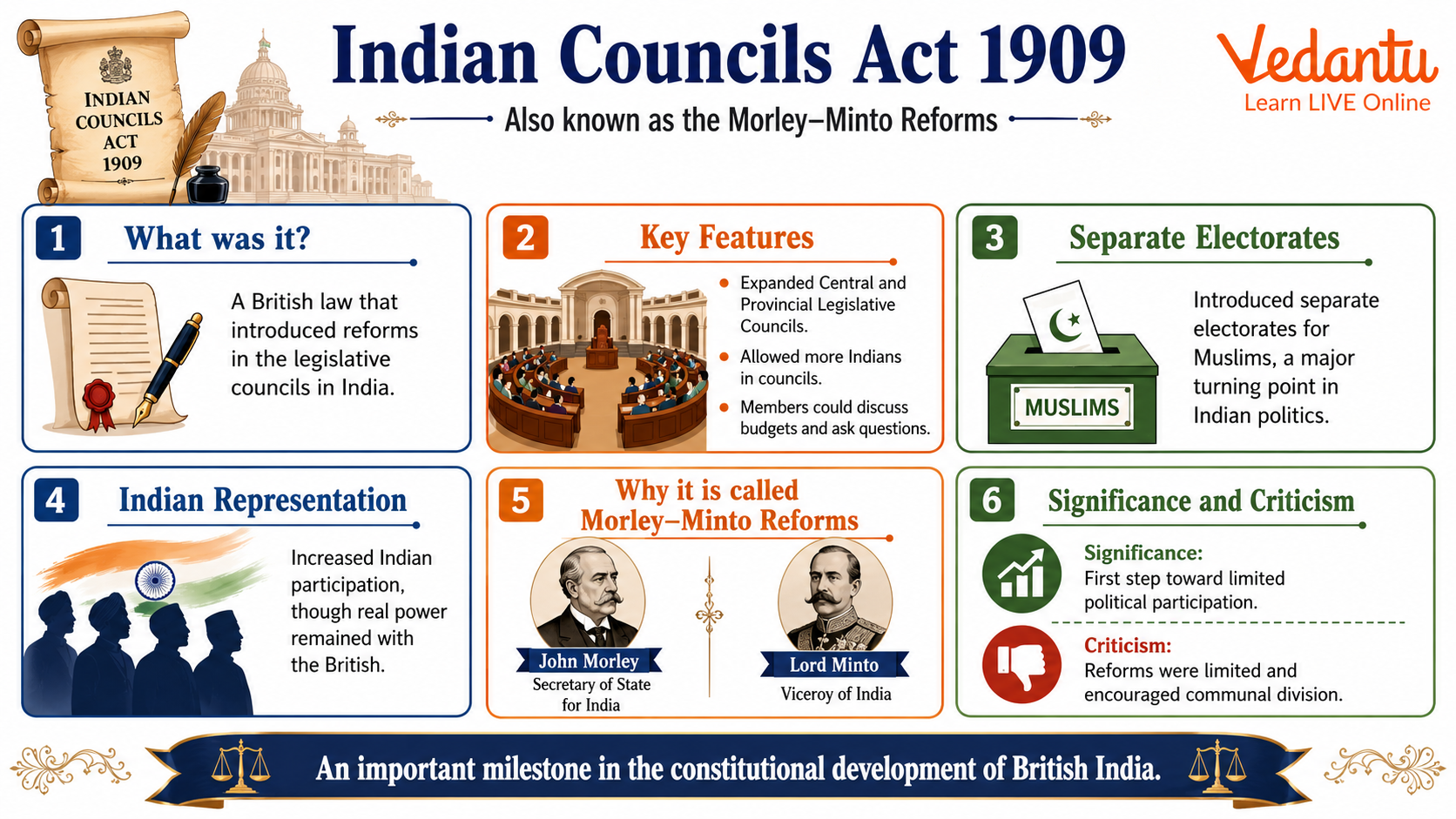
The Indian Council Act of 1909, popularly known as the Morley-Minto Reforms, was an important constitutional reform introduced by the British Government in India. It was enacted to increase Indian participation in legislative councils and to address the growing demand for political representation. The Act is named after Lord Morley, the Secretary of State for India, and Lord Minto, the Viceroy of India at that time. Though the reforms expanded legislative councils, they also introduced the controversial system of separate electorates for Muslims, which had long-term political consequences for India.
Background of the Indian Council Act 1909
The early 20th century witnessed increasing political awareness in India. The Indian National Congress was demanding greater representation and self-governance. The Partition of Bengal in 1905 and the Swadeshi Movement intensified political unrest. The British government introduced reforms to calm nationalist demands and secure loyalty from certain sections of society.
- Growing demand for self-government by Indian leaders
- Rise of extremist and moderate groups in Congress
- Impact of the Swadeshi and boycott movements
- British strategy to divide and rule
Objectives of the Morley-Minto Reforms
The British government introduced the reforms with specific political objectives. While it appeared to grant concessions, the underlying aim was to strengthen British control.
- To increase Indian participation in governance
- To reduce nationalist agitation
- To gain support from Muslim elites
- To maintain British supremacy in administration
Key Features of the Indian Council Act 1909
1. Expansion of Legislative Councils
The number of members in both Central and Provincial Legislative Councils was increased significantly. This allowed more Indians to participate in legislative discussions.
2. Introduction of Separate Electorates
The Act introduced separate electorates for Muslims. Under this system, Muslim voters elected their own representatives. This was the first official recognition of communal representation in India.
3. Increased Powers of Legislative Councils
Members were allowed to discuss budgets, ask supplementary questions, and move resolutions on public matters. However, their powers were limited and subject to approval by the executive.
4. Inclusion of Indians in Executive Councils
For the first time, Indians were appointed to the Viceroy’s Executive Council. Satyendra Prasad Sinha became the first Indian member.
Major Provisions of the Indian Council Act 1909
| Provision | Description | Impact |
|---|---|---|
| Expansion of Councils | Increased number of members in Central and Provincial Councils | More Indian participation but limited authority |
| Separate Electorates | Muslims elected their own representatives | Encouraged communal politics |
| Right to Discuss Budget | Members could discuss financial matters | Limited control over executive decisions |
Although the reforms expanded representation, real power remained with the British executive. The system of separate electorates had far-reaching political consequences.
Significance of the Morley-Minto Reforms
The Indian Council Act 1909 marked an important stage in constitutional development in India. It acknowledged the need for Indian representation but stopped short of granting responsible government.
- First step towards representative institutions
- Beginning of communal electoral politics
- Inclusion of Indians in higher executive positions
- Foundation for later constitutional reforms
Criticism of the Indian Council Act 1909
Despite introducing reforms, the Act faced criticism from Indian nationalists. Many leaders believed it was insufficient and divisive.
- No real transfer of power to Indians
- Separate electorates promoted communal division
- Limited franchise based on property and education
- Executive retained overriding authority
Comparison with Earlier Reforms
Indian Council Act 1892 vs Indian Council Act 1909
The Act of 1909 was more progressive than the Act of 1892. While the 1892 Act allowed limited discussion of budgets, the 1909 Act expanded council membership and introduced separate electorates. However, both Acts maintained British control over key decisions.
Conclusion
The Indian Council Act of 1909 or Morley-Minto Reforms was a significant milestone in the constitutional history of India. It expanded legislative councils and allowed limited Indian participation in governance. However, the introduction of separate electorates laid the foundation for communal politics in India. Though the reforms did not satisfy nationalist demands, they marked an important step in India’s gradual journey towards self-government.
FAQs on Indian Councils Act 1909 (Morley–Minto Reforms): Complete Guide for Students
1. What was the Indian Council Act of 1909 (Morley-Minto Reforms)?
The Indian Council Act of 1909, also known as the Morley-Minto Reforms, was a constitutional reform introduced to expand legislative councils and include Indians in governance.
- Enacted during Lord Minto’s tenure as Viceroy and introduced by John Morley, the Secretary of State.
- Expanded the size of Central and Provincial Legislative Councils.
- Introduced the system of separate electorates for Muslims.
- Allowed limited participation of Indians in administration.
It is considered a key milestone in the evolution of constitutional reforms in British India.
2. Why were the Morley-Minto Reforms introduced?
The Morley-Minto Reforms were introduced to address rising political unrest and demands for self-governance by Indian nationalists.
- Growth of the Indian National Congress.
- Aftermath of the Partition of Bengal (1905).
- Pressure from moderate leaders demanding reforms.
- Need to control revolutionary activities.
The reforms aimed to balance nationalist demands while maintaining British control over India.
3. What were the main features of the Indian Council Act 1909?
The main features of the Indian Council Act 1909 included expansion of councils and introduction of separate electorates.
- Increased members in Imperial Legislative Council.
- Introduction of separate electorates for Muslims.
- Allowed members to discuss the budget and ask questions.
- First time Indians appointed to the Viceroy’s Executive Council.
These features marked a gradual step toward representative institutions in colonial India.
4. What is meant by separate electorates under the Morley-Minto Reforms?
Separate electorates meant that Muslims could elect their own representatives separately from other communities.
- Muslim voters voted only for Muslim candidates.
- Institutionalized communal representation.
- Strengthened the position of the All India Muslim League.
This provision later contributed to communal politics and the demand for Pakistan.
5. Who were Morley and Minto in the Morley-Minto Reforms?
John Morley and Lord Minto were the British officials responsible for the Indian Council Act 1909.
- John Morley – Secretary of State for India.
- Lord Minto – Viceroy of India (1905–1910).
- Together introduced constitutional reforms in 1909.
Their names became associated with the reforms, hence called Morley-Minto Reforms.
6. What were the limitations of the Indian Council Act 1909?
The Indian Council Act 1909 had several limitations as it did not grant real power to Indians.
- No responsible government established.
- Executive remained under British control.
- Separate electorates promoted communal division.
- Limited voting rights restricted to elites.
Therefore, nationalists considered it inadequate for achieving Swaraj (self-rule).
7. How did the Indian National Congress react to the Morley-Minto Reforms?
The Indian National Congress gave a mixed reaction to the Morley-Minto Reforms.
- Moderates welcomed limited reforms.
- Extremists criticized them as insufficient.
- Opposed the system of separate electorates.
The reforms widened the divide between moderate and extremist leaders within the freedom movement.
8. What was the significance of the Indian Council Act 1909?
The significance of the Indian Council Act 1909 lies in its role in expanding legislative participation in British India.
- First step toward representative government.
- Recognized Muslims as a separate political community.
- Increased Indian involvement in law-making.
It paved the way for later reforms like the Government of India Act 1919.
9. How did the Morley-Minto Reforms affect communal politics in India?
The Morley-Minto Reforms strengthened communal politics by institutionalizing separate electorates.
- Encouraged political identity based on religion.
- Increased influence of the Muslim League.
- Deepened Hindu-Muslim political differences.
This development later influenced events like the Communal Award and Partition of India (1947).
10. How is the Indian Council Act 1909 important for competitive exams?
The Indian Council Act 1909 is important for competitive exams due to its constitutional and historical relevance.
- Frequently asked in UPSC, SSC, State PSC, and other GK exams.
- Key topics: separate electorates, legislative councils, Morley and Minto.
- Forms the foundation of modern Indian constitutional development.
Understanding this Act helps in linking later reforms like the Government of India Acts of 1919 and 1935.
