






Major Rajput Kings and Their Contributions to Indian History
The Rajputs were a prominent warrior clan that ruled various parts of northern and western India from the 6th century onwards. They are known for their bravery, chivalry, strong sense of honor, and resistance against foreign invasions. The Important Rulers of Rajputs played a significant role in shaping medieval Indian history through their military achievements, administrative systems, architectural contributions, and cultural patronage. Understanding these rulers is essential for students preparing for competitive exams and general knowledge studies.
Who Were the Rajputs?
The Rajputs were a group of warrior clans that emerged after the decline of the Gupta Empire. They established several independent kingdoms across regions such as Rajasthan, Gujarat, Madhya Pradesh, Uttar Pradesh, and parts of Central India. The term Rajput means son of a king. They followed a feudal system and were known for their loyalty, valor, and strict code of conduct.
- Prominent between 7th and 12th centuries
- Established many regional kingdoms
- Famous for resisting Turkish and Mughal invasions
- Patrons of art, architecture, and literature
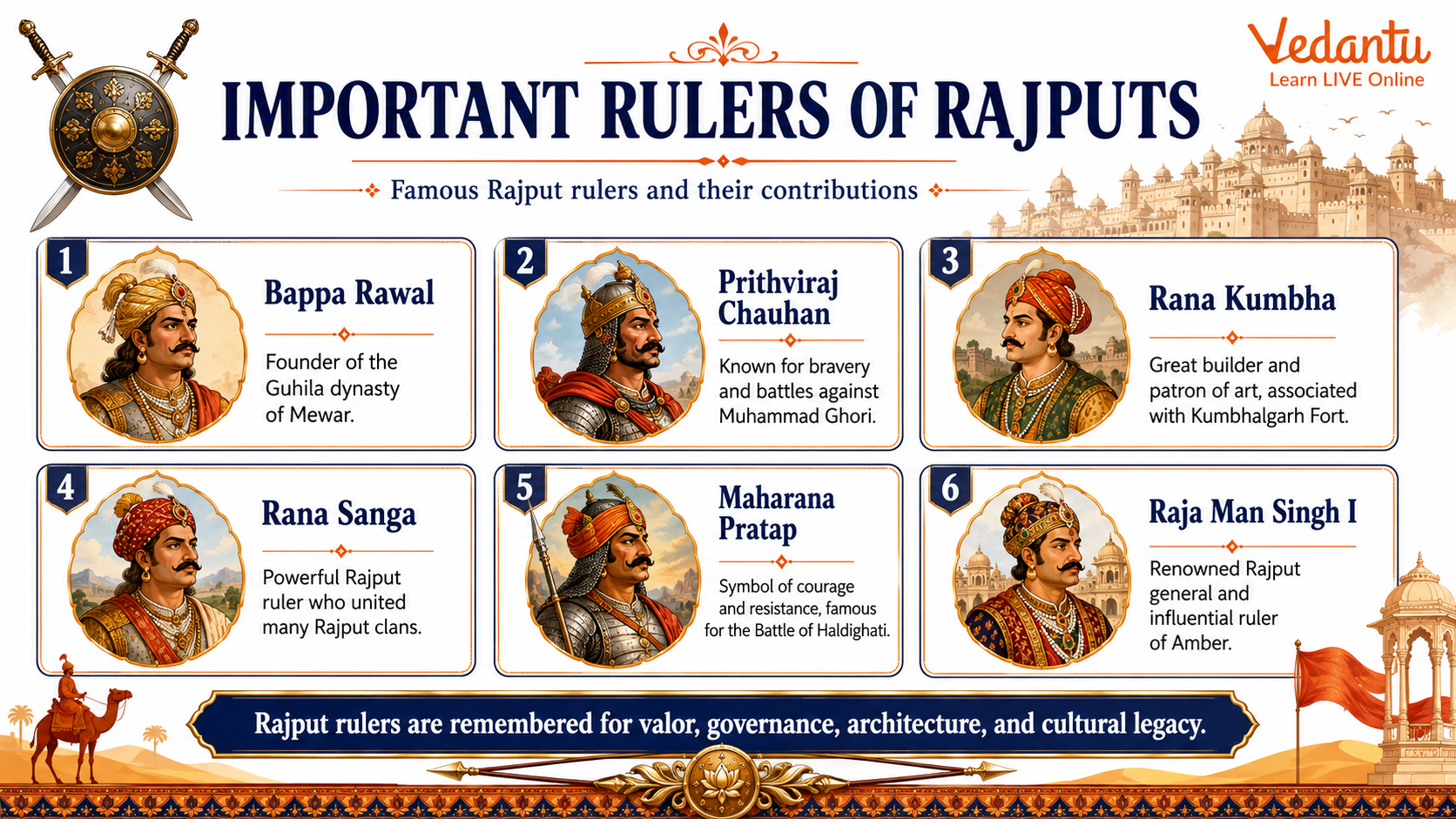
Important Rulers of Rajputs
1. Bappa Rawal
Bappa Rawal was the founder of the Mewar dynasty in the 8th century. He established his rule in Chittorgarh and is considered one of the earliest Rajput rulers. He successfully defended his kingdom against Arab invasions and laid the foundation of Rajput power in Rajasthan.
2. Prithviraj Chauhan
Prithviraj Chauhan was one of the most famous Rajput rulers of the Chauhan dynasty. He ruled from Ajmer and Delhi in the 12th century. He is best known for the Battles of Tarain fought against Muhammad Ghori. In the First Battle of Tarain in 1191, he defeated Ghori, but in the Second Battle of Tarain in 1192, he was defeated, which marked the beginning of Turkish rule in northern India.
3. Rana Kumbha
Rana Kumbha was a powerful ruler of Mewar during the 15th century. He was known for his military strength and architectural achievements. He built the famous Vijay Stambh in Chittorgarh to commemorate his victory over Mahmud Khilji of Malwa.
4. Rana Sanga
Rana Sanga, also known as Sangram Singh, was a prominent ruler of Mewar in the early 16th century. He united several Rajput clans and fought against Ibrahim Lodi and Babur. He was defeated by Babur in the Battle of Khanwa in 1527, which strengthened Mughal rule in India.
5. Maharana Pratap
Maharana Pratap was one of the greatest Rajput rulers of Mewar. He is remembered for his resistance against the Mughal Emperor Akbar. The Battle of Haldighati in 1576 is a significant event associated with him. Although he faced hardships, he never accepted Mughal supremacy and continued to fight for independence.
6. Raja Man Singh
Raja Man Singh was a Rajput ruler of Amber and one of the most trusted generals of Emperor Akbar. He played a key role in expanding the Mughal Empire and participated in several important military campaigns. His reign shows the political alliance between Rajputs and Mughals.
Major Rajput Rulers and Their Contributions
| Ruler | Dynasty/Region | Major Contribution |
|---|---|---|
| Bappa Rawal | Mewar | Founded Mewar dynasty, resisted Arab invasions |
| Prithviraj Chauhan | Chauhan - Ajmer and Delhi | Battles of Tarain against Muhammad Ghori |
| Rana Kumbha | Mewar | Built Vijay Stambh, expanded kingdom |
| Rana Sanga | Mewar | Battle of Khanwa against Babur |
| Maharana Pratap | Mewar | Battle of Haldighati, resistance to Akbar |
| Raja Man Singh | Amber | Trusted general of Akbar, Mughal expansion |
These rulers significantly influenced the political and cultural landscape of medieval India. Their resistance, diplomacy, and administrative policies shaped the history of northern India for centuries.
Military and Cultural Contributions
The Rajput rulers were not only warriors but also patrons of art and architecture. Their forts, temples, and monuments are remarkable examples of Rajput architecture.
- Construction of massive forts like Chittorgarh and Kumbhalgarh
- Promotion of temple architecture
- Encouragement of Sanskrit and regional literature
- Development of a feudal administrative system
Decline of Rajput Power
The decline of Rajput power began after repeated defeats against Turkish and Mughal invaders. Internal conflicts among different Rajput clans also weakened their unity. Although some Rajput states continued under Mughal suzerainty, their political dominance gradually reduced.
- Defeat in the Second Battle of Tarain in 1192
- Battle of Khanwa in 1527
- Internal rivalries among Rajput clans
- Political alliances with Mughals
Importance for Competitive Exams
Questions about the Important Rulers of Rajputs frequently appear in competitive exams such as UPSC, State PSC, SSC, and other government examinations. Students should focus on important battles, architectural contributions, and political alliances related to these rulers.
- Remember major battles like Tarain, Khanwa, and Haldighati
- Learn key monuments such as Vijay Stambh and Kumbhalgarh Fort
- Understand Rajput resistance against foreign invasions
- Study alliances between Rajputs and Mughals
Conclusion
The Important Rulers of Rajputs played a vital role in medieval Indian history. From Bappa Rawal to Maharana Pratap, these rulers are remembered for their courage, patriotism, and cultural contributions. Their legacy lives on through magnificent forts, monuments, and inspiring stories of valor. A clear understanding of these rulers helps students grasp the political developments of medieval India and perform well in general knowledge and competitive examinations.
FAQs on Important Rajput Rulers and Their Historic Achievements
1. Who were the most important rulers of Rajputs?
The most important rulers of Rajputs were powerful warrior kings who shaped medieval Indian history.
Some of the most famous Rajput rulers include:
• Prithviraj Chauhan – Known for the Battles of Tarain
• Maharana Pratap – Famous for the Battle of Haldighati
• Rana Sanga – Opposed Babur in the Battle of Khanwa
• Raja Man Singh – Trusted general of Akbar
• Bappa Rawal – Founder of the Mewar dynasty
These rulers are frequently discussed in medieval Indian history, Rajput dynasty, and GK for competitive exams.
2. Why is Prithviraj Chauhan famous in Rajput history?
Prithviraj Chauhan is famous for his bravery against Muhammad Ghori in the Battles of Tarain.
Key highlights of Prithviraj Chauhan:
• Ruled from Ajmer and Delhi
• Defeated Muhammad Ghori in the First Battle of Tarain (1191)
• Lost in the Second Battle of Tarain (1192)
• Celebrated in the epic Prithviraj Raso
He is an important topic in Rajput rulers GK questions, medieval India, and history exams.
3. What is Maharana Pratap best known for?
Maharana Pratap is best known for resisting Mughal Emperor Akbar and fighting the Battle of Haldighati.
Main achievements of Maharana Pratap:
• Ruler of Mewar
• Fought Battle of Haldighati (1576)
• Known for his loyal horse Chetak
• Symbol of Rajput pride and bravery
He remains a key figure in Rajputana history, Mewar dynasty, and Indian freedom struggle inspirations.
4. Who founded the Mewar dynasty?
The Mewar dynasty was founded by Bappa Rawal in the 8th century.
Important facts about Bappa Rawal:
• Founder of the Guhila (Sisodia) dynasty
• Established rule in Mewar (Rajasthan)
• Considered the first great Rajput ruler of Mewar
The Mewar dynasty later produced famous kings like Rana Sanga and Maharana Pratap.
5. Who was Rana Sanga and why is he important?
Rana Sanga was a powerful Rajput ruler who fought against Babur in the Battle of Khanwa.
Key points about Rana Sanga:
• Ruler of Mewar
• United several Rajput clans
• Fought Babur in 1527 (Battle of Khanwa)
• Known for courage despite multiple battle injuries
He is significant in topics like Rajput confederacy, Mughal invasion, and medieval Indian battles.
6. What role did Raja Man Singh play in Mughal history?
Raja Man Singh was a prominent Rajput ruler and a trusted general of Emperor Akbar.
Main contributions of Raja Man Singh:
• One of Akbar’s Navratnas (Nine Gems)
• Governor of Bengal and Bihar
• Led several Mughal military campaigns
He represents the Rajput-Mughal alliance, a key topic in Akbar’s administration and medieval Indian polity.
7. What were the main characteristics of Rajput rulers?
Rajput rulers were known for bravery, honor, and strong warrior traditions.
Main characteristics of Rajput kings:
• Strict code of valor and chivalry
• Loyalty to clan and kingdom
• Construction of forts and temples
• Frequent inter-clan conflicts
These traits are commonly asked in Rajput culture, medieval Indian society, and GK objective questions.
8. Which battles are associated with important Rajput rulers?
Several major battles in medieval India were fought by Rajput rulers.
Important battles include:
• Battle of Tarain (1191–1192) – Prithviraj Chauhan
• Battle of Khanwa (1527) – Rana Sanga vs Babur
• Battle of Haldighati (1576) – Maharana Pratap vs Akbar
These battles are key topics in Indian history GK, UPSC, SSC, and state PSC exams.
9. What was the contribution of Rajput rulers to Indian architecture?
Rajput rulers significantly contributed to Indian architecture through forts, palaces, and temples.
Major architectural achievements:
• Chittorgarh Fort
• Kumbhalgarh Fort
• Amber Fort
• Beautiful Rajput-style temples and palaces
Rajput architecture is an important topic under cultural heritage of Rajasthan and medieval Indian art.
10. Why are Rajput rulers important for competitive exams?
Rajput rulers are important for competitive exams because they played a major role in medieval Indian history.
Exam-relevant areas include:
• Famous Rajput kings and dynasties
• Important battles and dates
• Rajput-Mughal relations
• Contributions to culture and architecture
Questions on Important Rulers of Rajputs frequently appear in UPSC, SSC, Railway, NDA, and state-level GK exams.
