






What Are the Fundamental Laws of Physics Students Must Know?
The Important Laws of Physics form the foundation of our understanding of the natural world. These laws explain how matter, energy, force, motion, electricity, heat, light, and gravity behave under different conditions. For students preparing for board exams, competitive exams like NEET, JEE, and other entrance tests, a clear understanding of these laws is essential. This page provides a structured overview of the most important physics laws, their formulas, meanings, and real life applications.
What Are the Laws of Physics?
The laws of physics are scientifically proven principles that describe the behavior of physical systems. They are derived from experiments and observations and are expressed mathematically. These laws help in predicting outcomes in mechanics, thermodynamics, electromagnetism, optics, and modern physics.
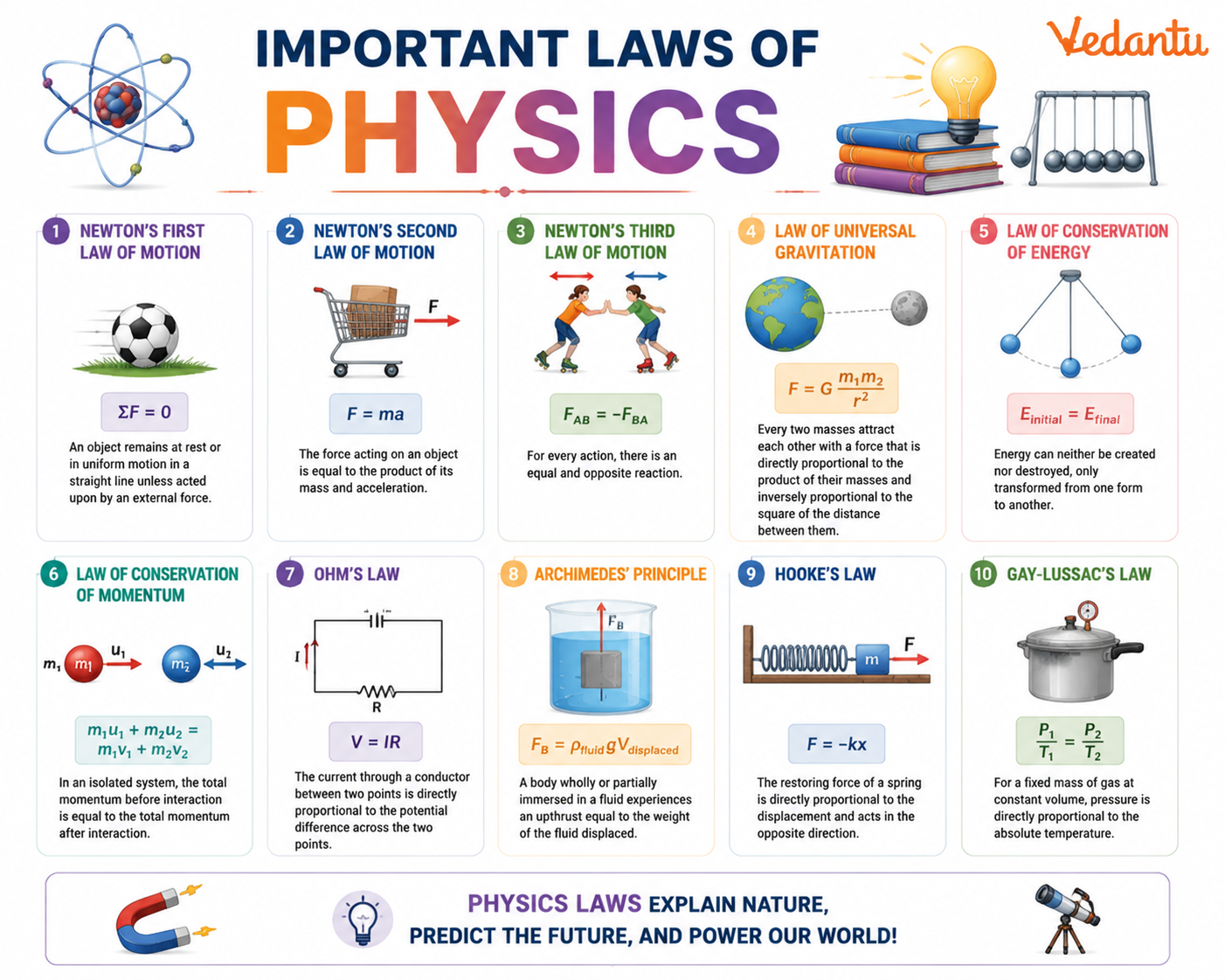
Important Laws of Motion
Newton's First Law of Motion
A body remains at rest or in uniform motion in a straight line unless acted upon by an external force. This law is also known as the Law of Inertia.
Newton's Second Law of Motion
The rate of change of momentum of a body is directly proportional to the applied force and takes place in the direction of the force. Mathematically, F = ma.
Newton's Third Law of Motion
For every action, there is an equal and opposite reaction. Forces in nature always occur in pairs.
Law of Universal Gravitation
Every particle in the universe attracts every other particle with a force directly proportional to the product of their masses and inversely proportional to the square of the distance between them.
Formula: F = G (m1m2 / r2)
Laws of Thermodynamics
First Law of Thermodynamics
Energy can neither be created nor destroyed, but it can change from one form to another. It is based on the law of conservation of energy.
Second Law of Thermodynamics
Heat cannot flow spontaneously from a colder body to a hotter body. It introduces the concept of entropy.
Third Law of Thermodynamics
As temperature approaches absolute zero, the entropy of a perfect crystal approaches zero.
Important Laws in Electricity and Magnetism
Ohm's Law
The current flowing through a conductor is directly proportional to the potential difference across it, provided temperature remains constant.
Formula: V = IR
Coulomb's Law
The electrostatic force between two charges is directly proportional to the product of their charges and inversely proportional to the square of the distance between them.
Faraday's Law of Electromagnetic Induction
The induced electromotive force in a circuit is directly proportional to the rate of change of magnetic flux linked with it.
Laws of Reflection and Refraction
Laws of Reflection
- The angle of incidence is equal to the angle of reflection.
- The incident ray, reflected ray, and normal lie in the same plane.
Snell's Law of Refraction
The ratio of sine of angle of incidence to sine of angle of refraction is constant for a given pair of media.
Formula: n1 sin i = n2 sin r
Conservation Laws in Physics
- Law of Conservation of Energy - Energy cannot be created or destroyed.
- Law of Conservation of Momentum - Total momentum remains constant if no external force acts.
- Law of Conservation of Charge - Total electric charge in an isolated system remains constant.
Summary of Important Laws of Physics
| Law | Field | Key Formula |
|---|---|---|
| Newton's Second Law | Mechanics | F = ma |
| Ohm's Law | Electricity | V = IR |
| Universal Gravitation | Gravity | F = G (m1m2 / r2) |
The table above highlights some of the most frequently asked laws in competitive exams. Students should understand both the conceptual meaning and mathematical expressions of these laws.
Why These Laws Are Important for Exams
- They form the base of numerical problem solving.
- Conceptual clarity helps in solving application based questions.
- Many advanced topics are derived from these fundamental laws.
- Direct formula based questions are common in NEET and board exams.
Preparation Tips for Students
- Memorize important formulas along with their units.
- Understand derivations to strengthen conceptual clarity.
- Practice numerical problems regularly.
- Revise laws through short notes and summary tables.
Conclusion
The important laws of physics provide a structured framework to understand the universe. From motion and gravity to electricity and thermodynamics, these laws explain everyday phenomena and complex scientific principles. Mastering these laws not only helps in scoring well in exams like NEET but also builds a strong conceptual foundation for higher studies in science and engineering.
FAQs on Important Laws of Physics and Their Real-Life Applications
1. What are the most important laws of Physics?
The most important laws of Physics are fundamental principles that describe how the universe behaves. These laws form the foundation of classical mechanics, thermodynamics, electromagnetism, and modern physics.
Key laws include:
• Newton’s Laws of Motion – explain motion and forces
• Law of Universal Gravitation – explains gravitational attraction
• Laws of Thermodynamics – govern heat and energy transfer
• Ohm’s Law – relates voltage, current, and resistance
• Faraday’s Law of Electromagnetic Induction – explains induced current
These fundamental laws of physics are widely asked in GK, competitive exams, and school science topics.
2. What are Newton’s Three Laws of Motion?
Newton’s Three Laws of Motion describe how objects move under the influence of forces. Proposed by Sir Isaac Newton in 1687, they are central to classical mechanics.
• First Law (Law of Inertia) – An object remains at rest or in uniform motion unless acted upon by an external force.
• Second Law – Force equals mass times acceleration (F = ma).
• Third Law – For every action, there is an equal and opposite reaction.
These laws explain motion, inertia, force, and acceleration in everyday life and physics problems.
3. What is the Law of Universal Gravitation?
The Law of Universal Gravitation states that every object in the universe attracts every other object with a force proportional to their masses and inversely proportional to the square of the distance between them.
Formula:
• F = G (m₁m₂ / r²)
Where:
• F = gravitational force
• G = gravitational constant
• m₁, m₂ = masses
• r = distance between centers
This law explains gravity, planetary motion, satellite movement, and weight on Earth.
4. What are the Laws of Thermodynamics?
The Laws of Thermodynamics describe the principles of heat, energy, and work in physical systems.
• Zeroth Law – If two bodies are in thermal equilibrium with a third, they are in equilibrium with each other.
• First Law – Energy cannot be created or destroyed (Law of Conservation of Energy).
• Second Law – Entropy of an isolated system always increases.
• Third Law – Entropy approaches zero as temperature approaches absolute zero.
These laws are essential in thermodynamics, heat engines, and energy transformation concepts.
5. What is Ohm’s Law in Physics?
Ohm’s Law states that the current flowing through a conductor is directly proportional to the voltage and inversely proportional to resistance, provided temperature remains constant.
Formula:
• V = IR
Where:
• V = voltage
• I = current
• R = resistance
This law is fundamental in electricity, electric circuits, and basic electronics.
6. What is the Law of Conservation of Energy?
The Law of Conservation of Energy states that energy can neither be created nor destroyed; it can only change from one form to another.
Examples:
• Potential energy converting into kinetic energy
• Electrical energy converting into light and heat energy
• Chemical energy converting into mechanical energy
This principle is central to physics laws, thermodynamics, mechanics, and energy transformation topics.
7. What is Faraday’s Law of Electromagnetic Induction?
Faraday’s Law of Electromagnetic Induction states that a change in magnetic flux through a circuit induces an electromotive force (EMF).
Key points:
• Changing magnetic field produces electric current
• Basis of generators and transformers
• Related to electromagnetic induction and Maxwell’s equations
This law is fundamental in electromagnetism and modern electrical technology.
8. What is Kepler’s First Law of Planetary Motion?
Kepler’s First Law states that planets move in elliptical orbits with the Sun at one focus.
Other Kepler’s Laws include:
• Second Law – Equal areas are swept in equal times.
• Third Law – Square of orbital period is proportional to cube of semi-major axis.
These laws explain planetary motion, astronomy concepts, and solar system dynamics.
9. What is the Law of Reflection of Light?
The Law of Reflection states that the angle of incidence is equal to the angle of reflection.
Main rules:
• Incident ray, reflected ray, and normal lie in the same plane
• Angle of incidence = Angle of reflection
This law is essential in optics, mirrors, light behavior, and ray diagrams.
10. Why are important laws of Physics essential for competitive exams?
Important laws of Physics are frequently asked in competitive exams because they form the core of scientific understanding and problem-solving.
They help in:
• Solving numerical and conceptual questions
• Understanding mechanics, electricity, thermodynamics, and optics
• Preparing for exams like SSC, UPSC, NEET, JEE, and other GK tests
Mastering fundamental physics laws improves analytical thinking and scientific reasoning skills.
