






List of Major Indian Committees and Commissions with Functions and Years
Important Committees and Commissions in India play a crucial role in shaping policies, recommending reforms, and strengthening governance. They are formed by the Government of India to study specific issues in detail and suggest measures for improvement in political, economic, social, and administrative sectors. Many competitive examinations such as UPSC, SSC, Banking, State PSC, and other government exams frequently ask questions about these committees and commissions. Understanding their purpose, year of formation, and key recommendations is essential for General Knowledge preparation.
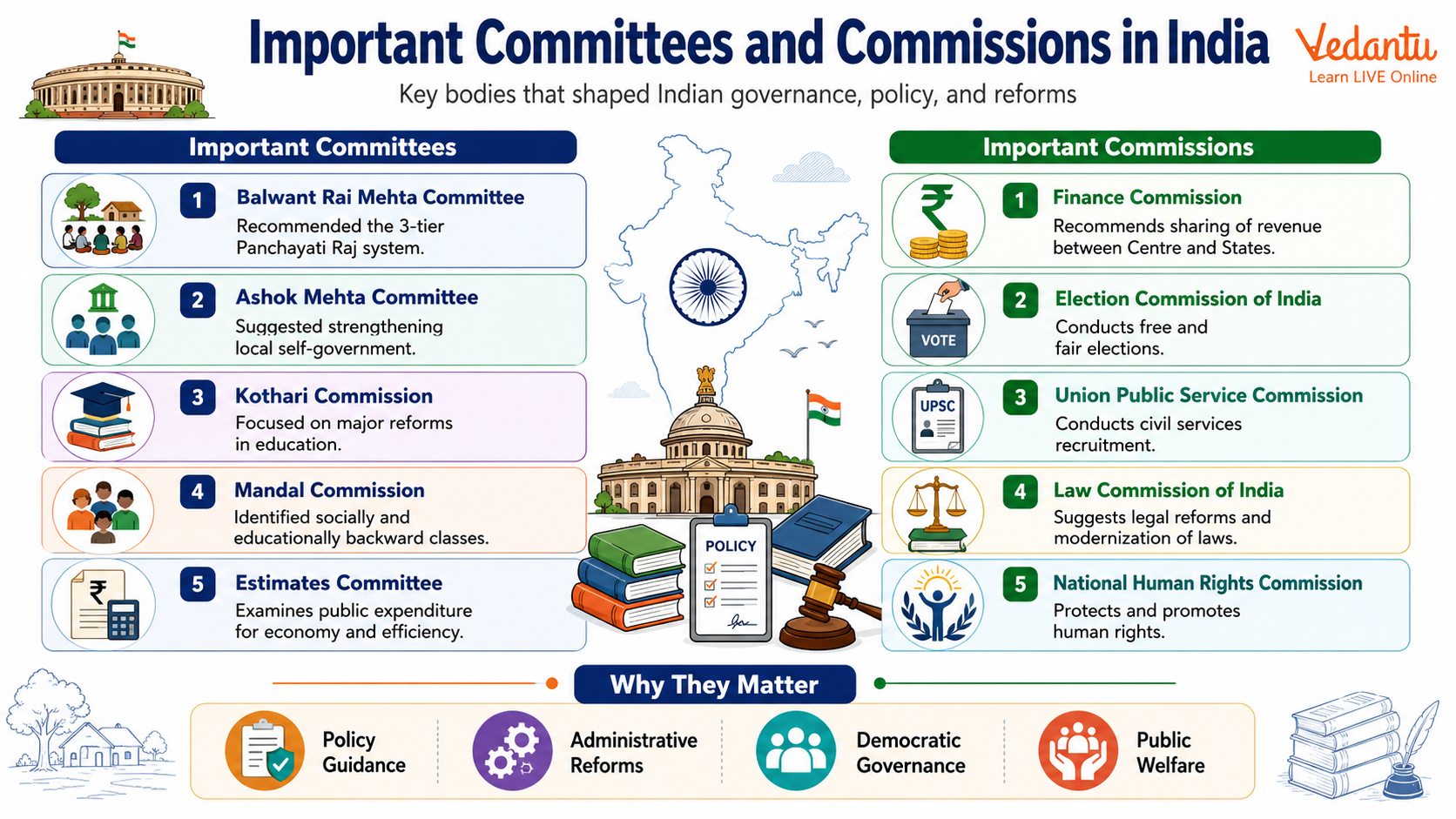
What Are Committees And Commissions?
Committees and commissions are expert bodies appointed by the government to examine particular subjects and provide recommendations. While committees are usually temporary bodies formed for a specific purpose, commissions may be constitutional, statutory, or ad hoc bodies with defined powers and functions.
Types Of Committees And Commissions
- Constitutional Commissions - Established under the Constitution of India.
- Statutory Commissions - Established by an Act of Parliament.
- Ad Hoc Committees - Temporary bodies formed for a specific purpose.
- Departmental Committees - Formed within ministries to review policies and programs.
Important Constitutional Commissions In India
| Commission | Article | Function |
|---|---|---|
| Election Commission of India | Article 324 | Conducts free and fair elections |
| Finance Commission | Article 280 | Distribution of financial resources between Centre and States |
| Union Public Service Commission | Article 315 | Conducts recruitment for civil services |
These commissions derive their authority directly from the Constitution and ensure transparency, accountability, and fairness in governance.
Important Statutory Commissions In India
| Commission | Year | Purpose |
|---|---|---|
| National Human Rights Commission | 1993 | Protection of human rights |
| National Commission for Women | 1992 | Safeguards for women |
| National Commission for Scheduled Castes | 2004 | Protection of SC rights |
Statutory commissions are created through legislation passed by Parliament and have clearly defined powers and responsibilities.
Major Committees In Indian History
Economic And Banking Committees
- Narasimham Committee - Banking sector reforms.
- Rangarajan Committee - Inflation and financial sector reforms.
- Kelkar Committee - Tax reforms.
Education Committees
- Kothari Commission 1964-66 - Recommended a common school system.
- Radhakrishnan Commission 1948 - Focused on university education.
- Mudaliar Commission 1952 - Secondary education reforms.
Administrative And Political Committees
- Sarkaria Commission - Centre-State relations.
- Punchhi Commission - Review of Centre-State relations.
- Balwant Rai Mehta Committee - Panchayati Raj system.
Difference Between Committee And Commission
| Basis | Committee | Commission |
|---|---|---|
| Nature | Temporary body | May be permanent or temporary |
| Authority | Executive decision | Constitutional or statutory backing |
| Function | Advisory role | Advisory and regulatory role |
Understanding the difference helps in answering conceptual questions in examinations and improves clarity regarding governance mechanisms.
Why Important For Competitive Exams?
- Frequently asked in UPSC, SSC, Banking, Railways, and State PSC exams.
- Questions are asked about chairman, year of formation, and key recommendations.
- Important for Indian Polity and Modern History sections.
- Helps in essay and interview preparation.
Preparation Tips
- Make short notes of important committees with year and purpose.
- Revise constitutional articles related to commissions.
- Focus on recent committees formed by the government.
- Practice multiple choice questions regularly.
Conclusion
Important Committees and Commissions in India have significantly influenced policy making and governance reforms. From economic restructuring to educational reforms and administrative improvements, these bodies have shaped modern India. For students and competitive exam aspirants, a clear understanding of their objectives, recommendations, and constitutional provisions is essential. Regular revision and conceptual clarity can help in mastering this important General Knowledge topic effectively.
FAQs on Important Committees and Commissions in India: Roles, Reports and Impact
1. What are the important committees and commissions in India?
Important committees and commissions in India are official bodies formed to recommend reforms and advise the government on key national issues.
- Constitutional Commissions: Finance Commission, Election Commission, UPSC
- Economic Committees: NITI Aayog, Planning Commission (abolished in 2015)
- Social Justice Commissions: Mandal Commission, National Commission for Women (NCW)
- Law and Reform Bodies: Law Commission of India
These bodies play a vital role in governance, policy-making, and administrative reforms in India.
2. What is the difference between a committee and a commission in India?
The main difference between a committee and a commission lies in their purpose and authority in the Indian governance system.
- Committee: Usually temporary; formed to examine specific issues (e.g., Estimates Committee)
- Commission: Often statutory or constitutional; has defined powers (e.g., Finance Commission)
- Committees submit reports; commissions may have advisory or regulatory authority
This distinction is important for understanding Indian polity and constitutional bodies.
3. What is the role of the Finance Commission in India?
The Finance Commission of India is a constitutional body that recommends the distribution of financial resources between the Centre and the States.
- Established under Article 280 of the Indian Constitution
- Recommends tax revenue sharing (vertical and horizontal devolution)
- Suggests grants-in-aid to states
- Appointed every five years by the President of India
It ensures fiscal federalism and balanced economic development.
4. What was the Mandal Commission and why is it important?
The Mandal Commission was set up to identify socially and educationally backward classes in India and recommend reservation policies.
- Established in 1979 under Prime Minister Morarji Desai
- Headed by B.P. Mandal
- Recommended 27% reservation for OBCs in government jobs
- Implemented in 1990
It significantly impacted India’s reservation system and social justice policies.
5. What is NITI Aayog and how is it different from the Planning Commission?
The NITI Aayog is a policy think tank that replaced the Planning Commission to promote cooperative federalism and sustainable development.
- Established in 2015
- Focuses on policy advice and long-term strategies
- Encourages cooperative and competitive federalism
- Does not allocate funds (unlike the Planning Commission)
It plays a key role in economic reforms and development planning in India.
6. What is the role of the Election Commission of India?
The Election Commission of India (ECI) is a constitutional authority responsible for conducting free and fair elections.
- Established under Article 324
- Conducts elections for Lok Sabha, Rajya Sabha, State Assemblies, and President
- Enforces the Model Code of Conduct
- Ensures transparency in the electoral process
It safeguards democracy and electoral integrity in India.
7. What is the Law Commission of India?
The Law Commission of India is an advisory body that recommends legal reforms and updates outdated laws.
- Established periodically by the Government of India
- Reviews existing laws and suggests amendments
- Works on legal modernization and judicial reforms
- Submits reports to the Ministry of Law and Justice
It contributes to strengthening the Indian legal system.
8. What is the National Human Rights Commission (NHRC)?
The National Human Rights Commission (NHRC) protects and promotes human rights in India.
- Established in 1993 under the Protection of Human Rights Act
- Investigates human rights violations
- Recommends compensation and corrective measures
- Promotes awareness of fundamental rights
It plays a crucial role in safeguarding civil liberties and constitutional rights.
9. What are some important Parliamentary Committees in India?
Important Parliamentary Committees assist Parliament in legislative scrutiny and financial oversight.
- Public Accounts Committee (PAC)
- Estimates Committee
- Committee on Public Undertakings
- Department-Related Standing Committees
These committees enhance accountability, transparency, and effective functioning of the Indian Parliament.
10. Why are committees and commissions important for competitive exams?
Committees and commissions are important for competitive exams because they are frequently asked in General Knowledge (GK) and Indian Polity sections.
- Common in UPSC, SSC, Banking, and State PCS exams
- Questions focus on chairpersons, year of establishment, and recommendations
- Helps in understanding governance, constitutional bodies, and public policy
Studying these bodies strengthens preparation for civil services and other government exams.
