






GK Solar System Quiz Questions with Answers and Interesting Facts
The Solar System is one of the most important topics in General Knowledge and is frequently asked in school exams, competitive exams, and quizzes. It includes the Sun, eight planets, their moons, dwarf planets, asteroids, comets, and other celestial bodies bound by gravity. Understanding the Solar System helps students learn about space science, planetary movements, and Earth's position in the universe. Below are carefully selected GK questions and answers on the Solar System to help learners strengthen their concepts in a simple and structured manner.
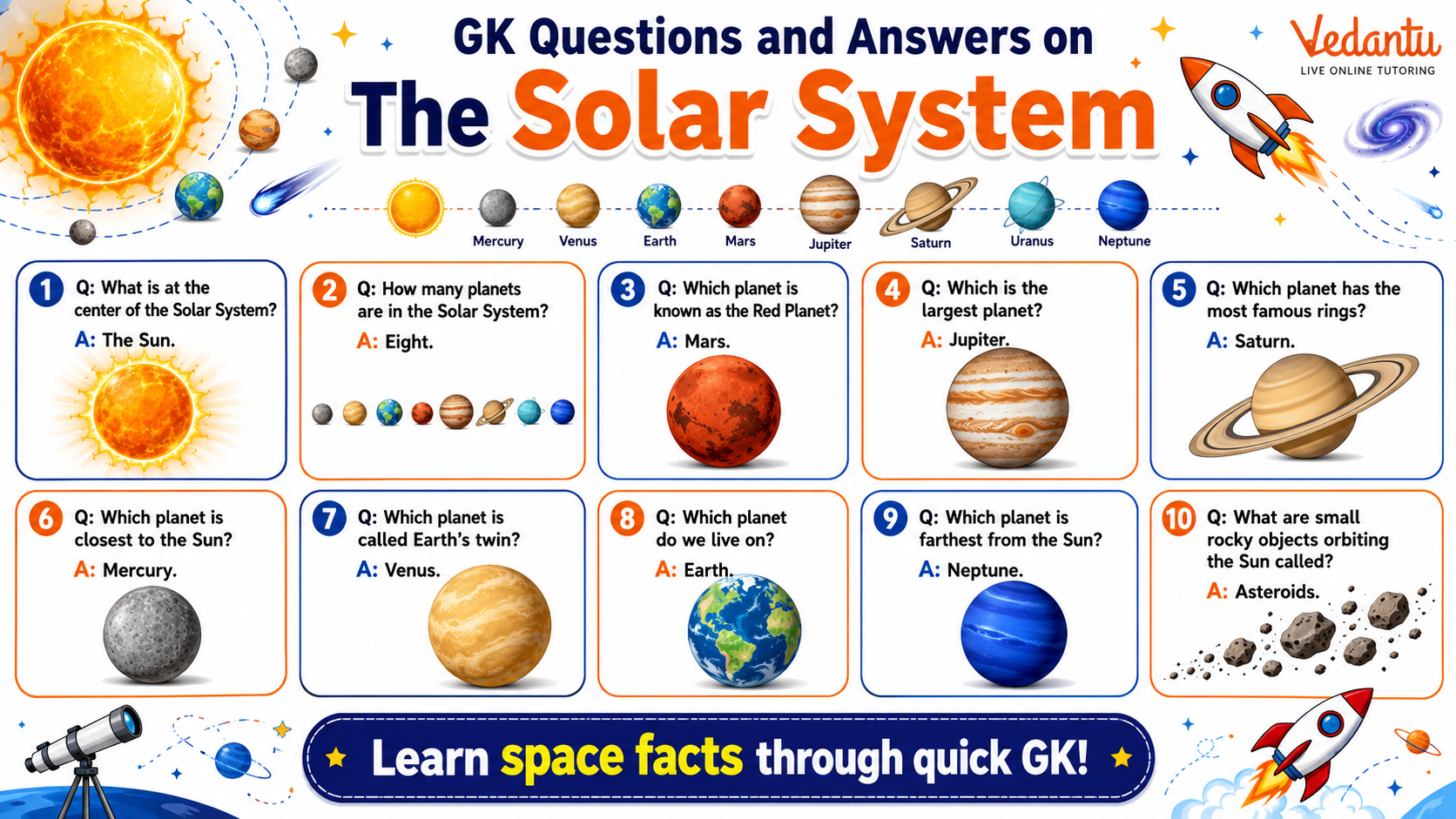
Overview of the Solar System
The Solar System was formed about 4.6 billion years ago from a giant cloud of gas and dust. The Sun is at the center and contains more than 99 percent of the total mass of the Solar System. All planets revolve around the Sun in elliptical orbits due to its strong gravitational pull.
- The Sun is a star located at the center of the Solar System.
- There are eight planets - Mercury, Venus, Earth, Mars, Jupiter, Saturn, Uranus, and Neptune.
- The inner planets are rocky, while the outer planets are gas giants or ice giants.
- Pluto is classified as a dwarf planet.
Planets of the Solar System and Key Facts
| Planet | Position from Sun | Key Feature |
|---|---|---|
| Mercury | 1st | Closest and smallest planet |
| Venus | 2nd | Hottest planet |
| Earth | 3rd | Only known planet with life |
| Mars | 4th | Known as the Red Planet |
| Jupiter | 5th | Largest planet |
| Saturn | 6th | Famous for its rings |
| Uranus | 7th | Rotates on its side |
| Neptune | 8th | Farthest planet from the Sun |
The table above highlights the order of planets and their most important identifying characteristics. Questions based on planetary order and features are very common in GK exams.
Important GK Questions and Answers on the Solar System
Basic Level Questions
- Q: What is the center of the Solar System?
A: The Sun. - Q: How many planets are there in the Solar System?
A: Eight planets. - Q: Which planet is known as the Red Planet?
A: Mars. - Q: Which is the largest planet in the Solar System?
A: Jupiter. - Q: Which planet is known for its prominent ring system?
A: Saturn.
Intermediate Level Questions
- Q: Which is the hottest planet in the Solar System?
A: Venus. - Q: Which planet has the shortest orbital period around the Sun?
A: Mercury. - Q: What is the name of Earth's natural satellite?
A: The Moon. - Q: Which planet rotates on its side?
A: Uranus. - Q: What type of celestial body is Pluto classified as?
A: A dwarf planet.
Advanced Level Questions
- Q: What is the asteroid belt?
A: A region between Mars and Jupiter where many asteroids orbit the Sun. - Q: Which planet has the Great Red Spot?
A: Jupiter. - Q: What force keeps the planets in orbit around the Sun?
A: Gravitational force. - Q: Which planet is known as the Morning Star or Evening Star?
A: Venus. - Q: Which is the coldest planet in the Solar System?
A: Uranus.
Other Important Facts About the Solar System
- The Solar System is located in the Milky Way Galaxy.
- Jupiter has the highest number of known moons.
- Neptune has the strongest winds among all planets.
- A year on Mercury is shorter than a year on Earth.
- Comets are made of ice, dust, and rocky material.
Why Solar System GK is Important for Exams
Questions about the Solar System frequently appear in school examinations, Olympiads, and competitive exams. They test a student's understanding of planetary order, unique characteristics, and scientific concepts related to space. Preparing these GK questions helps improve memory, conceptual clarity, and quick recall during objective tests.
Preparation Tips for Solar System GK
- Memorize the order of planets from the Sun.
- Focus on unique features of each planet.
- Revise important terms like asteroid belt, dwarf planet, and orbit.
- Practice multiple choice questions regularly.
Conclusion
The Solar System is a fascinating and essential topic in General Knowledge. By understanding the structure, planets, and important characteristics of celestial bodies, students can confidently answer a wide range of GK questions. Regular revision and practice of Solar System questions and answers will strengthen conceptual knowledge and improve performance in exams and quizzes.
FAQs on GK Questions & Answers on the Solar System for Students
1. What is the Solar System?
The Solar System is the collection of the Sun and all celestial bodies that revolve around it due to gravity. • It includes 8 planets, their moons, dwarf planets, asteroids, comets, and meteoroids. • The Sun contains about 99.8% of the total mass of the Solar System. • It formed around 4.6 billion years ago. • Also searched as: planetary system, space system, Sun and planets.
2. How many planets are there in the Solar System?
There are 8 recognized planets in the Solar System according to the International Astronomical Union (IAU). • The planets are Mercury, Venus, Earth, Mars, Jupiter, Saturn, Uranus, and Neptune. • Pluto was reclassified as a dwarf planet in 2006. • Planets are divided into inner (terrestrial) and outer (gas giants) planets. • People also ask: Is Pluto a planet? Why are there 8 planets?
3. Which is the largest planet in the Solar System?
The largest planet in the Solar System is Jupiter. • It is a gas giant made mainly of hydrogen and helium. • Jupiter has a famous storm called the Great Red Spot. • It has more than 90 known moons, including Ganymede, the largest moon. • Also known as: biggest planet, giant planet in space.
4. Which planet is known as the Red Planet?
The Red Planet is Mars because of its reddish appearance. • The red color is due to iron oxide (rust) on its surface. • Mars has the largest volcano, Olympus Mons. • Scientists study Mars for signs of past life and water. • People also search: Why is Mars red? Facts about Mars.
5. Which planet is closest to the Sun?
The planet closest to the Sun is Mercury. • It is the smallest planet in the Solar System. • Mercury has extreme temperatures due to lack of atmosphere. • It completes one orbit in about 88 Earth days. • Also asked as: first planet from the Sun, nearest planet to Sun.
6. What are the inner and outer planets?
The Solar System is divided into inner planets and outer planets based on their position and composition. • Inner planets: Mercury, Venus, Earth, Mars (rocky or terrestrial planets). • Outer planets: Jupiter, Saturn, Uranus, Neptune (gas and ice giants). • The Asteroid Belt separates them. • Also known as: terrestrial planets and Jovian planets.
7. What is the Asteroid Belt?
The Asteroid Belt is a region of rocky objects between Mars and Jupiter. • It contains thousands of asteroids and the dwarf planet Ceres. • These objects orbit the Sun like planets. • It marks the boundary between inner and outer Solar System. • People also ask: Where is the asteroid belt located?
8. What is a dwarf planet?
A dwarf planet is a celestial body that orbits the Sun but does not clear its orbital path. • Examples include Pluto, Ceres, Eris, Haumea, and Makemake. • Defined by the IAU in 2006. • Dwarf planets are smaller than main planets but larger than asteroids. • Also searched as: Pluto classification, minor planets.
9. Which planet is known as the Blue Planet?
The Blue Planet is Earth because of its abundant water. • About 71% of Earth’s surface is covered by water. • It is the only known planet with life and breathable atmosphere. • Earth has one natural satellite, the Moon. • People also search: Why is Earth called Blue Planet?
10. What is the Sun made of?
The Sun is mainly made of hot gases called hydrogen and helium. • Around 74% hydrogen and 24% helium. • Energy is produced through nuclear fusion. • The Sun is a medium-sized star at the center of the Solar System. • Also asked as: composition of the Sun, what powers the Sun?
