






Important GK Questions About Major Food Grain Crops and Farming Practices in India
Food grain crops play a vital role in ensuring food security and supporting the agricultural economy of India. The cultivation of food grain crops such as rice, wheat, maize, millets, and pulses forms the backbone of Indian agriculture. These crops provide essential nutrients to the population and are crucial for competitive exams and academic learning. Below are important GK questions and answers on the cultivation of food grain crops in India, covering seasons, major producing states, climatic requirements, and key agricultural practices.
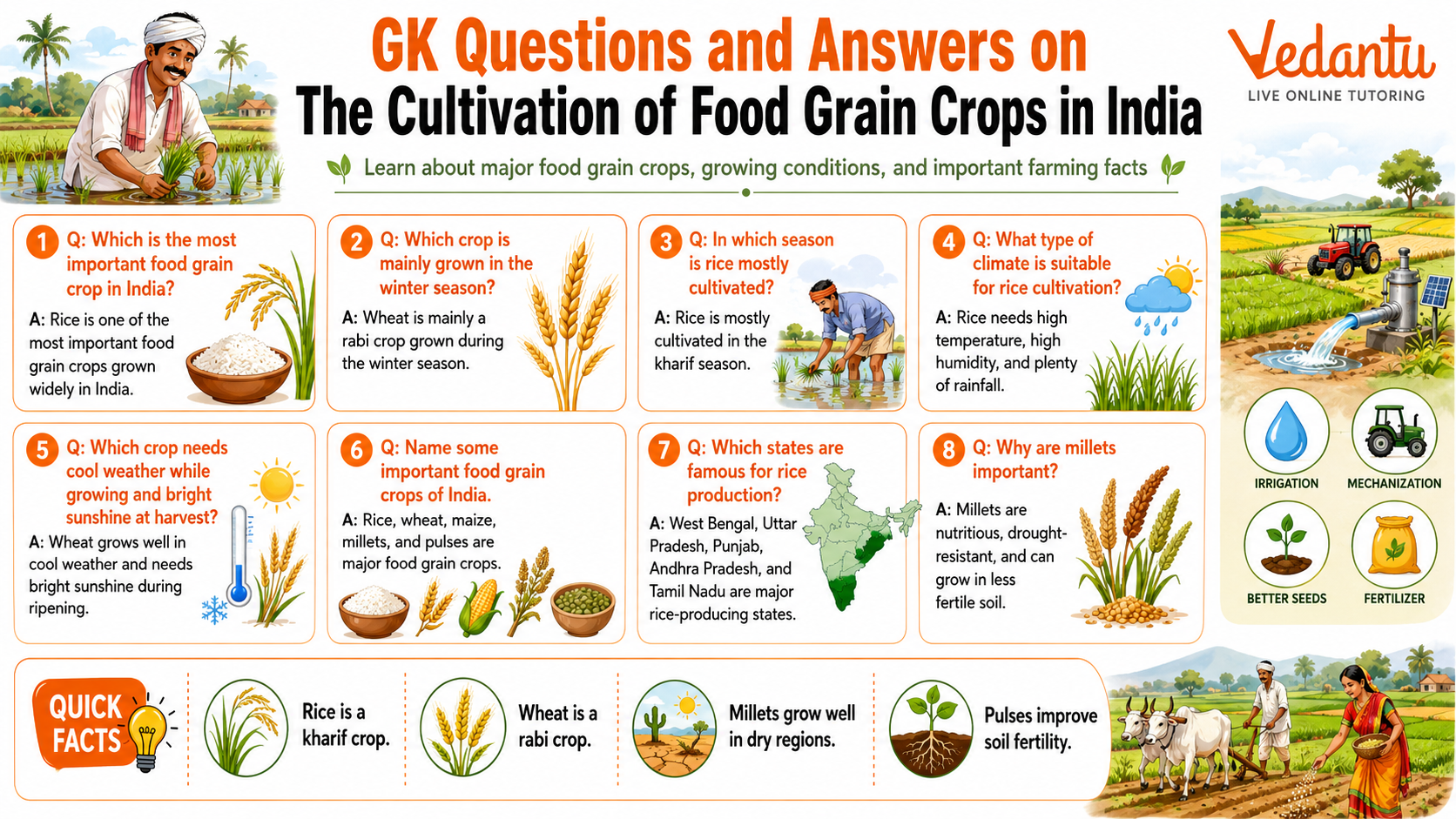
Major Food Grain Crops in India
Food grains in India are broadly divided into cereals and pulses. Cereals include rice, wheat, maize, and millets, while pulses include gram, tur, moong, and lentils. These crops are grown across different agro-climatic zones depending on soil type, rainfall, and temperature.
- Rice - Staple food of India, mainly grown in Kharif season
- Wheat - Major Rabi crop grown in northern India
- Maize - Grown in both Kharif and Rabi seasons
- Millets - Includes jowar, bajra, and ragi, suited for dry regions
- Pulses - Important source of protein, grown in semi-arid areas
Agricultural Seasons in India
Food grain crops in India are cultivated in three main agricultural seasons based on monsoon patterns and temperature conditions.
- Kharif Season - Sown in June to July and harvested in September to October. Examples: Rice, maize, jowar.
- Rabi Season - Sown in October to November and harvested in March to April. Examples: Wheat, barley, gram.
- Zaid Season - Short season between Rabi and Kharif. Examples: Some pulses and maize.
Major Food Grain Crops and Producing States
| Crop | Season | Major Producing States |
|---|---|---|
| Rice | Kharif | West Bengal, Uttar Pradesh, Punjab |
| Wheat | Rabi | Uttar Pradesh, Punjab, Haryana |
| Maize | Kharif and Rabi | Karnataka, Madhya Pradesh, Bihar |
The production of food grains varies based on irrigation facilities, soil fertility, climate, and adoption of modern agricultural practices. Punjab and Haryana are known for high productivity due to advanced irrigation and mechanization.
Climatic and Soil Requirements
Rice
Rice requires high temperature around 25 to 35 degrees Celsius and heavy rainfall above 100 cm. It grows well in alluvial and clayey soils with good water retention capacity.
Wheat
Wheat needs a cool growing season and bright sunshine at harvest. It grows best in well-drained loamy soil and requires moderate rainfall.
Millets and Pulses
Millets are drought-resistant crops and can grow in poor soils with low rainfall. Pulses improve soil fertility due to nitrogen fixation and require less water compared to cereals.
Green Revolution and Food Grain Production
The Green Revolution in the 1960s significantly increased food grain production in India. High-yielding variety seeds, chemical fertilizers, pesticides, and irrigation facilities boosted wheat and rice output, especially in Punjab, Haryana, and western Uttar Pradesh.
- Introduction of HYV seeds
- Expansion of irrigation facilities
- Use of fertilizers and pesticides
- Mechanization of farming
Important GK Questions and Answers
1. Which is the most widely grown food grain crop in India?
Rice is the most widely grown food grain crop in India.
2. Which crop is known as a Rabi crop and requires cool climate?
Wheat is a Rabi crop that requires a cool climate during its growing season.
3. Name two drought-resistant food grain crops.
Jowar and Bajra are drought-resistant food grain crops.
4. In which season is rice mainly cultivated?
Rice is mainly cultivated during the Kharif season.
5. What was the main objective of the Green Revolution?
The main objective of the Green Revolution was to increase food grain production and achieve self-sufficiency in food.
Importance of Food Grain Cultivation in India
Food grain cultivation is essential for feeding India's large population and supporting rural livelihoods. It contributes significantly to GDP and employment in the agricultural sector. Government initiatives such as Minimum Support Price, irrigation schemes, and crop insurance aim to support farmers and stabilize production.
- Ensures national food security
- Provides employment to millions of farmers
- Supports agro-based industries
- Contributes to export earnings
Understanding the cultivation of food grain crops in India is important for school examinations and competitive exams. Knowledge of seasons, soil requirements, producing states, and agricultural developments helps students build a strong foundation in Indian geography and agriculture.
FAQs on GK Questions and Answers on Food Grain Crop Cultivation in India
1. What are food grain crops in India?
Food grain crops are crops grown primarily for human consumption and form the staple diet of India. The major food grains in India include:
• Rice – main staple in eastern and southern India
• Wheat – widely grown in northern India
• Millets (Jowar, Bajra, Ragi) – also called coarse cereals
• Pulses (Gram, Arhar, Moong) – key source of protein
These crops are essential for food security, nutrition, and agricultural economy in India.
2. Which are the major food grain producing states in India?
The major food grain producing states contribute significantly to India’s agricultural output. Key states include:
• Uttar Pradesh – leading producer of wheat and rice
• Punjab and Haryana – major wheat and rice surplus states
• West Bengal – largest producer of rice
• Madhya Pradesh – major wheat and pulse producer
• Rajasthan – leading producer of millets
These states play a vital role in India’s food grain production and public distribution system (PDS).
3. What are the main seasons for cultivating food grains in India?
Food grains in India are cultivated in two major agricultural seasons: Kharif and Rabi.
• Kharif crops – Sown in June–July, harvested in September–October (e.g., Rice, Maize, Jowar)
• Rabi crops – Sown in October–November, harvested in March–April (e.g., Wheat, Gram, Barley)
• Zaid crops – Short summer season crops (e.g., Moong)
This seasonal pattern depends on monsoon rainfall, temperature, and irrigation facilities.
4. Why is rice an important food grain crop in India?
Rice is important because it is the staple food for more than half of India’s population. Key reasons include:
• Grown mainly in high rainfall and irrigated areas
• Requires hot and humid climate
• Major rice-producing states: West Bengal, Uttar Pradesh, Punjab, Andhra Pradesh
Rice cultivation supports food security, rural employment, and exports, making it a backbone of Indian agriculture.
5. What are the climatic conditions required for wheat cultivation?
Wheat requires a cool growing season and bright sunshine during harvesting. The ideal conditions include:
• Temperature: 10°C–15°C for growth, 21°C–26°C for ripening
• Moderate rainfall: 50–75 cm
• Well-drained loamy soil
Wheat is mainly grown in Punjab, Haryana, Uttar Pradesh, and Madhya Pradesh under Rabi season cultivation.
6. What role did the Green Revolution play in food grain production?
The Green Revolution significantly increased India’s food grain production during the 1960s–70s. Its major impacts were:
• Introduction of High Yielding Variety (HYV) seeds
• Increased use of fertilizers, pesticides, and irrigation
• Boost in wheat and rice production
States like Punjab and Haryana benefited greatly, making India self-sufficient in food grains.
7. What are millets and why are they important in India?
Millets are nutritious coarse cereals grown in dry and semi-arid regions. Important millets include:
• Jowar (Sorghum)
• Bajra (Pearl Millet)
• Ragi (Finger Millet)
Millets are rich in fiber, protein, and minerals and require less water, making them climate-resilient crops. India promotes millets under initiatives like the International Year of Millets 2023.
8. Why are pulses important in food grain cultivation?
Pulses are important because they are the main source of protein in the Indian diet. Key benefits include:
• Improve soil fertility by fixing nitrogen
• Require less water compared to cereals
• Major pulses: Gram, Arhar (Tur), Moong, Masoor
India is one of the largest producers and consumers of pulses in the world.
9. What are the major challenges in food grain cultivation in India?
Food grain cultivation faces several challenges affecting productivity and sustainability:
• Dependence on monsoon rainfall
• Small and fragmented land holdings
• Soil degradation and overuse of fertilizers
• Climate change and water scarcity
Addressing these issues is crucial for ensuring sustainable agriculture and food security in India.
10. How does the government support food grain farmers in India?
The Indian government supports food grain farmers through various schemes and policies. These include:
• Minimum Support Price (MSP) for wheat, rice, and pulses
• Public Distribution System (PDS) for food security
• Pradhan Mantri Fasal Bima Yojana (PMFBY) for crop insurance
• Subsidies on fertilizers, seeds, and irrigation
These initiatives promote agricultural development, farmer welfare, and stable food grain production.
