






General Knowledge Notes on Indian Miniature Art Schools and Key Features
Miniature Painting of India is one of the most celebrated art traditions in Indian history. These paintings are small in size but rich in detail, colors, and emotions. Developed mainly between the 16th and 19th centuries, Indian miniature paintings reflect themes from religion, literature, court life, nature, and mythology. They were created on materials like paper, cloth, palm leaves, and ivory using natural colors and fine brushes. This art form holds great importance in General Knowledge, especially for competitive exams, as it represents India's cultural and artistic heritage.
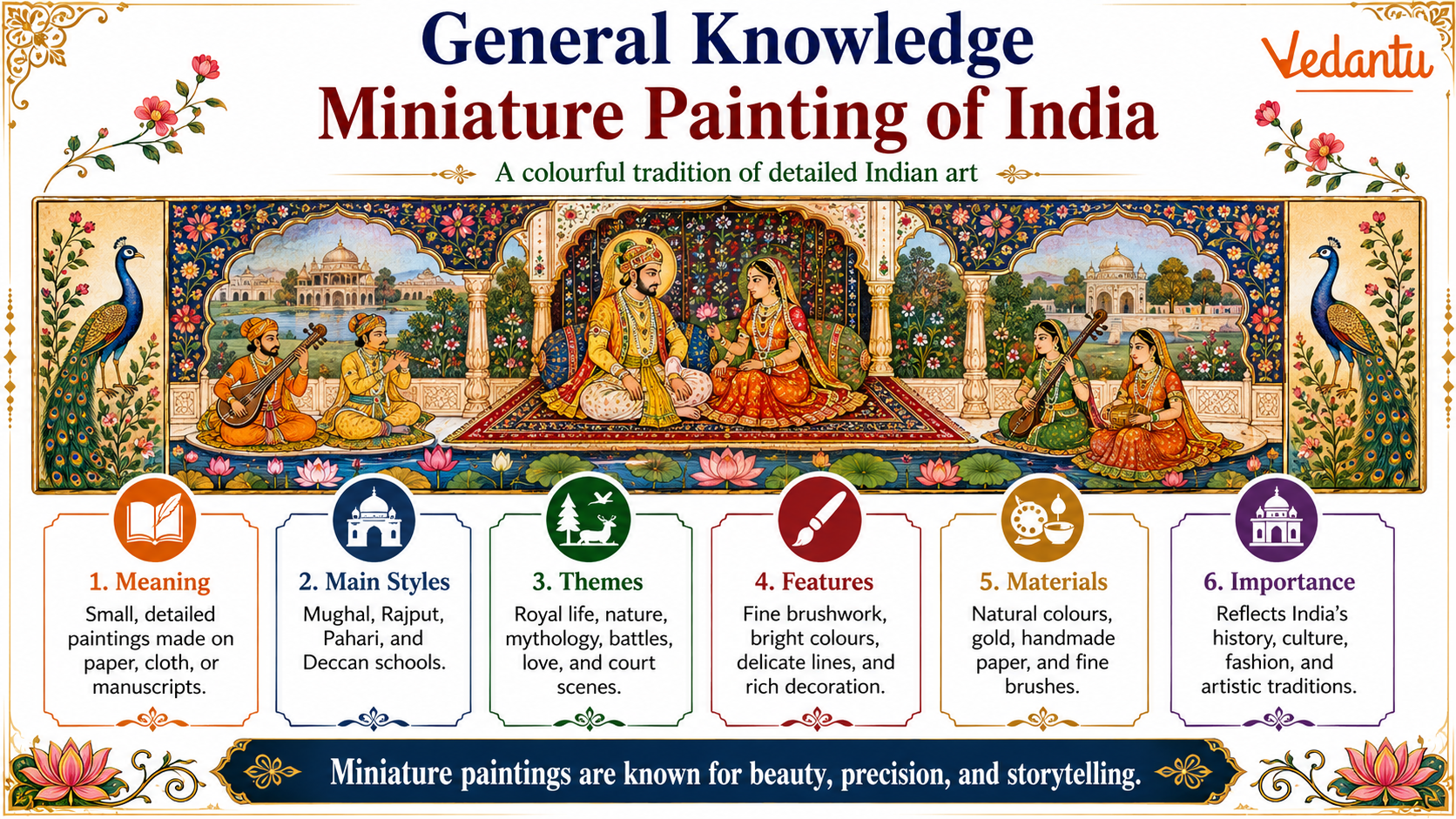
What is Miniature Painting?
Miniature paintings are small, detailed artworks that often illustrate scenes from epics, royal courts, ragas, festivals, and daily life. The term miniature refers to the size of the painting, not the subject. These artworks are known for their delicate brushwork, intricate patterns, vibrant colors, and decorative borders.
Key Features of Indian Miniature Paintings
- Small size with fine and detailed work
- Use of natural colors made from minerals, vegetables, and precious stones
- Themes based on mythology, religion, music, love, and royal life
- Decorative borders and intricate background patterns
- Use of handmade paper, cloth, palm leaves, or ivory as base material
Major Schools of Miniature Painting in India
Indian miniature paintings developed into different regional schools. Each school had unique characteristics influenced by local culture, rulers, and traditions.
Major Schools of Indian Miniature Painting
| School | Region | Main Features |
|---|---|---|
| Mughal School | Delhi, Agra | Realistic portraits, court scenes, Persian influence |
| Rajput School | Rajasthan | Bold colors, themes from Ramayana and Krishna Leela |
| Pahari School | Himachal Pradesh | Romantic themes, delicate lines, nature scenes |
Apart from these, other important schools include Deccan School, Bengal School, and Jain School of painting. Each contributed significantly to the richness of Indian miniature art.
1. Mughal Miniature Painting
The Mughal School flourished during the reign of emperors like Akbar, Jahangir, and Shah Jahan. It combined Indian and Persian styles. Artists focused on realism, portraits of kings, court scenes, hunting scenes, and historical events. Detailed facial expressions and natural backgrounds were major highlights.
2. Rajput Miniature Painting
The Rajput School developed in the royal courts of Rajasthan. These paintings were more symbolic and spiritual compared to Mughal art. Popular themes included stories from the Ramayana, Mahabharata, and life of Lord Krishna. Bright colors and dramatic expressions were commonly used.
3. Pahari Miniature Painting
The Pahari School emerged in the Himalayan hill kingdoms. It is famous for illustrating romantic and devotional themes, especially the love of Radha and Krishna. Soft colors, graceful figures, and scenic landscapes are distinctive features.
Materials and Techniques Used
Miniature paintings required patience and precision. Artists followed traditional methods to prepare colors and surfaces.
- Natural pigments extracted from stones, minerals, and plants
- Gold and silver foils for decoration
- Fine brushes made from squirrel hair
- Handmade paper prepared with starch and burnished for smoothness
Important Themes in Miniature Paintings
- Religious texts like Ramayana and Mahabharata
- Krishna Leela and Radha Krishna love stories
- Ragamala series depicting musical modes
- Royal court scenes and portraits
- Nature, seasons, and festivals
Decline and Revival
The decline of miniature painting began in the 19th century due to the decline of royal patronage and the rise of British rule. However, efforts were made in the 20th century to revive this traditional art form. Today, miniature painting continues to be practiced and preserved in art schools and cultural institutions.
Importance in General Knowledge and Competitive Exams
Miniature Painting of India is frequently asked in competitive exams under Art and Culture. Questions may cover different schools, characteristics, materials used, and famous rulers who promoted this art. Understanding the differences between Mughal, Rajput, and Pahari styles is particularly important for exams.
Quick Revision Points
- Miniature paintings are small but highly detailed artworks.
- Mughal School focused on realism and court life.
- Rajput School highlighted mythology and bright colors.
- Pahari School is known for romantic and devotional themes.
- Natural colors and fine brushes were used in creation.
Conclusion
Miniature Painting of India represents a glorious chapter of Indian art and culture. Though small in size, these paintings carry immense historical, religious, and artistic value. From the realistic Mughal portraits to the vibrant Rajput themes and romantic Pahari scenes, each school reflects the diversity of India. A clear understanding of their features, themes, and regional differences is essential for building strong General Knowledge and excelling in competitive examinations.
FAQs on General Knowledge: Indian Miniature Painting – History, Styles and Importance
1. What is Miniature Painting of India?
Indian Miniature Painting is a detailed and small-scale style of traditional painting known for its intricate brushwork and vibrant colors.
• Developed between the 16th and 19th centuries
• Painted on materials like paper, cloth, or palm leaves
• Depicts themes from royal courts, mythology, nature, and daily life
• Popular in regions such as Mughal, Rajput, and Pahari kingdoms
This art form is often searched under terms like Indian traditional art, Mughal paintings, Rajput art, and small-scale paintings.
2. What are the main schools of Indian Miniature Painting?
The major schools of Indian Miniature Painting developed under different regional kingdoms and rulers.
• Mughal School – Realistic portraits and court scenes
• Rajput School – Religious themes and bold colors
• Pahari School – Romantic and devotional subjects
• Deccan School – Persian influence with rich backgrounds
These schools are frequently discussed in GK exams, art history topics, and competitive exam preparation.
3. Who introduced Miniature Painting in India?
The organized development of Miniature Painting in India began under the patronage of the Mughal emperors.
• Introduced during the reign of Emperor Humayun
• Flourished under Akbar, Jahangir, and Shah Jahan
• Influenced by Persian miniature art
• Later adapted by Rajput and regional kingdoms
This topic is commonly searched as origin of miniature painting, Mughal art history, and Indian art evolution.
4. What are the main features of Indian Miniature Paintings?
Indian Miniature Paintings are known for their precision, decorative style, and expressive themes.
• Use of natural colors and gold leaf
• Fine and delicate brush strokes
• Detailed facial expressions and costumes
• Themes from Ramayana, Mahabharata, royal life, and love stories
These features make them important in Indian art and culture studies and general knowledge sections.
5. What materials were used in Miniature Paintings?
Traditional Miniature Paintings were created using handmade and natural materials.
• Natural dyes from plants, minerals, and stones
• Brushes made from squirrel or camel hair
• Surfaces like handmade paper, silk, or palm leaves
• Use of gold and silver foils for decoration
This is often searched under materials used in Indian art, traditional painting techniques, and ancient art methods.
6. What themes are commonly depicted in Indian Miniature Paintings?
The themes of Indian Miniature Art reflect religion, royalty, and romance.
• Stories from Ramayana, Mahabharata, and Bhagavata Purana
• Krishna-Leela and Radha-Krishna love scenes
• Royal court activities and hunting scenes
• Nature, seasons, and musical ragas (Ragamala paintings)
These themes are important for GK questions, art history exams, and cultural studies.
7. What is the difference between Mughal and Rajput Miniature Paintings?
The key difference lies in their themes, style, and influence.
• Mughal Paintings: Realistic portraits, Persian influence, court life focus
• Rajput Paintings: Religious themes, bold colors, symbolic backgrounds
• Mughal style emphasizes naturalism and shading
• Rajput style highlights devotion and mythology
This comparison is frequently asked in competitive exams, UPSC, SSC, and school GK tests.
8. Why is Miniature Painting important in Indian art and culture?
Miniature Painting holds great importance as it reflects India's rich cultural heritage and artistic excellence.
• Preserves historical records of Mughal and Rajput courts
• Showcases religious devotion and mythology
• Demonstrates advanced art techniques and craftsmanship
• Recognized as a vital part of Indian traditional art forms
It is widely covered in Indian culture GK, art and heritage syllabus, and history studies.
9. Which rulers promoted Miniature Painting in India?
Several rulers significantly promoted the growth of Miniature Painting in India.
• Akbar – Established royal painting workshops
• Jahangir – Encouraged naturalistic art and portraits
• Shah Jahan – Supported decorative refinement
• Rajput rulers of Mewar, Jaipur, and Bundi
This topic is common in searches like patronage of Mughal art, famous rulers of miniature painting, and Indian art patrons.
10. Where can Indian Miniature Paintings be seen today?
Indian Miniature Paintings are preserved in museums and art galleries across India and the world.
• National Museum, New Delhi
• Indian Museum, Kolkata
• British Museum, London
• Private art collections and heritage galleries
They are frequently searched under famous Indian museums, heritage art collections, and traditional Indian paintings.
