






Why Lord Dalhousie Introduced the Lapse Policy and Its Impact on Indian States
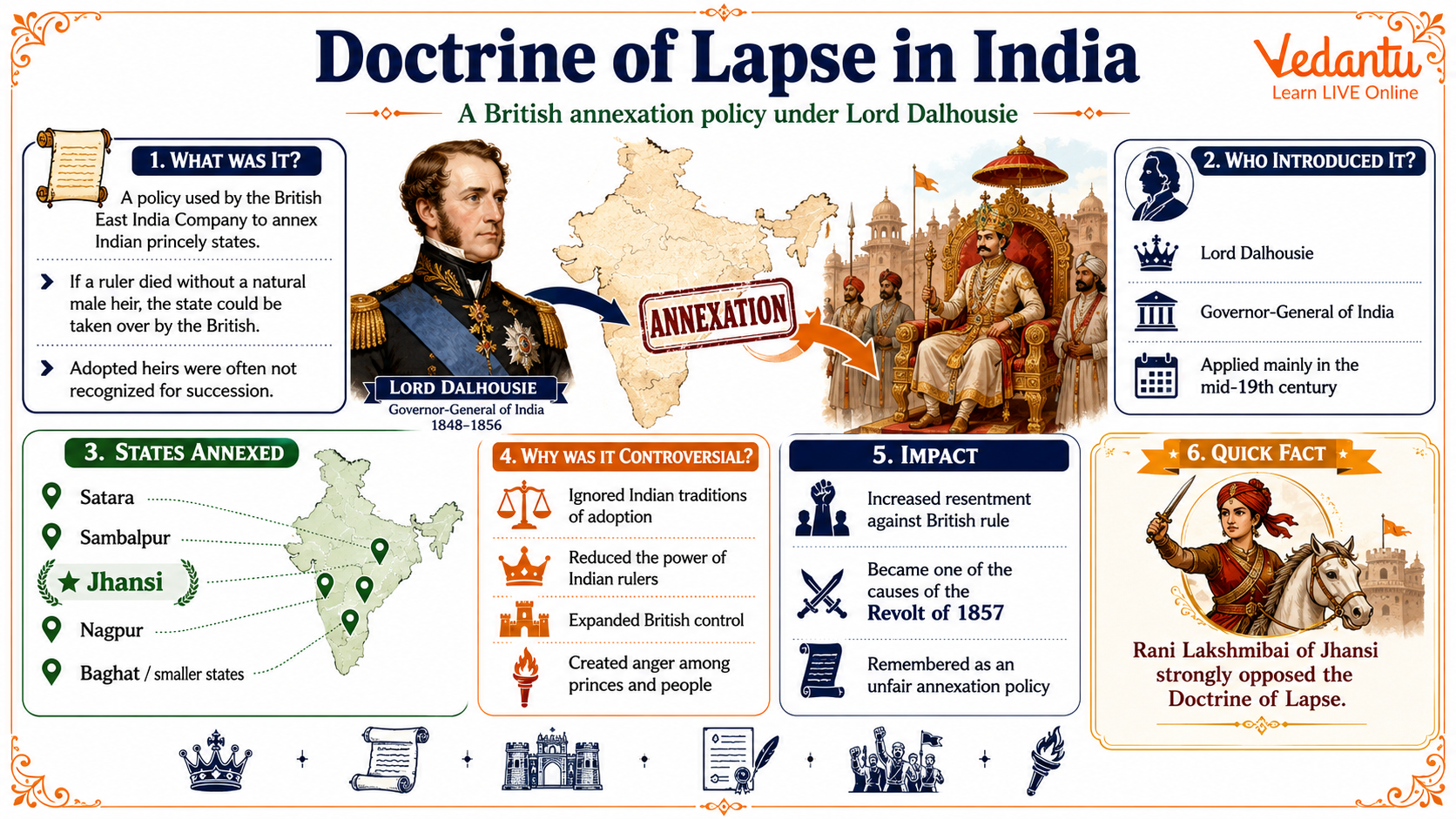
The Doctrine of Lapse was a policy introduced by the British East India Company in India during the mid-19th century. It became one of the most controversial annexation policies under Governor-General Lord Dalhousie. According to this doctrine, if a ruler of a princely state died without a natural male heir, his kingdom would automatically lapse and be annexed by the British. The policy significantly expanded British territories in India and played a major role in creating dissatisfaction among Indian rulers, eventually contributing to the Revolt of 1857.
What is the Doctrine of Lapse?
The Doctrine of Lapse was an annexation policy implemented by Lord Dalhousie between 1848 and 1856. Under this rule, the British East India Company refused to recognize adopted heirs of Indian rulers unless the adoption had been approved by the Company. If a ruler died without a direct biological male heir, his kingdom was taken over by the British.
Traditionally, Indian rulers had the right to adopt a son to succeed the throne if they did not have a natural heir. However, the British used this doctrine to deny such succession rights and expand their political control in India.
Key Features of the Doctrine of Lapse
- Applied to princely states under the East India Company.
- Denied recognition of adopted heirs without British approval.
- Allowed the British to annex states without a natural male successor.
- Strengthened British territorial expansion in India.
- Created resentment among Indian rulers and nobles.
States Annexed Under the Doctrine of Lapse
| State | Year of Annexation | Governor-General |
|---|---|---|
| Satara | 1848 | Lord Dalhousie |
| Jhansi | 1854 | Lord Dalhousie |
| Nagpur | 1853 | Lord Dalhousie |
| Sambalpur | 1849 | Lord Dalhousie |
These annexations significantly increased British territories in India. The annexation of Jhansi later became a major cause of resistance during the Revolt of 1857 under the leadership of Rani Lakshmibai.
Objectives Behind the Doctrine
The British justified the Doctrine of Lapse as a means to ensure good governance and prevent misrule in princely states. However, the actual objectives were political and economic expansion.
- To expand British territorial control.
- To increase revenue collection.
- To reduce the power of Indian rulers.
- To strengthen administrative uniformity under British rule.
Impact of the Doctrine of Lapse
Political Impact
The policy led to the annexation of several princely states, increasing British dominance in India. It weakened the authority and trust of Indian rulers towards the British government.
Social and Emotional Impact
The refusal to recognize adopted heirs was seen as interference in Indian traditions and customs. It created deep resentment among royal families and their supporters.
Role in the Revolt of 1857
The Doctrine of Lapse became one of the major political causes of the Revolt of 1857. Rani Lakshmibai of Jhansi strongly opposed the annexation of her kingdom. Nana Sahib, whose pension was stopped, also joined the revolt. The policy united many discontented rulers against the British.
Criticism of the Doctrine of Lapse
- It violated traditional Hindu laws of adoption.
- It was viewed as unjust and exploitative.
- It damaged the relationship between Indian rulers and the British.
- It contributed directly to widespread unrest in India.
Why the Doctrine of Lapse is Important in General Knowledge
The Doctrine of Lapse is an important topic in Indian history and General Knowledge. It is frequently asked in competitive exams, school exams, and civil service examinations. Understanding this policy helps students grasp the political strategies used by the British to expand their rule and the causes behind the Revolt of 1857.
The policy reflects the larger pattern of British imperial expansion and highlights the tensions between colonial power and traditional Indian political systems. Its long-term impact on Indian resistance movements makes it a significant chapter in modern Indian history.
Conclusion
The Doctrine of Lapse was a strategic annexation policy introduced by Lord Dalhousie to expand British territories in India. By denying recognition to adopted heirs, the British annexed several princely states, creating widespread resentment. The policy played a crucial role in triggering the Revolt of 1857 and remains a key topic in the study of Indian history. Understanding the Doctrine of Lapse provides valuable insight into the nature of British colonial expansion and its impact on Indian society and politics.
FAQs on Doctrine of Lapse in India: Meaning, History and Effects
1. What was the Doctrine of Lapse?
The Doctrine of Lapse was a policy introduced by Lord Dalhousie in 1848 under which the British East India Company annexed Indian princely states without a natural male heir.
- Applied when a ruler died without a biological son
- Adopted sons were not recognized as legal heirs
- The state was annexed to British territory
- Became a major cause of resentment before the Revolt of 1857
This policy is also linked to terms like British annexation policy, expansion of British Empire in India, and Dalhousie’s imperialism.
2. Who introduced the Doctrine of Lapse in India?
Lord Dalhousie, the Governor-General of India (1848–1856), introduced the Doctrine of Lapse to expand British control.
- Served as Governor-General from 1848 to 1856
- Believed in aggressive territorial expansion
- Annexed several princely states under this policy
- Considered it legally justified under Company rule
His expansionist approach significantly strengthened the British East India Company’s rule in India.
3. Which states were annexed under the Doctrine of Lapse?
Several princely states were annexed under the Doctrine of Lapse due to the absence of a natural heir.
- Satara (1848)
- Jaitpur and Sambalpur (1849)
- Baghat (1850)
- Udaipur (1852)
- Jhansi (1853)
- Nagpur (1854)
These annexations intensified political unrest and contributed to the Indian Rebellion of 1857.
4. Why was the Doctrine of Lapse introduced?
The Doctrine of Lapse was introduced to expand British territories and strengthen administrative control.
- To increase revenue and resources
- To prevent succession disputes in princely states
- To establish direct British governance
- To consolidate Company power in India
This policy reflects the broader strategy of British territorial expansion and colonial consolidation in the 19th century.
5. Why was the Doctrine of Lapse opposed by Indian rulers?
Indian rulers opposed the Doctrine of Lapse because it denied their traditional right to adopt heirs.
- Adoption was a recognized custom in Hindu law
- It disrespected Indian traditions and sovereignty
- It led to loss of kingdoms and royal privileges
- Created political instability and resentment
The policy deeply angered leaders like Rani Lakshmibai of Jhansi and fueled anti-British sentiment.
6. How did the Doctrine of Lapse contribute to the Revolt of 1857?
The Doctrine of Lapse became one of the political causes of the Revolt of 1857.
- Annexation of Jhansi angered Rani Lakshmibai
- Displacement of royal families created hostility
- Increased distrust toward British policies
- Combined with military and economic grievances
It is often cited as a key factor behind the First War of Indian Independence or Sepoy Mutiny.
7. Was Awadh annexed under the Doctrine of Lapse?
No, Awadh was not annexed under the Doctrine of Lapse but on grounds of alleged misgovernance in 1856.
- Annexed by Lord Dalhousie
- Accused Nawab of poor administration
- Separate from lapse policy criteria
- Still contributed to resentment before 1857
Though different in justification, the annexation of Awadh (Oudh) added to anti-British feelings.
8. What was the impact of the Doctrine of Lapse on Indian society?
The Doctrine of Lapse had major political and social consequences in India.
- Loss of sovereignty for princely states
- Unemployment for soldiers and court officials
- Spread of anti-British resentment
- Strengthening of nationalist feelings
It accelerated opposition to British colonial rule and laid groundwork for organized resistance.
9. When was the Doctrine of Lapse abolished?
The Doctrine of Lapse was effectively abolished after the Revolt of 1857.
- Power transferred to the British Crown in 1858
- Adoption rights of princes were restored
- Policy of non-annexation was followed
- Marked change in British administrative approach
The end of this doctrine came with the Government of India Act 1858.
10. Why is the Doctrine of Lapse important in Indian history?
The Doctrine of Lapse is important because it symbolizes British imperial expansion and triggered political unrest.
- Key example of colonial annexation policy
- Major cause of the Revolt of 1857
- Affected prominent states like Jhansi and Nagpur
- Highlighted clash between British law and Indian tradition
It remains a significant topic in modern Indian history, UPSC, and other competitive exams.
