






Reasons Muhammad Bin Tughlaq Was Known as the Wise but Foolish Sultan
Muhammad Bin Tughlaq was one of the most controversial rulers of the Delhi Sultanate. He ruled from 1325 to 1351 and is often described as the "Wise Fool" in Indian history. This unusual title reflects the contrast between his brilliant ideas and their poor execution. While he was highly educated, visionary, and ambitious, many of his policies failed because they were impractical and badly implemented. Understanding why he earned this title is important for students preparing for school exams and competitive examinations.
Who Was Muhammad Bin Tughlaq?
Muhammad Bin Tughlaq was the son of Ghiyasuddin Tughlaq and the second ruler of the Tughlaq dynasty. He was known for his intelligence, knowledge of mathematics, astronomy, philosophy, and medicine. He was fluent in several languages including Persian and Arabic. Despite his intellectual brilliance, his reign was marked by administrative failures and rebellions.
- Reign - 1325 to 1351
- Dynasty - Tughlaq Dynasty
- Capital - Delhi, later shifted to Daulatabad and then back to Delhi
- Known for - Ambitious experiments and administrative reforms
Why Is Muhammad Bin Tughlaq Called Wise Fool?
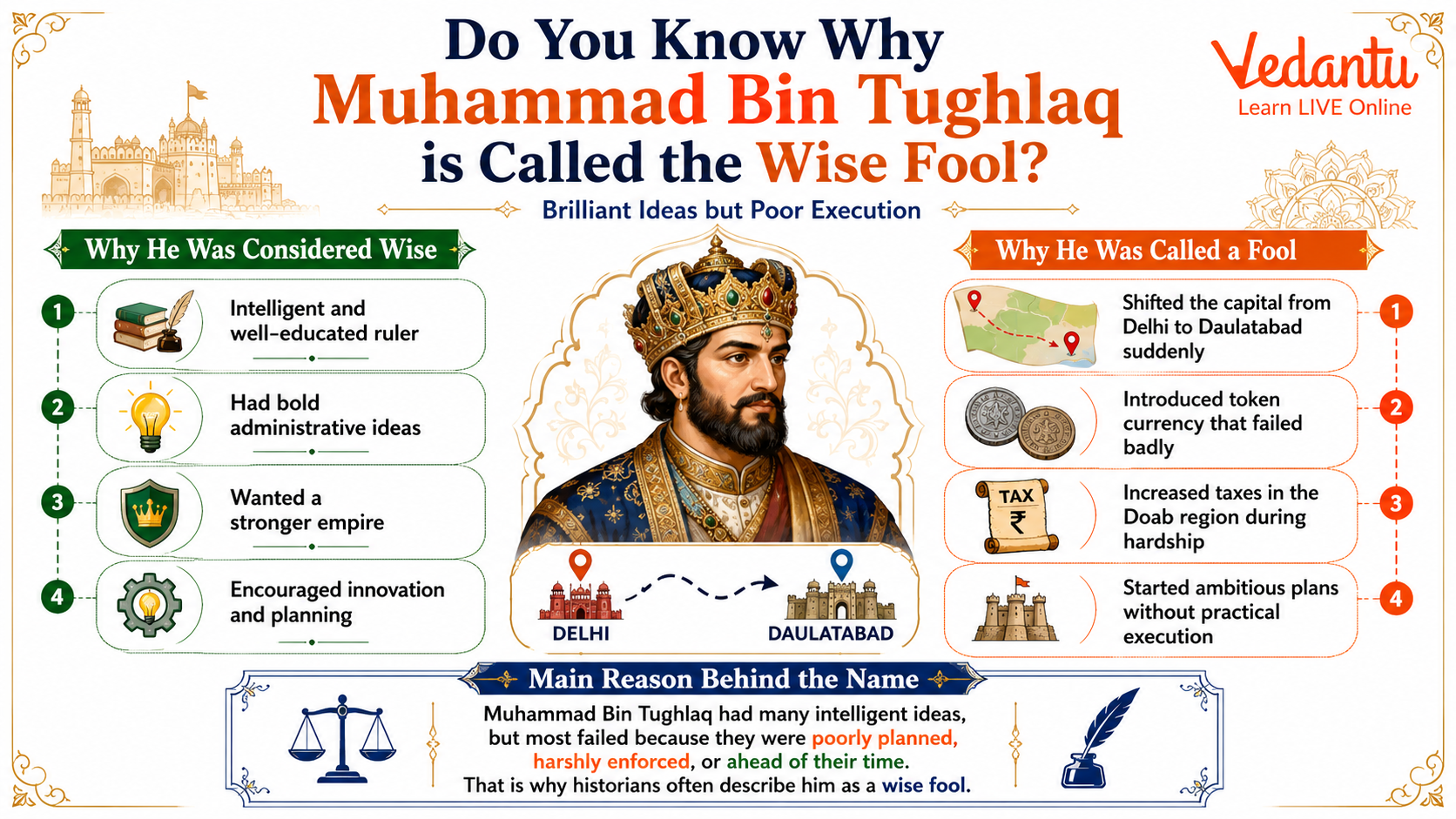
Muhammad Bin Tughlaq is called a Wise Fool because he introduced innovative and forward-thinking policies, but most of them failed due to poor planning, harsh implementation, and lack of practical understanding. His ideas were wise in theory but foolish in execution.
1. Transfer of Capital
He decided to shift the capital from Delhi to Daulatabad in the Deccan. He believed that Daulatabad was centrally located and safer from Mongol invasions. However, he forced the entire population of Delhi to move, causing great suffering and death. Later, he shifted the capital back to Delhi, making the decision appear foolish.
2. Introduction of Token Currency
Muhammad Bin Tughlaq introduced copper and brass coins with the same value as silver coins. His aim was to overcome the shortage of silver. However, there was no strict control over minting, and people started making fake coins at home. This led to economic chaos and heavy losses to the treasury.
3. Tax Increase in Doab Region
He increased taxes in the fertile Doab region between the Ganga and Yamuna rivers to increase state revenue. Unfortunately, this was done during a famine. Farmers suffered greatly, many revolted, and agricultural production declined.
4. Ambitious Military Campaigns
He planned to expand his empire into Central Asia and the Himalayas. He raised a large army and spent huge amounts of money. However, most of these campaigns failed, leading to financial strain and dissatisfaction among soldiers.
Major Policies and Their Outcomes
| Policy | Objective | Result |
|---|---|---|
| Transfer of Capital | Administrative control and safety | Public suffering and reversal |
| Token Currency | Overcome silver shortage | Counterfeiting and economic crisis |
| Tax Increase in Doab | Increase revenue | Revolt and agricultural decline |
The table clearly shows that although his intentions were practical and forward-looking, the outcomes were mostly negative due to poor implementation and lack of ground-level understanding.
Positive Qualities of Muhammad Bin Tughlaq
Despite his failures, historians acknowledge that he possessed several admirable qualities. He was not an ignorant ruler but rather an intellectual with progressive ideas.
- Highly educated and knowledgeable
- Religious tolerance towards different communities
- Strong administrative vision
- Encouraged agriculture and introduced new experiments
Reasons Behind the Failure of His Policies
The failure of Muhammad Bin Tughlaq's policies can be understood through the following factors:
- Lack of practical planning
- Harsh and forced implementation
- Poor communication with subjects
- Inadequate administrative machinery
- Ignoring ground realities such as famine and economic conditions
Historical Significance
Muhammad Bin Tughlaq remains an important figure in medieval Indian history because his reign highlights the importance of balancing intelligence with practicality. His experiments show that good ideas alone are not enough. Proper planning, timing, and execution are equally important for success. His rule also led to political instability and several rebellions, which weakened the Delhi Sultanate.
Conclusion
Muhammad Bin Tughlaq is called the Wise Fool because he combined extraordinary intelligence with impractical decisions. His policies were ahead of their time but failed due to poor execution and harsh enforcement. While he cannot be considered a foolish ruler in terms of knowledge, his administrative failures earned him this unique title in history. For students, this topic is important as it teaches that wisdom must be supported by practical action to achieve success.
FAQs on Do You Know Why Muhammad Bin Tughlaq Is Called Wise Fool in History?
1. Why is Muhammad Bin Tughlaq called the Wise Fool?
Muhammad Bin Tughlaq is called the Wise Fool because he was highly intelligent and visionary, but many of his ambitious policies failed due to poor planning and execution. Key reasons include:
• Introduction of Token Currency without proper control
• Sudden transfer of capital from Delhi to Daulatabad
• Heavy taxation in the Doab region
Although he had advanced ideas, their impractical implementation earned him the title of a ruler who was both wise and foolish.
2. Who was Muhammad Bin Tughlaq?
Muhammad Bin Tughlaq was the Sultan of the Delhi Sultanate who ruled from 1325 to 1351 CE. Important facts about him:
• Son of Ghiyasuddin Tughlaq
• Known for administrative experiments
• Ruled a vast empire in medieval India
He is remembered as one of the most controversial rulers in Indian history.
3. What was the Token Currency experiment of Muhammad Bin Tughlaq?
Token Currency was an experiment where Muhammad Bin Tughlaq introduced copper and brass coins equal in value to silver coins. Main features:
• Intended to increase treasury revenue
• Inspired by Chinese paper currency system
• Failed due to widespread forgery
The lack of strict regulation led to economic chaos, making it one of his biggest administrative failures.
4. Why did Muhammad Bin Tughlaq shift the capital from Delhi to Daulatabad?
Muhammad Bin Tughlaq shifted the capital from Delhi to Daulatabad to strengthen control over southern India. Reasons included:
• Strategic central location
• Protection from Mongol invasions
• Better administration of the Deccan region
However, the forced migration caused hardship and suffering, and the decision was later reversed.
5. What were the major administrative reforms of Muhammad Bin Tughlaq?
Muhammad Bin Tughlaq introduced several administrative reforms to expand and strengthen his empire. Key reforms included:
• Introduction of Token Currency
• Transfer of capital to Daulatabad
• Increase in land revenue in the Doab
• Plans for expansion into Central Asia
Though innovative, many reforms failed due to poor implementation.
6. Why did the Doab taxation policy fail?
The Doab taxation policy failed because heavy taxes were imposed during a period of famine. Important points:
• High revenue demand from farmers
• Crop failure due to drought
• Harsh punishment for non-payment
This led to revolts and economic distress, damaging the Sultan’s reputation.
7. Was Muhammad Bin Tughlaq really intelligent?
Muhammad Bin Tughlaq was highly intelligent and well-educated, fluent in subjects like mathematics, philosophy, and medicine. Evidence of his wisdom:
• Knowledge of multiple languages
• Innovative economic and military ideas
• Visionary expansion plans
However, his lack of practical judgment led to repeated failures.
8. What were the main reasons for the failure of Muhammad Bin Tughlaq’s policies?
The main reasons for the failure of his policies were poor execution and lack of public support. Major causes include:
• Sudden implementation without preparation
• Harsh administrative measures
• Inadequate monitoring systems
These factors turned visionary reforms into administrative disasters.
9. How did Muhammad Bin Tughlaq’s rule impact the Delhi Sultanate?
Muhammad Bin Tughlaq’s rule weakened the Delhi Sultanate despite his ambitious plans. Key impacts:
• Economic instability due to failed currency reform
• Regional revolts and rebellions
• Loss of territories in the Deccan
His reign marked a period of political unrest in medieval Indian history.
10. What is the historical significance of Muhammad Bin Tughlaq?
Muhammad Bin Tughlaq holds historical significance as one of the most debated rulers of medieval India. He is remembered for:
• Bold administrative experiments
• Expansion of the Delhi Sultanate
• Being labeled the Wise Fool of Indian History
His reign provides important lessons on leadership, governance, and policy implementation.
