






Key Differences Between Metro Rail and Local Railway Services
Metro and Local Train are two important modes of urban transportation in many cities. Both systems help millions of people travel daily for work, education, and other activities. However, they differ in terms of route coverage, speed, infrastructure, capacity, and operation. Understanding the difference between Metro and Local Train is important for students preparing for competitive exams as well as for general awareness. This article explains their key differences, features, advantages, and similarities in a clear and structured manner.
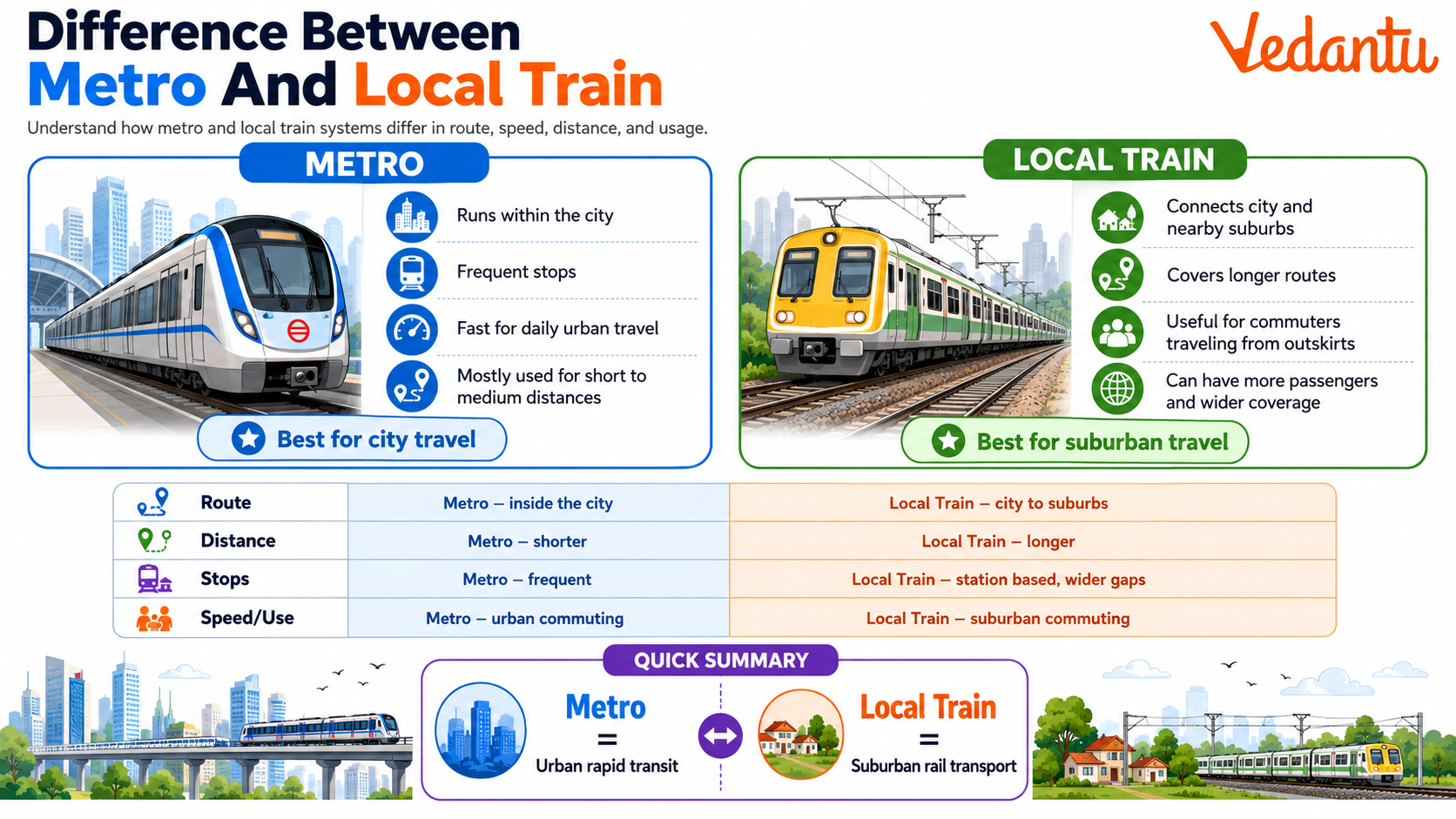
What Is a Metro Train?
A Metro train is a rapid transit system designed mainly for urban areas. It operates within a city and connects important commercial, residential, and industrial zones. Metro systems usually run on dedicated tracks that are either underground, elevated, or on separate corridors. They are designed for high frequency, fast travel, and reduced traffic congestion in densely populated cities.
Key Features of Metro Trains
- Operates within city limits
- Runs on dedicated tracks, often elevated or underground
- High frequency with short waiting time
- Air-conditioned coaches in most cities
- Automated ticketing and smart card systems
What Is a Local Train?
A Local train, also known as a suburban train, connects the main city with its suburbs and nearby towns. It operates on the conventional railway network and shares tracks with long-distance trains in many cases. Local trains are commonly used in metropolitan regions to support daily commuting over longer distances compared to metro systems.
Key Features of Local Trains
- Connects city with suburbs and nearby towns
- Runs on existing railway tracks
- Covers longer distances compared to metro
- Generally non air-conditioned coaches
- Lower fare compared to metro in many cities
Difference Between Metro And Local Train
| Basis of Comparison | Metro Train | Local Train |
|---|---|---|
| Area of Operation | Within city limits | City and suburban areas |
| Track Type | Dedicated elevated or underground tracks | Shared railway tracks |
| Speed and Frequency | High frequency and moderate speed | Moderate frequency and longer travel time |
| Distance Covered | Short to medium distance | Medium to long suburban distance |
| Comfort Level | More comfortable and air-conditioned | Basic seating, often crowded |
| Fare Structure | Slightly higher fare | Generally lower fare |
The table above highlights the major differences between Metro and Local Train systems. While metro trains focus on fast and efficient travel within cities, local trains play a key role in connecting urban centers with suburban and nearby regions.
Similarities Between Metro And Local Train
Despite their differences, both Metro and Local trains share certain similarities as public transport systems.
- Both are electric powered train systems in most cities
- Both reduce road traffic congestion
- Both are affordable compared to private vehicles
- Both serve daily commuters in large numbers
Advantages of Metro Trains
- Reduces travel time within the city
- Provides a clean and comfortable environment
- Less affected by road traffic conditions
- Environment friendly transportation
Advantages of Local Trains
- Covers longer distances at affordable rates
- Connects rural and suburban areas with cities
- High passenger carrying capacity
- Essential for daily long distance commuters
Conclusion
In conclusion, the difference between Metro and Local Train lies mainly in their area of operation, infrastructure, speed, comfort, and purpose. Metro trains are ideal for quick travel within city boundaries, while local trains are suitable for connecting cities with surrounding suburbs and towns. Both systems are essential for urban mobility and play a significant role in reducing traffic congestion and supporting economic growth. Understanding these differences helps students and aspirants answer comparative questions effectively in examinations and enhances general knowledge about public transportation systems.
FAQs on Difference Between Metro and Local Trains in India
1. What is the main difference between Metro and Local Train?
The main difference between Metro and Local Train lies in their route coverage and purpose of service.
• Metro trains operate within a city and are designed for urban mass rapid transit.
• Local trains connect the city with suburban and nearby rural areas.
• Metro systems are usually underground or elevated, while local trains run on ground-level railway tracks.
• Metro focuses on short-distance city travel, whereas local trains cover longer suburban distances.
2. What is a Metro Train?
A Metro Train is a rapid transit system designed for fast and efficient transportation within a city.
• Also known as Mass Rapid Transit (MRT).
• Operates on dedicated tracks, often underground or elevated.
• Has frequent stops at short intervals.
• Found in major cities like Delhi Metro, Mumbai Metro, and Kolkata Metro.
3. What is a Local Train?
A Local Train is a suburban railway service that connects a city with its surrounding areas.
• Operates on regular railway tracks.
• Covers longer distances compared to metro.
• Managed by Indian Railways in India.
• Common in cities like Mumbai Suburban Railway and Chennai Suburban Railway.
4. Which is faster: Metro or Local Train?
In general, Metro trains are faster for city travel due to fewer delays and dedicated tracks.
• Metro avoids traffic congestion.
• Has advanced signaling systems.
• Local trains may face delays due to shared railway tracks.
• Average metro speed: 30–40 km/h; Local train speed varies based on route and stops.
5. Which is more comfortable: Metro or Local Train?
Metro trains are usually more comfortable and modern compared to local trains.
• Metro coaches are air-conditioned in most cities.
• Cleaner interiors and better security systems.
• Automatic doors in metro trains.
• Local trains can be crowded, especially during peak hours.
6. What are the similarities between Metro and Local Train?
Both Metro and Local Trains are public transport systems used for daily commuting.
• Operate on railway tracks.
• Carry a large number of passengers.
• Affordable mode of transportation.
• Help reduce traffic congestion and pollution in urban areas.
7. Why is Metro called a rapid transit system?
Metro is called a Rapid Transit System because it ensures fast, efficient, and high-frequency travel within cities.
• Runs on exclusive tracks.
• Minimal crossing with road traffic.
• Uses advanced signaling technology.
• Designed for quick passenger movement in metropolitan areas.
8. Which train is better for long-distance travel within a city?
For long-distance travel between city and suburbs, Local Trains are generally better.
• Cover extended suburban routes.
• Connect towns and outskirts to city centers.
• Metro is ideal for short to medium distances within city limits.
• Choice depends on travel distance and destination.
9. How are Metro and Local Train ticket systems different?
Metro and Local Train ticket systems differ in technology and booking methods.
• Metro uses smart cards, tokens, and digital QR tickets.
• Local trains use paper tickets and railway reservation systems.
• Metro fare is calculated by distance within the city.
• Local train fares are generally cheaper for longer suburban distances.
10. Are Metro and Local Train part of Indian Railways?
Local trains are operated by Indian Railways, while metro systems are managed by separate metro corporations.
• Example: Delhi Metro Rail Corporation (DMRC).
• Local trains fall under Indian Railways zones.
• Metro systems are state or centrally governed joint ventures.
• Both contribute significantly to India's urban transport network.
