






In-Situ vs Ex-Situ Conservation Differences with Examples and Comparison Table
Conservation of biodiversity is essential for maintaining ecological balance and ensuring the survival of various plant and animal species. In biology, conservation methods are broadly classified into two types - In Situ Conservation and Ex Situ Conservation. Understanding the difference between in situ and ex situ conservation is important for students, especially for competitive exams like NEET, as it forms a key part of environmental science and biodiversity topics. This page explains both concepts clearly, along with their features, advantages, disadvantages, and examples.
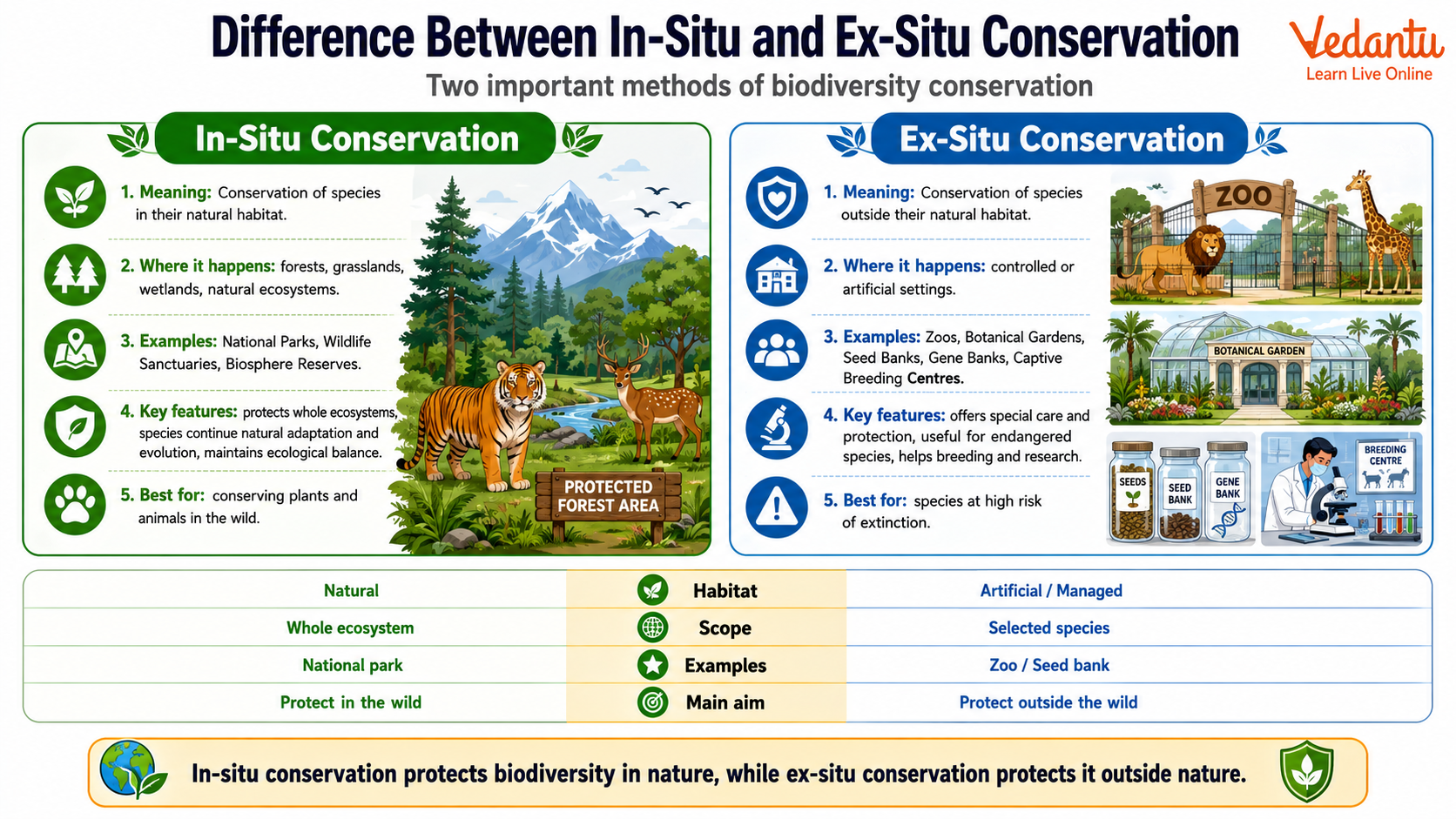
What is In Situ Conservation?
In situ conservation refers to the protection and preservation of species in their natural habitat. The term "in situ" means "on site." This method allows plants and animals to live and reproduce in the ecosystem where they naturally occur. It helps maintain not only individual species but also the entire ecosystem and its interactions.
Key Features of In Situ Conservation
- Conservation of species in their natural habitats
- Protects entire ecosystems along with flora and fauna
- Allows natural evolution and adaptation
- Maintains ecological balance
Examples of In Situ Conservation
- National Parks
- Wildlife Sanctuaries
- Biosphere Reserves
- Sacred Groves
What is Ex Situ Conservation?
Ex situ conservation refers to the protection of species outside their natural habitat. The term "ex situ" means "off site." In this method, organisms are removed from their original habitat and placed in controlled environments where they can be protected, bred, and preserved.
Key Features of Ex Situ Conservation
- Conservation outside natural habitats
- Suitable for endangered species with very small populations
- Provides controlled environmental conditions
- Enables captive breeding and genetic preservation
Examples of Ex Situ Conservation
- Zoos
- Botanical Gardens
- Seed Banks
- Cryopreservation
- Gene Banks
Difference Between In Situ And Ex Situ Conservation
| Basis of Comparison | In Situ Conservation | Ex Situ Conservation |
|---|---|---|
| Location | Within natural habitat | Outside natural habitat |
| Focus | Entire ecosystem | Specific species |
| Environmental Conditions | Natural conditions | Controlled conditions |
| Examples | National parks, sanctuaries | Zoos, seed banks |
| Suitability | Large populations | Critically endangered species |
The main difference between in situ and ex situ conservation lies in the place where protection occurs. In situ conservation maintains species within their natural ecosystems, while ex situ conservation protects them in artificial or controlled environments. Both methods are complementary and play an important role in biodiversity conservation.
Advantages of In Situ Conservation
- Preserves natural habitat and ecosystem interactions
- Ensures long term survival through natural adaptation
- Cost effective compared to ex situ methods
- Protects multiple species at the same time
Advantages of Ex Situ Conservation
- Provides immediate protection to critically endangered species
- Enables scientific research and monitoring
- Facilitates captive breeding and reintroduction programs
- Allows preservation of genetic material for future use
Limitations of Both Methods
Limitations of In Situ Conservation
- Difficult to control natural disasters and poaching
- Requires large areas of land
- Human interference may still occur
Limitations of Ex Situ Conservation
- Expensive to maintain facilities
- Limited genetic diversity due to small population size
- Species may lose natural survival skills
Importance for NEET and Competitive Exams
For NEET preparation, students should clearly understand definitions, examples, and differences between in situ and ex situ conservation. Questions are often asked in the form of direct definitions, match the following, or statement based MCQs. Focus on examples such as national parks and biosphere reserves for in situ conservation, and zoos and seed banks for ex situ conservation. Understanding their advantages and limitations will also help in solving conceptual questions.
Conclusion
In situ and ex situ conservation are two important strategies used to protect biodiversity. While in situ conservation preserves species within their natural habitats and maintains ecosystem integrity, ex situ conservation provides controlled protection for endangered species outside their habitats. Both approaches are essential and often used together to ensure long term survival of species and ecological balance. A clear understanding of their differences is crucial for academic learning and competitive examinations.
FAQs on Difference Between In-Situ and Ex-Situ Conservation: Key Differences and Examples
1. What is the difference between In Situ and Ex Situ Conservation?
In Situ Conservation protects species in their natural habitat, while Ex Situ Conservation conserves them outside their natural environment.
• In Situ means “on-site” conservation (e.g., national parks, wildlife sanctuaries).
• Ex Situ means “off-site” conservation (e.g., zoos, botanical gardens, seed banks).
• In situ maintains natural ecosystems and evolutionary processes.
• Ex situ provides controlled conditions for endangered species protection.
This difference between in situ vs ex situ conservation is important in biodiversity conservation and environmental studies.
2. What is In Situ Conservation?
In Situ Conservation is the protection of species within their natural habitats.
• Conserves plants and animals in forests, oceans, grasslands, etc.
• Examples: National Parks, Wildlife Sanctuaries, Biosphere Reserves.
• Maintains ecological balance and natural adaptation.
• Suitable for protecting large populations.
It is a key method of biodiversity conservation and is widely discussed in competitive exams and environmental science.
3. What is Ex Situ Conservation?
Ex Situ Conservation involves conserving endangered species outside their natural habitats under controlled conditions.
• Examples: Zoos, Botanical Gardens, Seed Banks, Gene Banks, Cryopreservation.
• Protects critically endangered species.
• Allows scientific breeding and research.
• Useful when natural habitats are destroyed.
This method supports species survival when natural ecosystem conservation is not possible.
4. What are the examples of In Situ and Ex Situ Conservation?
Examples clearly show the practical difference between in situ and ex situ conservation methods.
• In Situ Examples: Gir National Park (Asiatic Lions), Kaziranga National Park (One-horned Rhino), Biosphere Reserves.
• Ex Situ Examples: Zoo breeding programs, Botanical gardens, Seed banks like the Svalbard Global Seed Vault.
These examples are frequently asked in GK, UPSC, SSC, and school exams.
5. What are the advantages of In Situ Conservation?
In Situ Conservation helps maintain natural ecosystems and biodiversity effectively.
• Preserves species in their natural surroundings.
• Maintains genetic diversity through natural evolution.
• Protects multiple species at once.
• Cost-effective for large-scale conservation.
It supports ecosystem conservation, wildlife protection, and habitat preservation.
6. What are the advantages of Ex Situ Conservation?
Ex Situ Conservation provides controlled protection for endangered species.
• Protects species from poaching and habitat loss.
• Allows selective breeding programs.
• Helps in scientific research and education.
• Enables reintroduction into the wild.
This method is crucial for endangered species conservation and genetic resource preservation.
7. Which is better: In Situ or Ex Situ Conservation?
Both in situ and ex situ conservation methods are important and complementary.
• In Situ is better for long-term ecosystem sustainability.
• Ex Situ is better for critically endangered species.
• Combined strategies give the best results in biodiversity protection.
The choice depends on species condition, habitat status, and conservation goals.
8. Why is In Situ Conservation considered more effective?
In Situ Conservation is considered more effective because it preserves natural habitats and ecological interactions.
• Maintains food chains and ecological balance.
• Encourages natural adaptation and evolution.
• Protects entire ecosystems instead of single species.
However, it may not work when habitats are severely damaged or fragmented.
9. What are the limitations of In Situ and Ex Situ Conservation?
Both conservation methods have certain limitations.
• In Situ Limitations: Risk from natural disasters, poaching, habitat destruction.
• Ex Situ Limitations: High cost, limited space, loss of natural behavior.
Understanding these challenges helps improve wildlife conservation strategies.
10. Why is conservation important for biodiversity?
Conservation is important to protect biodiversity and ensure ecological balance.
• Prevents species extinction.
• Maintains ecosystem services like pollination and climate regulation.
• Preserves genetic diversity for future generations.
• Supports sustainable development.
Both in situ and ex situ conservation play a vital role in global biodiversity protection and environmental sustainability.
