






Causes and Effects of Indian Rupee Devaluation in India’s Economy
The devaluation of the Indian Rupee refers to a deliberate reduction in the value of the Indian currency relative to foreign currencies, especially the US Dollar. It is usually carried out by the government or the Reserve Bank of India in a fixed exchange rate system to correct economic imbalances such as trade deficits and declining foreign exchange reserves. Devaluation plays an important role in international trade, inflation control, and overall economic stability. Understanding the devaluation of the Indian Rupee is essential for students preparing for competitive exams and for anyone interested in India's economic development.
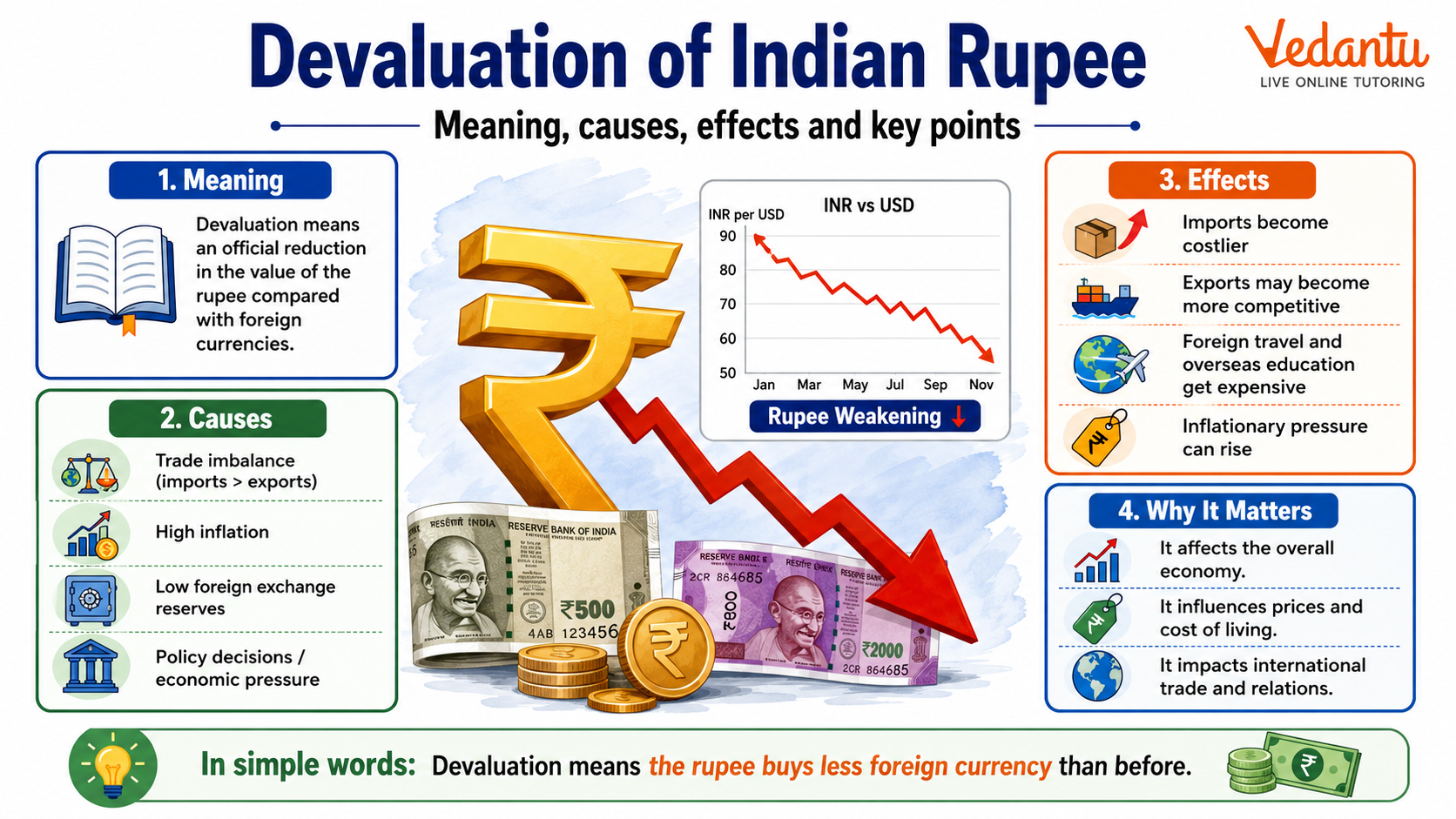
What is Devaluation?
Devaluation is the official reduction in the value of a country's currency compared to other currencies under a fixed exchange rate system. It is different from depreciation, which occurs due to market forces in a floating exchange rate system. In India, devaluation has historically been used as a tool to improve the balance of payments and boost exports.
Devaluation vs Depreciation
Difference Between Devaluation and Depreciation
| Basis | Devaluation | Depreciation |
|---|---|---|
| Meaning | Official reduction in currency value | Fall in currency value due to market forces |
| Exchange System | Fixed exchange rate system | Floating exchange rate system |
| Control | Government or central bank decision | Demand and supply of foreign exchange |
While devaluation is a planned policy decision, depreciation happens automatically in the foreign exchange market. India currently follows a managed floating exchange rate system, so changes in the rupee's value are mostly due to depreciation rather than official devaluation.
Major Instances of Devaluation of Indian Rupee
Historical Devaluations of Indian Rupee
| Year | Reason | Impact |
|---|---|---|
| 1949 | Post independence economic crisis | Rupee devalued against Pound Sterling |
| 1966 | Trade deficit and foreign aid pressure | Rupee devalued by about 36 percent |
| 1991 | Balance of payments crisis | Rupee devalued in two stages to stabilize economy |
The 1991 devaluation was the most significant. It was part of the economic reforms that liberalized the Indian economy and opened it to global markets.
Causes of Devaluation of Indian Rupee
- Persistent trade deficit where imports exceed exports.
- Decline in foreign exchange reserves.
- High inflation compared to other countries.
- External debt obligations and balance of payments crisis.
- Pressure from international financial institutions.
Effects of Devaluation
Positive Effects
- Boosts exports as Indian goods become cheaper in foreign markets.
- Reduces trade deficit over time.
- Encourages domestic production.
Negative Effects
- Increases import costs leading to inflation.
- Raises burden of foreign debt repayment.
- May reduce purchasing power of citizens.
Impact on Indian Economy
Devaluation directly affects various sectors of the Indian economy. Export oriented industries such as textiles, IT services, and pharmaceuticals benefit from a weaker rupee. However, sectors dependent on imports like oil, electronics, and machinery face higher costs. Since India imports a large portion of its crude oil, devaluation often leads to fuel price increases and inflation.
In the long term, devaluation can improve competitiveness if supported by structural reforms. However, frequent or uncontrolled fall in currency value can create economic instability.
Role of Reserve Bank of India
The Reserve Bank of India monitors and manages the exchange rate through various monetary tools. Although India follows a managed floating exchange rate system, the RBI intervenes in the foreign exchange market to prevent excessive volatility in the rupee.
- Buying and selling foreign currency.
- Adjusting interest rates.
- Managing foreign exchange reserves.
Key Terms Related to Devaluation
- Exchange Rate - The value of one currency in terms of another.
- Balance of Payments - Record of all economic transactions between residents of a country and the rest of the world.
- Trade Deficit - Situation where imports exceed exports.
- Foreign Exchange Reserves - Assets held by the central bank in foreign currencies.
Conclusion
The devaluation of the Indian Rupee is an important economic policy tool used during times of financial crisis and trade imbalance. While it can improve export competitiveness and stabilize the balance of payments, it also increases import costs and inflation. A balanced approach, supported by strong economic reforms and effective monetary policy, is necessary to ensure that devaluation leads to long term economic growth. For students and competitive exam aspirants, understanding its causes, historical instances, and impacts is essential for mastering Indian economic concepts.
FAQs on Devaluation of the Indian Rupee Explained for Students
1. What is meant by Devaluation of Indian Rupee?
The devaluation of the Indian Rupee refers to a deliberate reduction in the value of the rupee against foreign currencies by the government or central bank.
- It usually happens in a fixed exchange rate system.
- The value of INR is officially lowered against currencies like the US Dollar.
- It makes exports cheaper and imports costlier.
This concept is commonly asked in GK, UPSC, SSC, and banking exams under topics like currency depreciation, exchange rate policy, and balance of payments.
2. When was the Indian Rupee devalued in history?
India officially devalued the rupee majorly twice in history to tackle economic crises.
- 1966: During an economic crisis and foreign exchange shortage.
- 1991: During the Balance of Payments (BoP) crisis under PM P.V. Narasimha Rao and FM Dr. Manmohan Singh.
The 1991 devaluation was part of India’s Liberalization, Privatization, and Globalization (LPG) reforms.
3. What are the main causes of devaluation of the Indian Rupee?
The main causes of rupee devaluation are economic imbalances and external pressures.
- High trade deficit (more imports than exports)
- Balance of Payments crisis
- Low foreign exchange reserves
- High inflation rate
- Weak economic growth
These factors reduce the demand for the Indian currency (INR) in global markets.
4. What is the difference between devaluation and depreciation?
The key difference lies in government control over the exchange rate.
- Devaluation: Government deliberately reduces the currency value in a fixed exchange system.
- Depreciation: Market forces reduce currency value in a floating exchange rate system.
India currently follows a managed floating exchange rate, so changes are usually termed depreciation rather than devaluation.
5. What are the effects of devaluation of the Indian Rupee?
Devaluation impacts trade, inflation, and economic growth both positively and negatively.
Positive Effects:
- Boosts exports
- Improves trade balance
- Encourages domestic production
Negative Effects:
- Makes imports expensive
- Increases inflation
- Raises cost of foreign loans
Thus, rupee devaluation affects GDP, inflation, and foreign trade.
6. How does devaluation affect common people in India?
Devaluation directly impacts daily expenses and purchasing power.
- Imported goods like petrol, electronics, and machinery become costly.
- Air travel and foreign education expenses increase.
- Inflation reduces the real income of consumers.
However, export-oriented industries may generate more jobs due to increased global demand.
7. Why did India devalue the Rupee in 1991?
India devalued the rupee in 1991 due to a severe Balance of Payments crisis.
- Foreign exchange reserves fell to critical levels.
- India could barely finance two weeks of imports.
- The country pledged gold to the IMF.
This devaluation led to major economic reforms and opened India to globalization.
8. Does devaluation help increase exports?
Yes, devaluation generally makes exports more competitive globally.
- Indian goods become cheaper in foreign markets.
- Export sectors like IT, textiles, and pharmaceuticals benefit.
- It may improve the current account deficit.
However, the benefit depends on global demand and production capacity.
9. Who controls currency devaluation in India?
Currency management in India is handled by the Reserve Bank of India (RBI) under government supervision.
- RBI manages the foreign exchange market.
- It intervenes by buying or selling dollars.
- Policies are aligned with the Ministry of Finance.
India follows a managed float system, not a strict fixed exchange regime.
10. Is devaluation good or bad for the Indian economy?
Devaluation can be both beneficial and harmful depending on economic conditions.
Good When:
- Boosting exports
- Correcting trade deficits
- Reviving economic growth
Bad When:
- Causing high inflation
- Increasing external debt burden
- Reducing investor confidence
Thus, the impact of Indian Rupee devaluation depends on inflation control, global markets, and domestic policy stability.
