






Difference Between Deltas and Estuaries with Simple Examples
A delta and an estuary are two important landforms formed at the mouth of a river where it meets a larger water body such as a sea or an ocean. Though both are associated with river mouths, they differ in their formation process, physical characteristics, and ecological importance. Understanding delta and estuary is essential in Geography and Environmental Studies, especially for students preparing for competitive exams. These landforms play a vital role in agriculture, fisheries, trade, biodiversity, and human settlements.
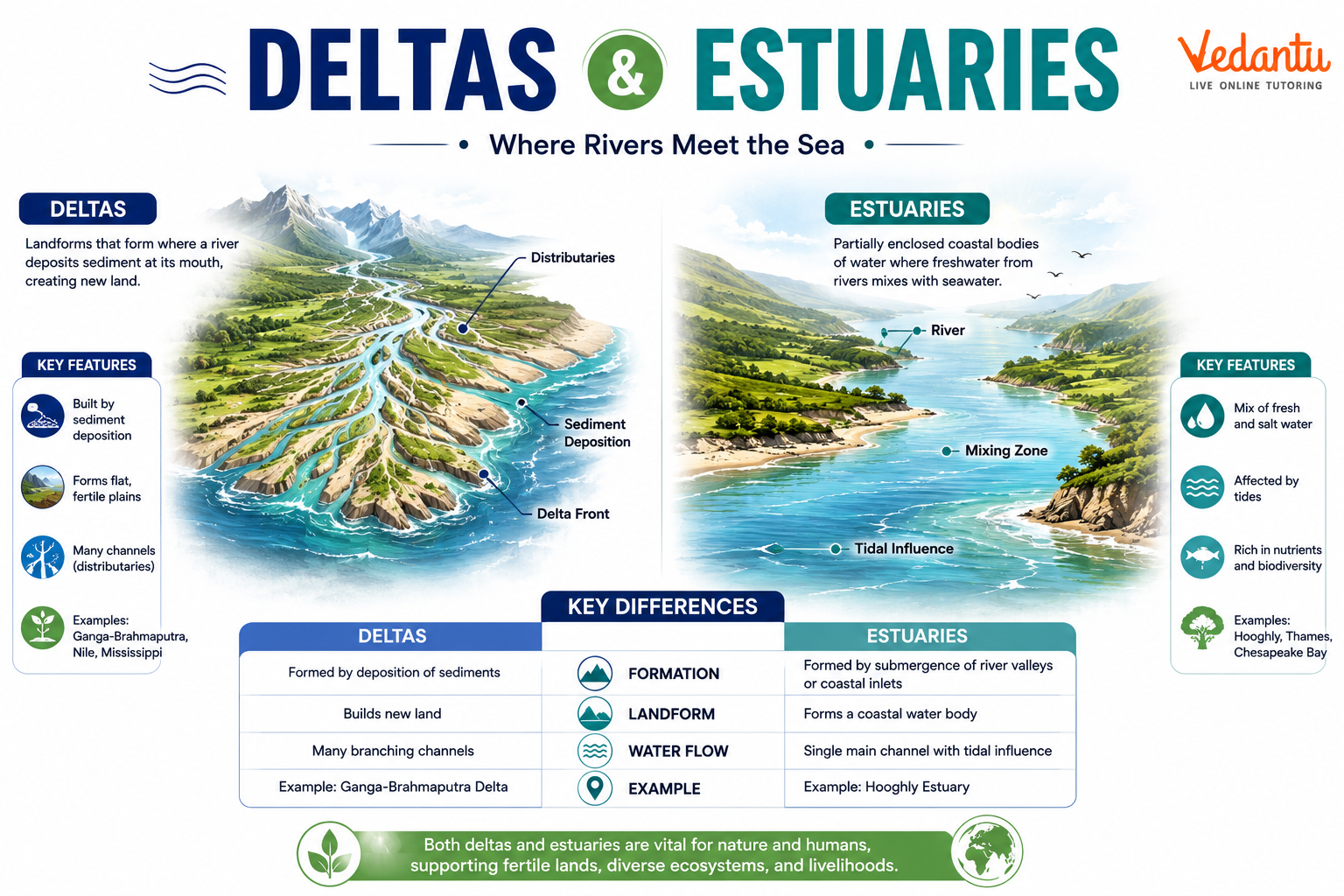
What is a Delta?
A delta is a landform formed at the mouth of a river due to the deposition of sediments carried by the river. When a river enters a sea or ocean, its velocity decreases, causing it to deposit sand, silt, and clay. Over time, these deposits accumulate and form a triangular or fan-shaped landmass known as a delta.
Features of a Delta
- Formed by deposition of sediments.
- Usually triangular in shape.
- River divides into smaller channels called distributaries.
- Very fertile soil suitable for agriculture.
- Common in regions with low tidal action.
Types of Deltas
- Arcuate Delta - Fan-shaped delta such as the Nile Delta.
- Bird's Foot Delta - Resembles a bird's foot such as the Mississippi Delta.
- Cuspate Delta - Formed by strong wave action such as the Tiber Delta.
What is an Estuary?
An estuary is a partially enclosed coastal water body where freshwater from a river mixes with saltwater from the sea. Unlike a delta, an estuary is formed when strong tidal waves and currents prevent sediment deposition and instead carry the sediments away.
Features of an Estuary
- Formed due to submergence of river valleys.
- Mixing of fresh and saline water.
- Strong tidal action present.
- Less sediment deposition.
- Often deep and suitable for natural harbors.
Difference Between Delta and Estuary
| Basis of Comparison | Delta | Estuary |
|---|---|---|
| Formation | Formed by deposition of sediments | Formed by submergence and tidal action |
| Shape | Triangular or fan-shaped | Funnel-shaped |
| Water Type | Mainly freshwater with sediment | Mix of fresh and salt water |
| Examples | Ganga-Brahmaputra Delta | Narmada Estuary |
The key difference lies in sediment deposition and tidal influence. Deltas are formed where deposition dominates, while estuaries are formed where tidal currents are strong enough to prevent sediment accumulation.
Importance of Delta and Estuary
Economic Importance
- Deltas provide fertile land for crops like rice and wheat.
- Estuaries serve as natural harbors for ports and trade.
- Both support fishing and aquaculture.
Ecological Importance
- Rich biodiversity and breeding grounds for fish.
- Mangrove forests are commonly found in delta regions.
- Estuaries act as natural filters by trapping pollutants.
Major Examples in the World
- Ganga-Brahmaputra Delta - Largest delta in the world.
- Nile Delta - Famous arcuate delta in Egypt.
- Mississippi Delta - Example of bird's foot delta.
- Thames Estuary - Important estuary in the United Kingdom.
- Amazon Estuary - Large estuarine system in South America.
Preparation Tips for Exams
- Understand the formation process clearly.
- Memorize key differences in tabular form.
- Practice labeling diagrams of delta and estuary.
- Remember important examples from India and the world.
Conclusion
Delta and estuary are significant coastal landforms formed at river mouths, but they differ in their formation, structure, and characteristics. While deltas are created by sediment deposition and are agriculturally rich, estuaries are formed by tidal action and serve as important ecological and economic zones. A clear understanding of their differences, features, and examples helps students strengthen their geographical knowledge and perform well in competitive examinations.
FAQs on Deltas and Estuaries: Formation, Features, and Importance
1. What is a delta in geography?
A delta is a landform created at the mouth of a river where it deposits sediments as it enters a sea or lake.
• Formed by deposition of silt, sand, and clay
• Occurs where the river slows down before meeting a larger water body
• Creates fertile land suitable for agriculture
• Example: Ganga-Brahmaputra Delta, the world's largest delta
This concept is commonly asked in GK, geography exams, and People Also Ask queries like “how are deltas formed?” and “examples of river deltas.”
2. What is an estuary?
An estuary is a partially enclosed coastal water body where freshwater from rivers mixes with saltwater from the sea.
• Contains brackish water (mixture of salt and fresh water)
• Influenced by tides
• Rich in biodiversity and marine life
• Example: Narmada and Tapi estuaries in India
This topic is frequently searched under terms like “definition of estuary,” “river mouth types,” and “difference between delta and estuary.”
3. What is the main difference between a delta and an estuary?
The main difference between a delta and an estuary lies in sediment deposition and water mixing.
• Delta: Formed by heavy sediment deposition; river splits into distributaries
• Estuary: Formed where tides prevent sediment buildup; river meets sea in a single channel
• Delta water is mostly fresh; estuary water is brackish
• Deltas are triangular in shape; estuaries are funnel-shaped
This comparison is important for competitive exams and common search queries like “delta vs estuary differences.”
4. How is a delta formed?
A delta is formed when a river deposits sediments at its mouth over a long period.
• River carries alluvium (silt and sand)
• Flow velocity decreases near the sea or lake
• Sediments accumulate and build up land
• River divides into smaller channels called distributaries
This process of deposition is a key concept in physical geography and often appears in GK questions like “steps of delta formation.”
5. Why are estuaries important?
Estuaries are important because they support rich ecosystems and protect coastlines.
• Provide habitat for fish, birds, and marine species
• Act as natural nurseries for aquatic life
• Filter pollutants from water
• Protect coastal areas from storms and erosion
Due to their ecological significance, estuaries are often discussed under “coastal ecosystems” and “importance of estuaries” in exams and environmental studies.
6. What are the types of deltas?
Deltas are classified based on their shape and formation process.
• Arcuate Delta: Fan-shaped (e.g., Nile Delta)
• Bird’s Foot Delta: Looks like a bird’s foot (e.g., Mississippi Delta)
• Cuspate Delta: Pointed shape (e.g., Tiber Delta)
These types are frequently asked in geography GK and People Also Search queries like “classification of deltas.”
7. Which is the largest delta in the world?
The Ganga-Brahmaputra Delta is the largest delta in the world.
• Located in India and Bangladesh
• Also called the Sundarbans Delta
• Known for dense mangrove forests
• Home to the Royal Bengal Tiger
This GK fact is commonly asked in school exams and competitive exams under “largest river delta in the world.”
8. Why are deltas fertile regions?
Deltas are fertile because they are made of nutrient-rich alluvial soil.
• Continuous deposition of fine sediments
• Soil retains moisture
• Suitable for crops like rice and wheat
• Support dense human settlements
This is a common People Also Ask query related to agriculture and river valley civilizations.
9. Which Indian rivers form estuaries?
Several west-flowing Indian rivers form estuaries instead of deltas.
• Narmada River
• Tapi River
• Mahi River
• Periyar River
These rivers flow into the Arabian Sea, where strong tides prevent sediment deposition, a key GK topic in Indian geography.
10. Can a river have both a delta and an estuary?
A river generally forms either a delta or an estuary depending on coastal conditions.
• Strong tides and waves favor estuaries
• Calm waters favor delta formation
• Sediment load plays a major role
• Rarely, changes over time can alter the river mouth type
This concept is important for understanding river landforms and appears in queries like “types of river mouths” and “coastal landform formation.”
