






Effects of Cronyistic Capitalism on Economy and Democracy
Crony Capitalism is an economic system in which business success depends not on free market competition, but on close relationships between business leaders and government officials. In such a system, companies gain advantages through political connections, favoritism, and influence rather than innovation or efficiency. This concept is important in economics and general knowledge because it explains how corruption, inequality, and policy manipulation can distort markets and harm economic growth. Understanding crony capitalism helps students analyze economic systems, governance issues, and public policy debates.
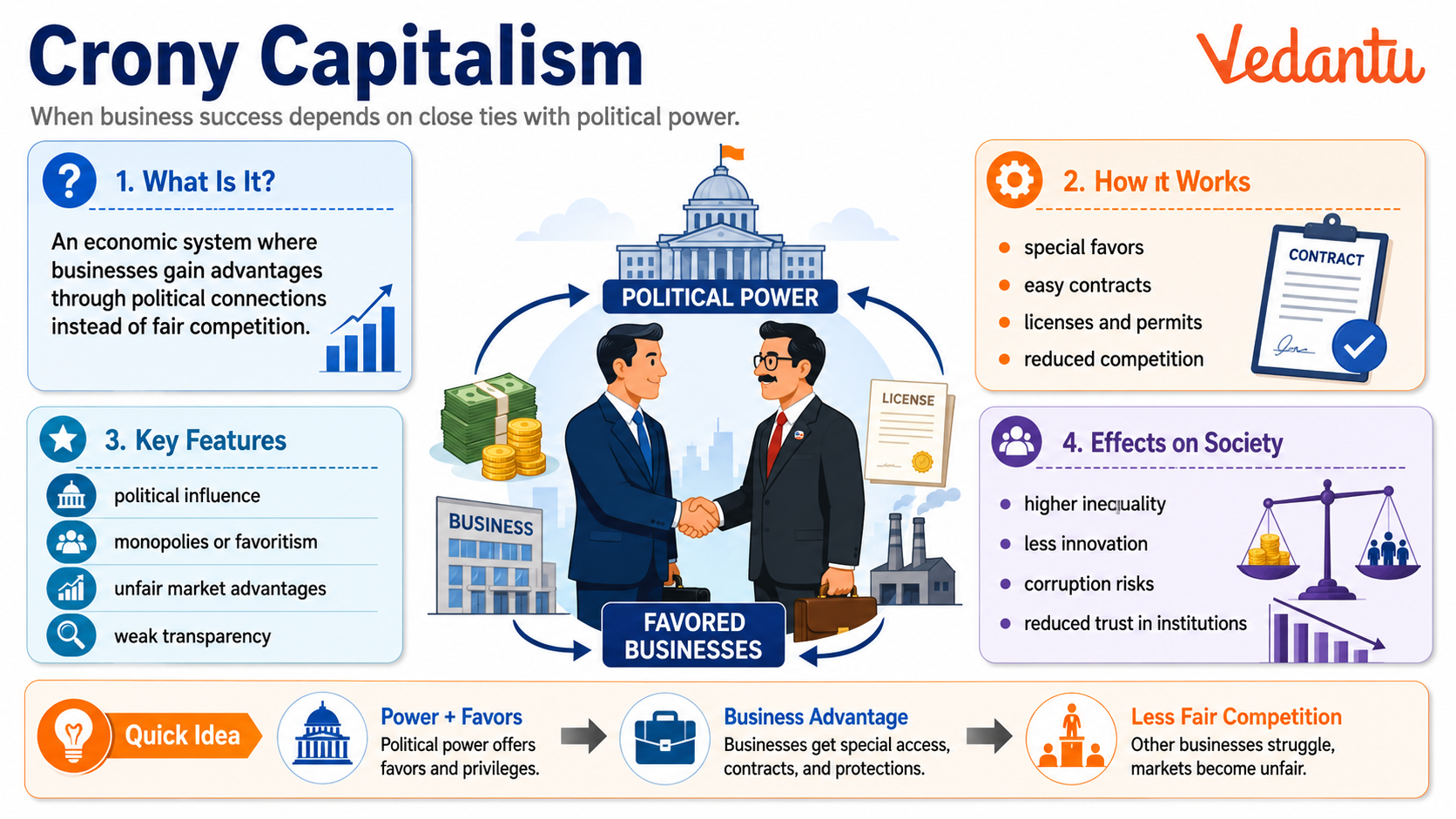
Meaning of Crony Capitalism
Crony Capitalism refers to a situation where businesses thrive due to special favors from the government. These favors may include tax breaks, subsidies, government contracts, relaxed regulations, or protection from competition. Instead of fair competition, personal connections and political influence determine success.
- Close ties between politicians and business leaders
- Unfair allocation of public resources
- Limited market competition
- Increased corruption and lack of transparency
Key Features of Crony Capitalism
1. Political Favoritism
Governments provide advantages to selected businesses due to personal or political connections rather than merit.
2. Regulatory Capture
Regulatory agencies meant to supervise industries become influenced or controlled by the industries they regulate.
3. Monopoly or Oligopoly Formation
Connected firms may dominate markets, reducing competition and harming consumers.
4. Corruption and Bribery
Bribes, illegal donations, and unethical lobbying may be used to secure favorable decisions.
Crony Capitalism vs Free Market Capitalism
| Basis of Comparison | Crony Capitalism | Free Market Capitalism |
|---|---|---|
| Business Success | Depends on political connections | Depends on competition and efficiency |
| Role of Government | Selective favoritism | Minimal interference |
| Market Competition | Limited and controlled | Open and fair |
The table highlights how crony capitalism differs from a genuine free market system. In free markets, competition and innovation determine success, whereas in crony capitalism, political influence plays a major role.
Causes of Crony Capitalism
- Weak legal and regulatory frameworks
- Lack of transparency in governance
- Political funding by corporations
- Poor accountability mechanisms
- Concentration of economic power in a few hands
Effects of Crony Capitalism
Economic Effects
- Inefficient allocation of resources
- Reduced innovation and productivity
- Market distortions
- Higher prices for consumers
Social and Political Effects
- Increased income inequality
- Loss of public trust in institutions
- Growth of corruption
- Weak democratic governance
Examples of Crony Capitalism
Examples of crony capitalism can be observed when governments award large infrastructure contracts to companies owned by political allies, provide bailouts to influential corporations without accountability, or create policies that benefit selected industries unfairly. Such practices have been reported in different countries at various times, especially where transparency and regulatory oversight are weak.
How to Prevent Crony Capitalism
- Strengthening anti corruption laws
- Ensuring transparency in political funding
- Promoting fair competition policies
- Enhancing judicial independence
- Encouraging public accountability and media freedom
Importance in General Knowledge and Competitive Exams
Crony Capitalism is frequently discussed in economics, political science, and current affairs. It is relevant for competitive exams because it relates to governance, public policy, corruption, and economic reforms. Questions may appear in objective formats or descriptive essays, especially in topics related to economic systems and public administration.
Conclusion
Crony Capitalism represents a distortion of the free market system where political influence replaces fair competition. It leads to corruption, inequality, and inefficient economic outcomes. Understanding this concept enables students and readers to critically evaluate economic policies and governance practices. A transparent regulatory framework, strong institutions, and accountable leadership are essential to prevent the harmful effects of crony capitalism.
FAQs on Crony Capitalism: Meaning, Features, and Real-World Examples
1. What is Crony Capitalism?
Crony Capitalism is an economic system where businesses succeed based on close relationships with government officials rather than fair competition.
• It involves political favoritism, corruption, and misuse of public resources.
• Government contracts, tax benefits, or licenses are given to selected firms.
• It weakens free-market competition and promotes inequality.
• Also known as cronyism, political capitalism, or rent-seeking economy.
2. What are the main features of Crony Capitalism?
The key features of Crony Capitalism include favoritism and lack of transparency in economic policies.
• Close ties between business leaders and politicians.
• Special subsidies, tax exemptions, or government contracts.
• Weak enforcement of competition laws.
• Growth of monopolies or oligopolies.
• Limited opportunities for small and medium enterprises (SMEs).
3. How does Crony Capitalism differ from Free Market Capitalism?
Crony Capitalism differs from Free Market Capitalism because success depends on political connections rather than merit.
• Free markets promote open competition and equal opportunity.
• Crony systems rely on government favoritism.
• Free markets reward innovation and efficiency.
• Crony capitalism often leads to corruption and economic inefficiency.
4. What are the causes of Crony Capitalism?
The main causes of Crony Capitalism are weak institutions and lack of transparency in governance.
• Poor regulation and oversight.
• Political funding by big corporations.
• Weak judicial and anti-corruption systems.
• Concentration of economic power.
• Limited media freedom and accountability.
5. What are the effects of Crony Capitalism on the economy?
Crony Capitalism negatively affects economic growth and social equality.
• Increases income inequality and wealth concentration.
• Reduces innovation and productivity.
• Creates unfair competition and entry barriers.
• Leads to misuse of public funds.
• Damages investor confidence and economic stability.
6. Which countries are often associated with Crony Capitalism?
Several developing and developed nations have faced issues related to Crony Capitalism.
• Countries with weak governance structures are more vulnerable.
• It has been discussed in relation to nations in Asia, Latin America, and Eastern Europe.
• Even advanced economies may experience corporate-political favoritism.
• The level of cronyism varies depending on transparency and institutional strength.
7. What is the Crony Capitalism Index?
The Crony Capitalism Index measures the extent to which billionaire wealth depends on government-connected sectors.
• Published by The Economist.
• Focuses on industries like mining, construction, and defense.
• Highlights the link between political power and private wealth.
• Helps compare levels of cronyism across countries.
8. How does Crony Capitalism affect democracy?
Crony Capitalism weakens democracy by concentrating power among elites.
• Influences policy-making in favor of powerful corporations.
• Reduces public trust in government institutions.
• Encourages corruption and lack of accountability.
• Undermines the principle of equal representation.
9. What are some real-world examples of Crony Capitalism?
Real-world examples of Crony Capitalism include scandals involving political-business collusion.
• Awarding government contracts without fair bidding.
• Bank bailouts benefiting select corporations.
• Preferential treatment in licensing or natural resource allocation.
• Cases of corporate lobbying influencing major policy decisions.
10. How can Crony Capitalism be reduced or prevented?
Crony Capitalism can be reduced through strong governance and transparency reforms.
• Enforce strict anti-corruption laws.
• Promote transparency in political funding.
• Strengthen independent judiciary and regulatory bodies.
• Encourage fair competition and market reforms.
• Increase public awareness and media accountability.
