






Causes, Key Events, and Results of the Champaran Peasant Movement
The Champaran Satyagraha was Mahatma Gandhi’s first successful experiment with Satyagraha in India. It took place in 1917 in the Champaran district of Bihar. This movement was launched to address the grievances of indigo farmers who were forced by British planters to grow indigo under oppressive conditions. The Champaran Satyagraha marked the beginning of Gandhi’s active involvement in India’s freedom struggle and introduced the method of non-violent civil disobedience on Indian soil.
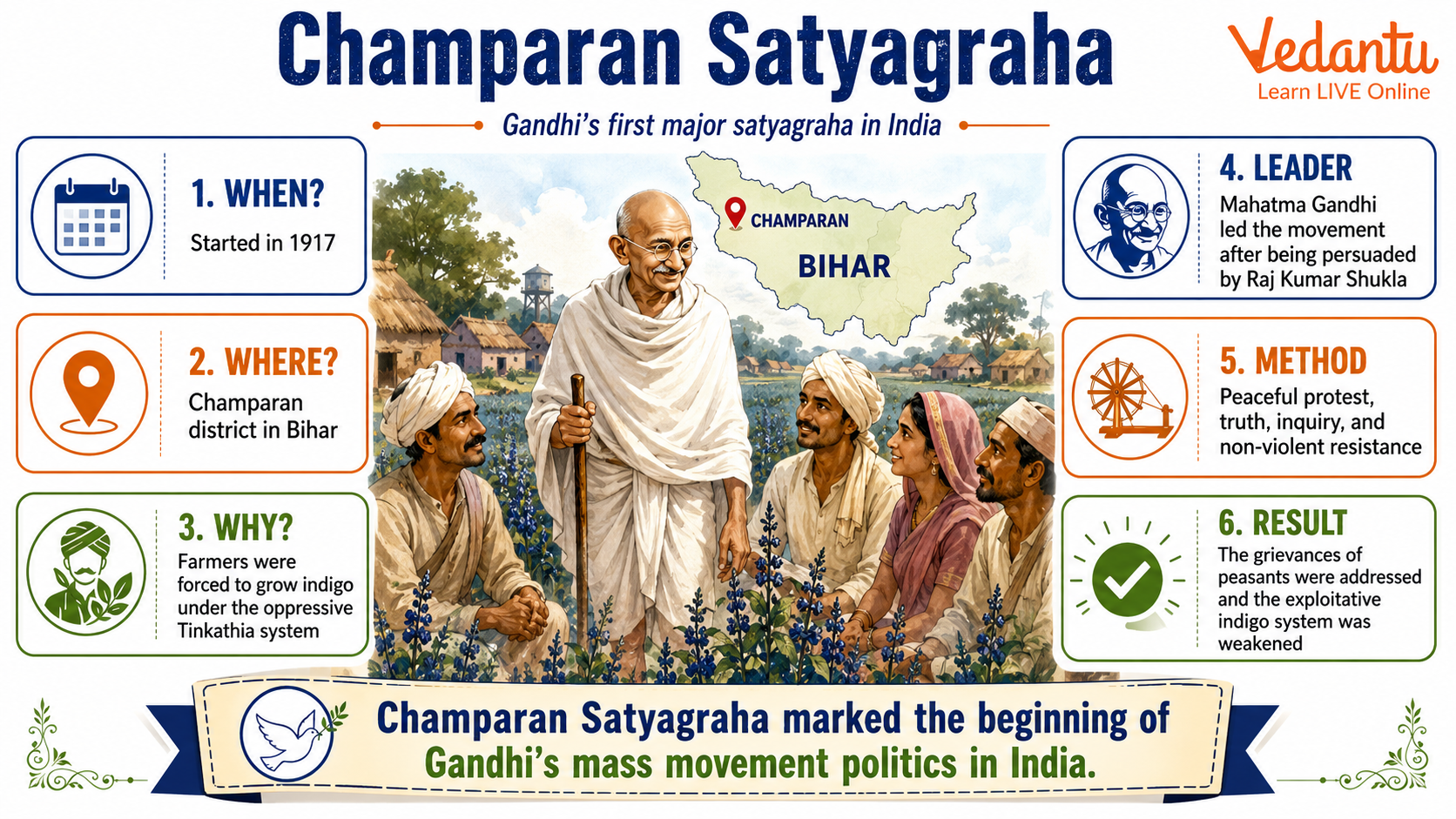
Background of Champaran Satyagraha
During the British rule, European indigo planters forced Indian farmers in Champaran to cultivate indigo on a portion of their land under the Tinkathia system. Farmers had to grow indigo on 3 out of every 20 parts of their land and sell it at very low prices. This led to poverty, exploitation, and heavy debt among peasants.
- Farmers were compelled to grow indigo instead of food crops.
- They were paid extremely low prices for indigo produce.
- Heavy taxes and illegal dues were imposed by British planters.
- Farmers suffered from poverty, famine, and exploitation.
A local farmer, Raj Kumar Shukla, approached Mahatma Gandhi and requested him to visit Champaran to address these issues. Gandhi agreed and visited Champaran in 1917.
Objectives of Champaran Satyagraha
- To end the Tinkathia system.
- To reduce exploitation of indigo farmers.
- To secure fair compensation for peasants.
- To establish justice through non-violent resistance.
Course of the Movement
When Gandhi reached Champaran, he conducted detailed investigations by meeting farmers and recording their statements. The British authorities ordered him to leave the district, but Gandhi refused and was ready to face arrest. His act of civil disobedience gained public support.
- Gandhi collected evidence of exploitation from peasants.
- He defied the official order to leave Champaran.
- Public support increased for the movement.
- The British government appointed a committee of inquiry with Gandhi as a member.
- The Tinkathia system was abolished and farmers received partial refunds.
Key Facts about Champaran Satyagraha
| Aspect | Details | Year |
|---|---|---|
| Location | Champaran, Bihar | 1917 |
| Leader | Mahatma Gandhi | 1917 |
| Main Issue | Tinkathia System | 1917 |
The movement resulted in the abolition of the Tinkathia system and marked the first major success of Gandhi’s method of Satyagraha in India.
Role of Important Leaders
- Mahatma Gandhi - Led the movement and introduced Satyagraha.
- Raj Kumar Shukla - Invited Gandhi to Champaran.
- Dr. Rajendra Prasad - Supported Gandhi and later became the first President of India.
- Brajkishore Prasad and Anugrah Narayan Sinha - Assisted in organizing the movement.
Significance of Champaran Satyagraha
The Champaran Satyagraha was a turning point in India’s freedom struggle. It demonstrated the power of non-violent resistance and boosted the confidence of Indian peasants. It also established Gandhi as a mass leader in Indian politics.
- First application of Satyagraha in India.
- Marked Gandhi’s rise as a national leader.
- Encouraged peasants to fight for their rights.
- Strengthened the foundation of the Indian National Movement.
Champaran Satyagraha and Competitive Exams
Champaran Satyagraha is an important topic for school exams and competitive examinations. Questions are frequently asked about its year, causes, leaders, objectives, and significance. Understanding this movement helps students grasp the beginning of Gandhi’s leadership in India’s freedom struggle.
- Year of movement - 1917
- System opposed - Tinkathia system
- Place - Champaran in Bihar
- Leader - Mahatma Gandhi
In conclusion, the Champaran Satyagraha was a landmark event in modern Indian history. It not only relieved the suffering of indigo farmers but also laid the foundation for future mass movements based on truth and non-violence.
FAQs on Champaran Indigo Satyagraha: Gandhi’s First Civil Disobedience in India
1. What was the Champaran Satyagraha?
Champaran Satyagraha (1917) was Mahatma Gandhi’s first successful experiment with Satyagraha (non-violent resistance) in India against British oppression.
• It took place in Champaran district, Bihar.
• Farmers were forced to grow indigo under the Tinkathia system.
• Led by Mahatma Gandhi, it marked the beginning of mass participation in the Indian National Movement.
• It is also known as the Champaran Indigo Movement (People Also Ask: What was Gandhi’s first movement in India?).
2. When and where did the Champaran Satyagraha take place?
The Champaran Satyagraha took place in 1917 in Champaran, Bihar.
• Year: 1917
• Location: Champaran district (now in Bihar)
• It was Gandhi’s first civil disobedience movement in India.
• It marked the rise of Gandhian methods of protest like non-violence and truth (People Also Search: First Satyagraha in India, Indigo Revolt Bihar).
3. What was the Tinkathia system in Champaran?
The Tinkathia system was a forced indigo cultivation system imposed by British planters.
• Farmers had to grow indigo on 3/20th (three kathas per bigha) of their land.
• They received very low compensation.
• Peasants suffered heavy losses due to falling indigo prices.
• It became the main cause of the Champaran Indigo Revolt (PAS: What was Tinkathia System?).
4. Why did Mahatma Gandhi launch the Champaran Satyagraha?
Gandhi launched the Champaran Satyagraha to protect indigo farmers from exploitation by British planters.
• Farmers were oppressed under the Tinkathia system.
• Local leader Raj Kumar Shukla requested Gandhi’s help.
• Gandhi aimed to apply his method of non-violent civil disobedience.
• It was a fight for peasants’ rights and justice in colonial India.
5. Who were the important leaders involved in the Champaran Movement?
Several national and local leaders supported Gandhi during the Champaran Movement.
• Mahatma Gandhi – Leader of the movement
• Raj Kumar Shukla – Invited Gandhi to Champaran
• Dr. Rajendra Prasad – Later first President of India
• J.B. Kripalani and Mahadev Desai – Active supporters
• Their participation strengthened the Indian freedom struggle.
6. What were the main causes of the Champaran Satyagraha?
The main cause of Champaran Satyagraha was the exploitation of indigo farmers by British planters.
• Forced indigo cultivation under Tinkathia system
• Low payments and heavy taxes
• Harsh treatment by European planters
• Economic distress of peasants in Bihar
• It became a turning point in the Indian National Movement (People Also Ask: Causes of Champaran Satyagraha).
7. What were the outcomes of the Champaran Satyagraha?
The Champaran Satyagraha ended with significant relief for the indigo farmers.
• The British government formed an inquiry committee.
• Gandhi was included as a member.
• The Tinkathia system was abolished.
• Farmers received refunds and better conditions.
• It established Gandhi as a major leader of the Indian independence movement.
8. Why is Champaran Satyagraha considered important in Indian history?
Champaran Satyagraha is important because it marked Gandhi’s first successful mass movement in India.
• Introduced Satyagraha and non-violence as political tools.
• Increased public faith in Gandhi’s leadership.
• Inspired later movements like Non-Cooperation Movement and Civil Disobedience Movement.
• Strengthened the foundation of the freedom struggle (PAS: Importance of Champaran Movement).
9. How did Champaran Satyagraha impact the Indian National Movement?
The Champaran Satyagraha gave a new direction to the Indian National Movement.
• Shifted politics from elite leaders to mass participation.
• Encouraged peasants to join the freedom movement.
• Demonstrated the power of non-violent protest.
• Marked the beginning of Gandhi’s active leadership in Indian politics.
10. Who invited Mahatma Gandhi to Champaran and why?
Raj Kumar Shukla, a local farmer leader, invited Mahatma Gandhi to Champaran to address farmers’ grievances.
• He persistently requested Gandhi to visit Bihar.
• Farmers were suffering under the indigo plantation system.
• Gandhi agreed and launched his first Indian Satyagraha movement in 1917.
• This event became a milestone in the history of Indian independence.
