






Types of Indian Certification Marks and Their Role in Quality Assurance
Certification Marks in India are official symbols issued by authorized bodies to certify that a product or service meets specific quality, safety, and performance standards. These marks help consumers identify reliable products and protect them from substandard goods. Certification marks are important from a General Knowledge perspective and are frequently asked in competitive exams such as UPSC, SSC, Banking, Railways, State PSC, and other entrance tests. Understanding these marks also helps consumers make informed purchasing decisions.
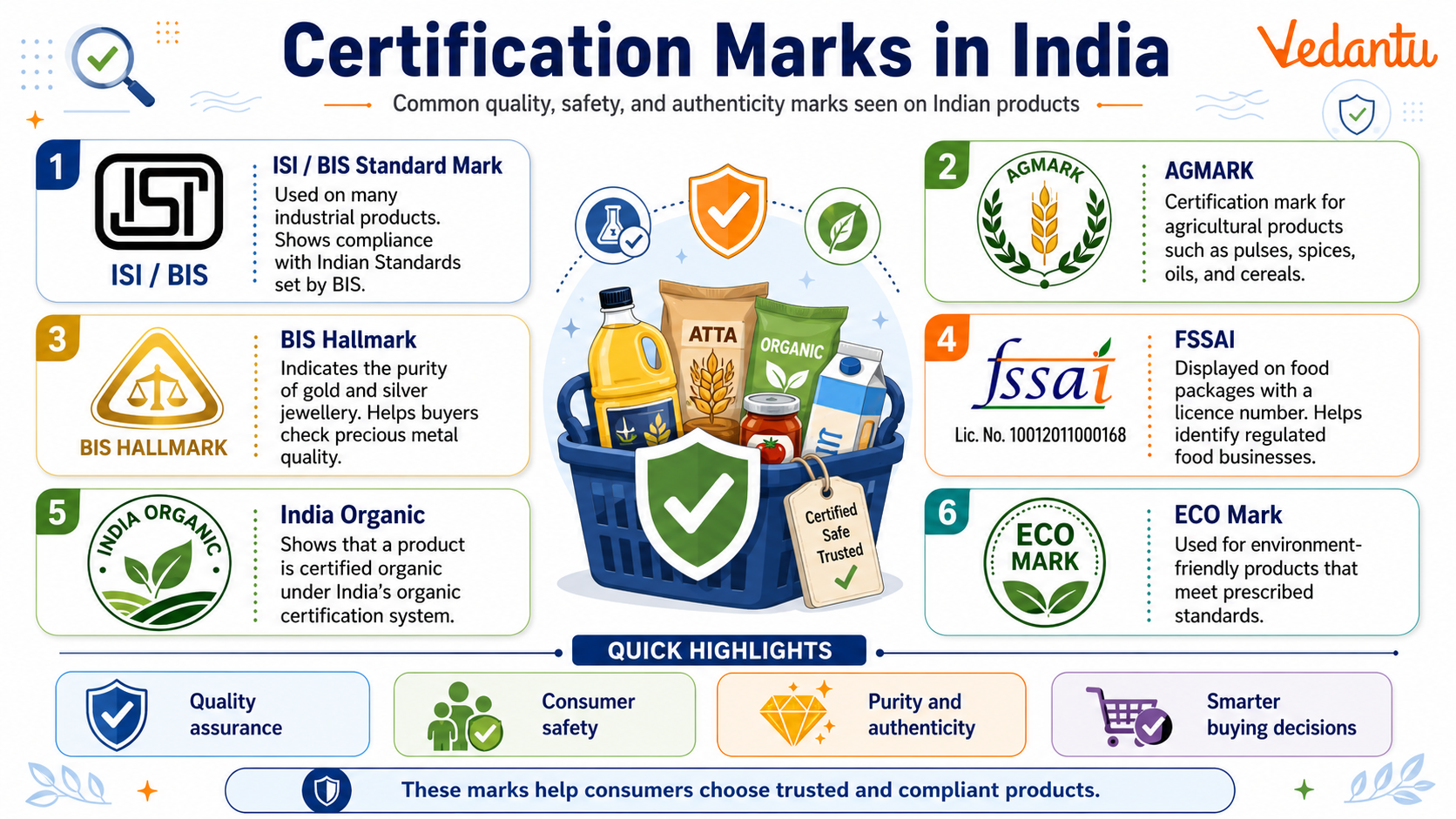
What are Certification Marks?
Certification marks are standardized symbols displayed on products to indicate that they conform to certain quality standards prescribed by government or authorized agencies. These marks are granted after proper testing and inspection. They ensure consumer safety, maintain product quality, and regulate market practices in India.
Objectives of Certification Marks in India
- To ensure quality and safety of products.
- To protect consumer interests.
- To prevent sale of substandard goods.
- To promote standardization in manufacturing.
- To enhance trust in Indian products in domestic and international markets.
Major Certification Marks in India
| Certification Mark | Issued By | Purpose |
|---|---|---|
| ISI Mark | Bureau of Indian Standards (BIS) | Certifies industrial and consumer products |
| AGMARK | Directorate of Marketing and Inspection | Certifies agricultural products |
| FSSAI Mark | Food Safety and Standards Authority of India | Ensures food safety and hygiene standards |
| Hallmark | Bureau of Indian Standards (BIS) | Certifies purity of gold and silver jewellery |
| ECO Mark | BIS and Ministry of Environment | Identifies environment friendly products |
These certification marks are widely recognized across India and are frequently asked in competitive examinations. Each mark has a specific purpose and regulatory authority.
Detailed Explanation of Important Certification Marks
ISI Mark
The ISI Mark is one of the most recognized certification marks in India. It is issued by the Bureau of Indian Standards under the BIS Act. It is mandatory for certain products such as electrical appliances, cement, packaged drinking water, and LPG cylinders. The ISI mark ensures that the product conforms to Indian safety and quality standards.
AGMARK
AGMARK is a certification mark for agricultural products such as pulses, cereals, spices, and edible oils. It is implemented under the Agricultural Produce Grading and Marking Act, 1937. AGMARK ensures quality grading and standardization of agricultural commodities.
FSSAI Certification
The FSSAI mark is issued by the Food Safety and Standards Authority of India. It ensures that food products meet safety and hygiene standards. Every packaged food product must display an FSSAI license number, which confirms regulatory compliance.
Hallmark
The Hallmark certification guarantees the purity of gold and silver jewellery. It is issued by BIS. The hallmark includes details such as BIS logo, purity in karats, and identification of the jeweller.
ECO Mark
ECO Mark is provided to products that are environmentally friendly. It promotes sustainable production and consumption. Products with ECO Mark meet environmental criteria along with quality standards.
Difference Between ISI and AGMARK
| Basis | ISI Mark | AGMARK |
|---|---|---|
| Applicable To | Industrial and consumer goods | Agricultural products |
| Issued By | BIS | Directorate of Marketing and Inspection |
| Legal Basis | BIS Act | AGMARK Act 1937 |
While ISI focuses mainly on industrial and manufactured goods, AGMARK is specific to agricultural commodities. Both ensure quality assurance but apply to different sectors.
Importance for Competitive Exams
- Frequently asked in General Awareness sections.
- Important for questions related to consumer protection and government policies.
- Helps in understanding quality control mechanisms in India.
- Relevant for civil services, SSC, banking, and state exams.
Key Points to Remember
- BIS issues ISI and Hallmark certifications.
- AGMARK applies only to agricultural products.
- FSSAI certification is mandatory for food businesses.
- ECO Mark identifies environment friendly products.
- Certification marks help maintain quality and consumer trust.
Conclusion
Certification Marks in India play a crucial role in ensuring product quality, consumer safety, and standardization across industries. These marks not only protect consumers but also strengthen the credibility of Indian products. For students preparing for competitive exams, knowledge of certification marks is essential as it forms an important part of General Knowledge. A clear understanding of issuing authorities, purposes, and differences between marks helps in answering objective as well as descriptive questions effectively.
FAQs on Certification Marks in India: Meaning, Types and Importance for Students
1. What are Certification Marks in India?
Certification Marks in India are official quality symbols issued by authorized bodies to ensure product safety and standards.
• A Certification Mark indicates that a product meets specific quality, safety, and performance standards.
• These marks are regulated by government agencies like BIS, AGMARK, FSSAI.
• They help consumers identify genuine and standardized products.
• Common examples include ISI Mark, AGMARK, Hallmark, and FPO Mark.
2. What is the ISI Mark and who issues it?
The ISI Mark is a quality certification mark issued by the Bureau of Indian Standards (BIS) for industrial and consumer products.
• ISI stands for Indian Standards Institution.
• Issued by BIS (Bureau of Indian Standards).
• Ensures products meet Indian quality and safety standards.
• Common on items like electrical appliances, cement, LPG cylinders.
3. What is AGMARK and what does it certify?
AGMARK is a certification mark for agricultural products ensuring quality and purity.
• Issued by the Directorate of Marketing and Inspection.
• Covers products like pulses, cereals, spices, edible oils.
• Ensures grading and standardization of agricultural goods.
• Important for farm produce quality assurance in India.
4. What is the Hallmark certification for gold?
Hallmark certification guarantees the purity of gold and silver jewellery in India.
• Issued by BIS (Bureau of Indian Standards).
• Indicates gold purity levels such as 22K, 18K.
• Protects consumers from adulteration and fraud.
• Includes details like BIS logo, purity grade, jeweller’s identification mark.
5. What is the FSSAI certification mark?
FSSAI certification ensures that food products meet safety and hygiene standards in India.
• Issued by the Food Safety and Standards Authority of India (FSSAI).
• Mandatory for food manufacturers and sellers.
• Ensures compliance with Food Safety and Standards Act, 2006.
• Displays a 14-digit license number on packaging.
6. What is the difference between ISI Mark and AGMARK?
The ISI Mark certifies industrial products, while AGMARK certifies agricultural products.
• ISI Mark: Issued by BIS for industrial and consumer goods.
• AGMARK: Issued by Directorate of Marketing and Inspection for farm produce.
• ISI focuses on safety and technical standards.
• AGMARK focuses on quality grading of agricultural commodities.
7. Why are certification marks important for consumers?
Certification marks protect consumers by ensuring product quality, safety, and authenticity.
• Guarantee compliance with government standards.
• Reduce risk of fake or substandard products.
• Build consumer trust and confidence.
• Helpful for competitive exams and general awareness topics.
8. What is the FPO Mark in India?
The FPO Mark certifies processed fruit products to ensure quality standards.
• FPO stands for Fruit Products Order.
• Mandatory for jam, juice, pickles, squashes.
• Ensures hygienic processing and packaging.
• Now regulated under FSSAI guidelines.
9. Which organization issues certification marks in India?
Different government bodies issue certification marks depending on the product category.
• BIS – ISI Mark and Hallmark certification.
• Directorate of Marketing and Inspection – AGMARK.
• FSSAI – Food safety certification.
• Ensures standardization, grading, and quality control across sectors.
10. Are certification marks mandatory in India?
Some certification marks are mandatory while others are voluntary depending on the product type.
• Mandatory: ISI for certain products, FSSAI for food items, Hallmark for gold jewellery.
• Voluntary: Some BIS certifications for specific goods.
• Mandatory certification ensures public safety and legal compliance.
• Important topic in GK, SSC, UPSC, and other competitive exams.
