






How Canal Irrigation in India Supports Agriculture and Farmers
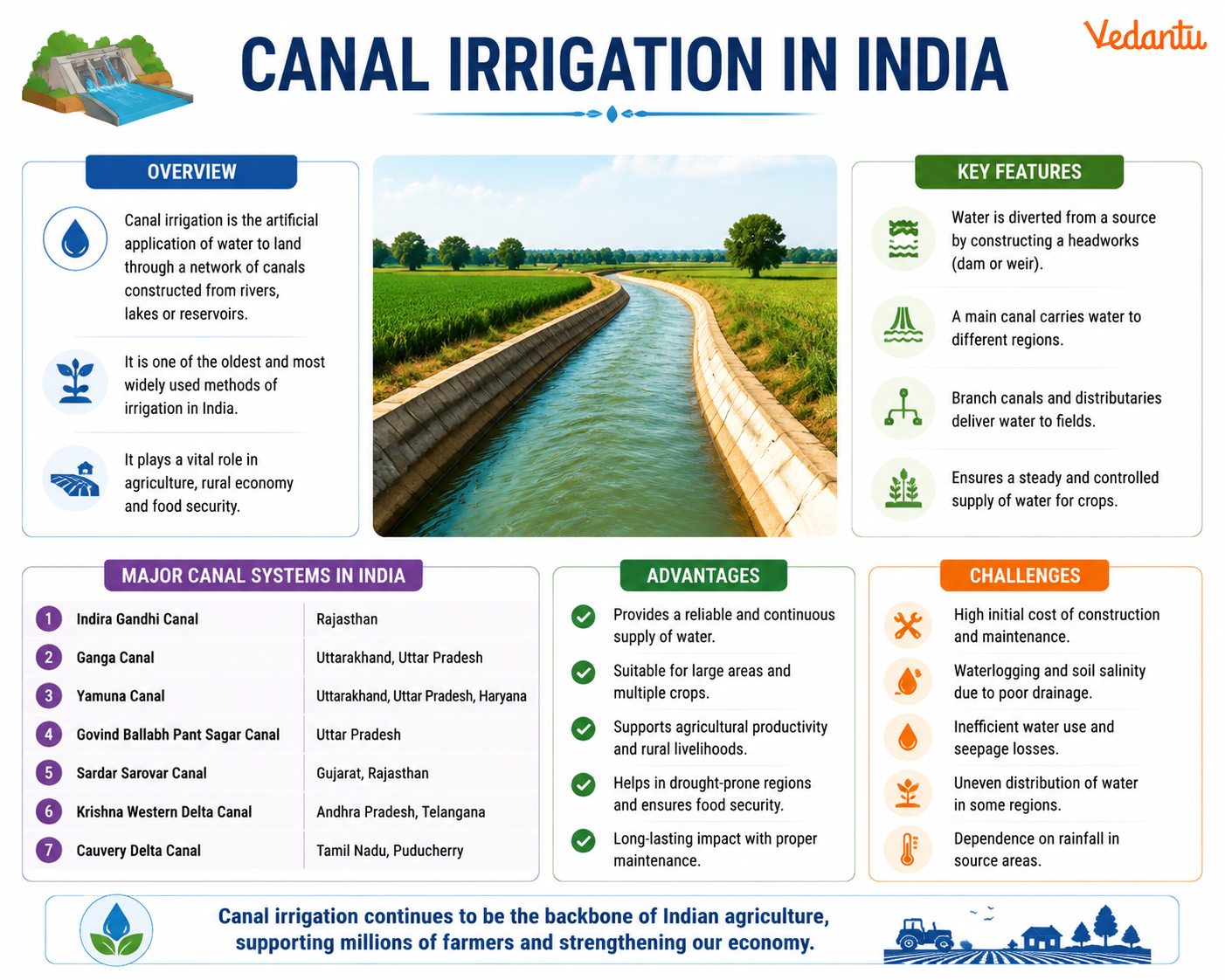
Canal irrigation in India is one of the oldest and most important methods of artificial irrigation. It involves the diversion of river water through canals to agricultural fields for crop cultivation. Given the uneven distribution of rainfall and the dominance of monsoon climate in India, canal irrigation plays a crucial role in ensuring stable agricultural production. It is widely practiced in northern plains and delta regions where perennial rivers provide a reliable source of water.
What is Canal Irrigation?
Canal irrigation is a system in which water from rivers, reservoirs, or dams is diverted through man-made channels called canals to irrigate agricultural lands. These canals distribute water across large areas, ensuring crops receive adequate moisture even during dry periods. This method is especially useful in regions with fertile alluvial soil and gentle slopes.
Types of Canal Irrigation in India
1. Perennial Canals
Perennial canals receive water throughout the year from dams or barrages constructed across rivers. These canals ensure a continuous water supply and are suitable for regions with regular agricultural activities.
2. Inundation Canals
Inundation canals depend on floodwater from rivers during the rainy season. These canals do not have permanent headworks and supply water only when river levels rise.
Types of Canals in India
| Type of Canal | Source of Water | Water Supply Period |
|---|---|---|
| Perennial Canal | Dams and Barrages | Throughout the Year |
| Inundation Canal | Flood Water from Rivers | Rainy Season Only |
Perennial canals are more reliable and widely used in modern irrigation systems, while inundation canals were more common in earlier times.
Major Canal Irrigation Regions in India
Canal irrigation is most developed in the northern plains due to flat topography and perennial rivers. The important regions include:
- Punjab and Haryana - Extensive canal networks from rivers like Sutlej and Beas
- Uttar Pradesh - Ganga Canal system
- Rajasthan - Indira Gandhi Canal
- Andhra Pradesh and Tamil Nadu - Delta regions of Krishna and Godavari rivers
Advantages of Canal Irrigation
Canal irrigation has significantly contributed to agricultural development in India. Its major advantages include:
- Assured water supply throughout the year in perennial canal systems
- Increases agricultural productivity and enables multiple cropping
- Helps in irrigation of large areas at a lower cost per hectare
- Reduces dependence on monsoon rainfall
- Promotes rural development and food security
Disadvantages of Canal Irrigation
Despite its benefits, canal irrigation also has certain limitations and challenges:
- Waterlogging and soil salinity in poorly drained areas
- High initial construction and maintenance costs
- Unequal distribution of water in tail-end areas
- Seepage losses in unlined canals
Important Canal Projects in India
Major Canal Projects
| Canal Project | River | State |
|---|---|---|
| Indira Gandhi Canal | Sutlej and Beas | Rajasthan |
| Upper Ganga Canal | Ganga | Uttar Pradesh |
These projects have transformed arid and semi-arid regions into productive agricultural lands and contributed significantly to the Green Revolution in India.
Role of Canal Irrigation in Indian Agriculture
Canal irrigation supports the cultivation of major crops such as wheat, rice, sugarcane, and cotton. It is particularly important in states that form the food grain basket of India. By ensuring timely water supply, canal systems enhance crop yield, stabilize farm income, and support national food security. It also enables farmers to adopt modern agricultural practices and high-yielding varieties.
Conclusion
Canal irrigation in India remains a vital component of the agricultural infrastructure. With extensive canal networks in the northern plains and delta regions, it has played a key role in increasing agricultural productivity and supporting rural livelihoods. While challenges such as waterlogging and maintenance exist, proper management and modernization can enhance its efficiency. Understanding canal irrigation is essential for students and competitive exam aspirants as it is an important topic in Indian geography and general knowledge.
FAQs on Canal Irrigation in India – Meaning, Types and Importance
1. What is canal irrigation in India?
Canal irrigation in India is a method of supplying water to agricultural fields through man-made channels constructed from rivers or reservoirs.
• It involves diverting water from rivers, dams, or barrages into canals.
• It is widely used in the Northern Plains where river water is abundant.
• It supports the cultivation of crops like rice, wheat, sugarcane, and cotton.
This system is an important source of irrigation in India and plays a key role in agricultural productivity.
2. What are the types of canal irrigation?
Canal irrigation is mainly classified into two types based on the availability of water.
• Perennial Canals – Receive water from rivers throughout the year (e.g., canals from dams and barrages).
• Inundation Canals – Depend on floodwater during the rainy season.
Perennial canals are more reliable, while inundation canals are seasonal and depend on monsoon flow.
3. Which states in India use canal irrigation the most?
Punjab, Haryana, Uttar Pradesh, Rajasthan, and Bihar are the leading states in canal irrigation in India.
• The Indira Gandhi Canal in Rajasthan is one of the largest irrigation projects.
• The fertile Indo-Gangetic Plains benefit greatly from canal networks.
• These states grow major food grains due to reliable irrigation facilities.
Canal irrigation is especially important in regions with flat terrain and perennial rivers.
4. What are the advantages of canal irrigation?
Canal irrigation offers reliable and large-scale water supply for agriculture.
• Ensures regular water supply throughout the year.
• Increases crop yield and agricultural productivity.
• Helps in irrigation of large and dry areas.
• Reduces dependence on rainfall and monsoon.
It plays a significant role in India’s Green Revolution and food security.
5. What are the disadvantages of canal irrigation?
Despite its benefits, canal irrigation has several drawbacks.
• Waterlogging and soil salinity problems.
• High construction and maintenance costs.
• Unequal distribution of water in tail-end areas.
• Risk of canal breaches and flooding.
Proper management is essential to reduce environmental and economic issues.
6. What is the difference between canal irrigation and well irrigation?
Canal irrigation and well irrigation differ in source and scale of water supply.
• Canal Irrigation – Uses river or dam water; suitable for large areas.
• Well Irrigation – Uses groundwater; suitable for small farms.
• Canal irrigation is government-managed, while wells are often privately owned.
Both systems are important sources of irrigation in Indian agriculture.
7. What is the Indira Gandhi Canal Project?
The Indira Gandhi Canal Project is one of the largest canal irrigation projects in India.
• Located in Rajasthan.
• Draws water from the Sutlej and Beas Rivers.
• Transformed the Thar Desert into cultivable land.
It is a major example of large-scale irrigation development in India.
8. Why is canal irrigation more common in Northern India?
Canal irrigation is more common in Northern India due to favorable geographical conditions.
• Presence of perennial rivers like the Ganga, Yamuna, and Sutlej.
• Flat and fertile alluvial plains.
• Suitable slope for canal construction.
These natural advantages make canal irrigation highly effective in the northern plains.
9. How does canal irrigation support Indian agriculture?
Canal irrigation supports Indian agriculture by ensuring stable and adequate water supply.
• Enables multiple cropping seasons.
• Supports cultivation of water-intensive crops like rice and sugarcane.
• Reduces drought risk and crop failure.
• Contributes to food security and rural development.
It is a backbone of irrigated farming systems in India.
10. What are perennial canals in India?
Perennial canals are canals that receive water throughout the year from permanent river sources.
• Constructed with the help of dams and barrages.
• Provide controlled and regulated water flow.
• Example: Canals from the Bhakra-Nangal Project.
They are more reliable than inundation canals and form a major part of modern irrigation systems in India.
