






How Does an Aircraft Black Box Record and Store Data?
A Black Box is a crucial safety device installed in aircraft to record flight data and cockpit conversations. Despite its name, the black box is actually bright orange to make it easier to find after an accident. It plays a vital role in investigating air crashes and improving aviation safety. Understanding how a black box works helps students and competitive exam aspirants grasp important concepts related to aviation technology, physics, and data recording systems.
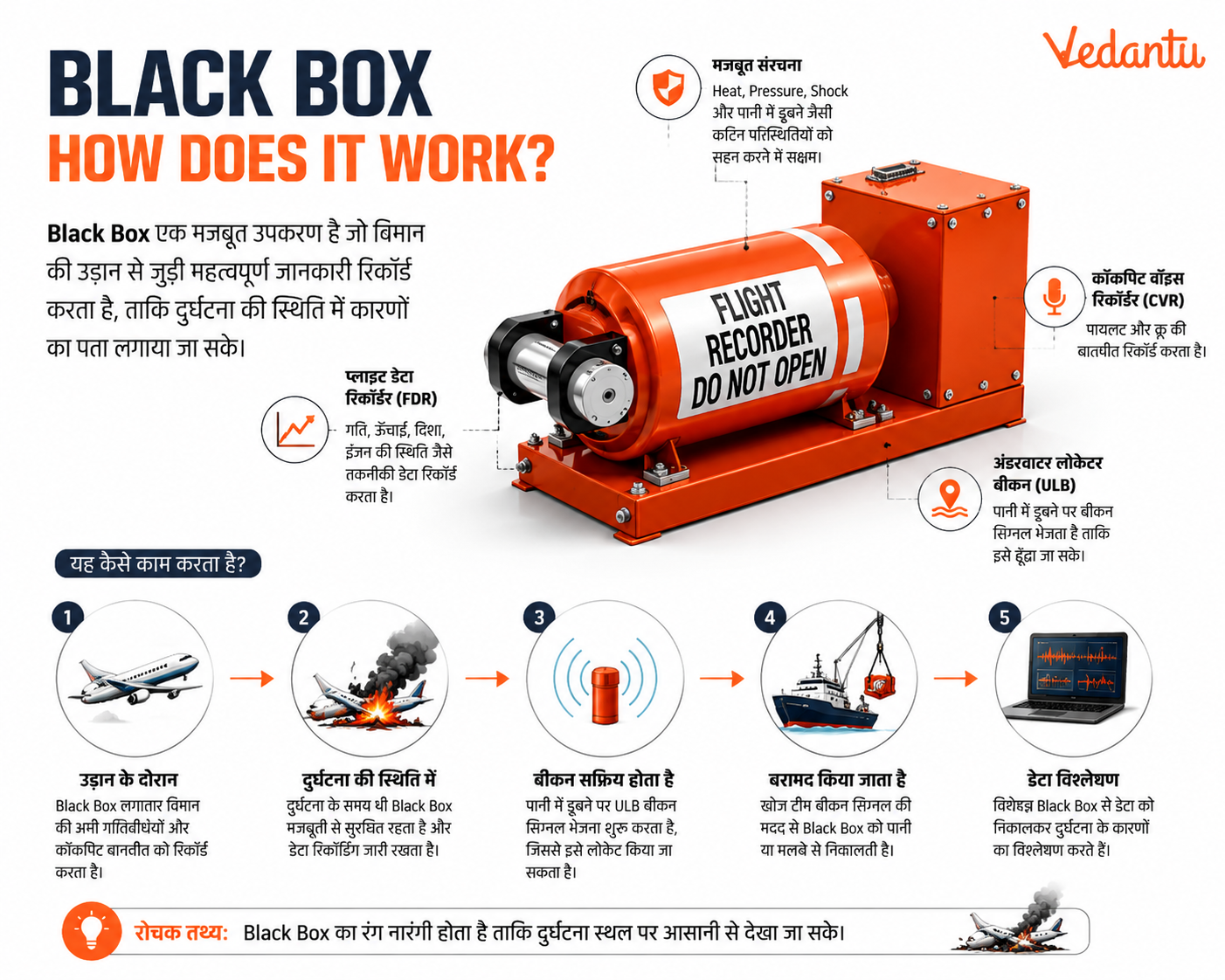
What Is a Black Box?
A black box is a flight recording device used in airplanes to collect and store important information about the aircraft’s performance and pilot communication. It helps investigators determine the cause of an accident or technical failure. Modern aircraft are equipped with two main recording systems that together are commonly referred to as the black box.
- Flight Data Recorder - FDR
- Cockpit Voice Recorder - CVR
Main Components of a Black Box
1. Flight Data Recorder - FDR
The Flight Data Recorder records technical flight parameters. It continuously collects data from various sensors installed in the aircraft.
- Altitude
- Airspeed
- Engine performance
- Direction and heading
- Control surface movements
Modern FDR systems can record hundreds to thousands of parameters every second, storing data for at least 25 hours of flight time.
2. Cockpit Voice Recorder - CVR
The Cockpit Voice Recorder captures audio inside the cockpit. It records conversations between pilots, communication with air traffic control, and background sounds such as engine noise or warning alarms.
The CVR typically stores the last 2 hours of audio recordings. These recordings help investigators understand the sequence of events before an incident.
How Does a Black Box Work?
The black box works by continuously collecting data from aircraft sensors and cockpit microphones. The process involves recording, storing, and protecting critical information.
- Sensors placed throughout the aircraft send signals to the FDR.
- Microphones inside the cockpit record audio for the CVR.
- Data is converted into digital format.
- Information is stored in highly durable memory units.
- The device is built to survive extreme conditions such as fire, impact, and deep-sea pressure.
Why Is the Black Box Orange?
Although called a black box, the device is painted bright orange. This high-visibility color makes it easier for rescue teams to locate it among debris after a crash. It also contains a locator beacon that emits ultrasonic signals underwater for up to 30 days.
Construction and Safety Features
Black boxes are designed to withstand extreme conditions. They are built using strong materials such as titanium or stainless steel and are heavily insulated.
- Impact resistance up to very high forces
- Fire resistance up to about 1100 degrees Celsius for a limited time
- Water pressure resistance for deep-sea crashes
- Underwater locator beacon for tracking
Black Box Components Overview
| Component | Function | Recording Duration |
|---|---|---|
| Flight Data Recorder | Records flight parameters and technical data | Minimum 25 hours |
| Cockpit Voice Recorder | Records cockpit audio and communication | About 2 hours |
Together, these two components provide a complete picture of the aircraft’s performance and the crew’s actions before an incident.
Importance of the Black Box
The black box is essential for aviation safety. It helps investigators identify the root cause of accidents and recommend improvements in aircraft design, pilot training, and safety protocols.
- Accident investigation
- Improving flight safety standards
- Preventing future crashes
- Supporting aviation research
Key Points for Competitive Exams
Students preparing for competitive exams such as NEET and other GK based tests should remember the following facts:
- Black box includes FDR and CVR.
- It is painted orange for visibility.
- It can survive extreme heat, pressure, and impact.
- It helps determine the cause of air accidents.
Conclusion
The black box is one of the most important safety devices in aviation. By recording flight data and cockpit conversations, it helps investigators understand accidents and improve air travel safety. Its durable design, advanced recording technology, and critical role in aviation investigations make it a significant topic in General Knowledge. Understanding how a black box works not only enhances technical awareness but also supports preparation for competitive examinations.
FAQs on Black Box Explained: How It Records Flight Data
1. What is a Black Box and how does it work?
A Black Box is a flight recording device that stores crucial flight data and cockpit conversations to investigate aircraft accidents.
- It consists of two main parts: Flight Data Recorder (FDR) and Cockpit Voice Recorder (CVR).
- The FDR records speed, altitude, engine performance, and flight controls.
- The CVR records pilot conversations and cockpit sounds.
- It is designed to survive crashes, fire, and deep-sea pressure.
- Commonly searched as: aircraft black box, flight recorder, airplane crash investigation device.
2. Why is it called a Black Box?
The term Black Box refers to a device whose internal workings are not visible to users, though it is actually bright orange in color.
- The name comes from engineering terminology meaning a closed system.
- It is painted bright orange for easy recovery after crashes.
- Also known as: flight recorder, aviation data recorder.
- Frequently asked: Why is the black box orange?
3. What information is recorded in a flight Black Box?
A flight Black Box records technical flight data and cockpit audio for accident analysis.
- Records altitude, airspeed, heading, and engine status.
- Captures pilot communication and warning alarms.
- Stores data for at least 25 hours (FDR) and 2 hours (CVR).
- Helps aviation authorities determine causes of crashes.
- Related searches: flight data recording system, cockpit voice recording.
4. Where is the Black Box located in an aircraft?
The Black Box is usually installed in the tail section of an aircraft for maximum protection.
- The rear part suffers less damage during crashes.
- It is securely attached to withstand high impact.
- Equipped with an Underwater Locator Beacon (ULB) for detection in oceans.
- People also ask: Why is the black box kept at the back?
5. Who invented the Black Box flight recorder?
The Black Box flight recorder was invented by Australian scientist Dr. David Warren in 1953.
- He developed it after investigating early jet crashes.
- Officially adopted by airlines in the 1960s.
- His invention improved aviation safety worldwide.
- Also searched as: inventor of flight data recorder, history of black box.
6. How does the Black Box survive plane crashes?
The Black Box survives crashes because it is built with highly durable and heat-resistant materials.
- Made with titanium or stainless steel casing.
- Can withstand temperatures up to 1,100°C.
- Survives deep-sea pressure and heavy impact.
- Includes shock absorbers and insulation layers.
- Related query: How strong is a black box?
7. What is the difference between FDR and CVR?
The Flight Data Recorder (FDR) records technical flight data, while the Cockpit Voice Recorder (CVR) records audio from the cockpit.
- FDR tracks altitude, speed, and engine performance.
- CVR captures pilot conversations and background sounds.
- Both devices together form the aircraft’s Black Box.
- Common comparison search: FDR vs CVR difference.
8. How long does a Black Box record data?
A modern Black Box records flight data for about 25 hours and cockpit audio for about 2 hours.
- FDR continuously records recent 25 hours of flight data.
- CVR stores last 2 hours of cockpit conversations.
- Old data gets overwritten automatically.
- People also search: black box recording duration.
9. Can a Black Box transmit data in real time?
Traditional Black Boxes do not transmit data in real time but store it internally for later recovery.
- Data is retrieved after locating the device.
- Some modern aircraft use satellite-based tracking systems.
- Real-time streaming is still limited due to high costs.
- Related topic: aircraft real-time flight monitoring.
10. Why is the Black Box important for aviation safety?
The Black Box is essential for improving aviation safety by helping investigators identify the exact cause of accidents.
- Provides accurate technical and voice evidence.
- Helps aviation authorities like NTSB and AAIB.
- Leads to safety improvements and new regulations.
- Frequently asked: importance of flight recorder in crash investigation.
