






Basic Structure of the Indian Army Hierarchy and Command System Explained
The Basic Structure and Commands of the Indian Army form an essential part of General Knowledge, especially for students preparing for competitive exams such as NDA, CDS, AFCAT, CAPF, and other defence-related examinations. The Indian Army is one of the largest and most disciplined land forces in the world. Understanding its organizational hierarchy, command system, and operational structure helps aspirants gain clarity about how the army functions to safeguard the nation. This article provides a detailed overview of the structure, commands, ranks, and operational framework of the Indian Army in a clear and exam-oriented format.
Overview of the Indian Army
The Indian Army is the land-based branch of the Indian Armed Forces. It is responsible for defending the territorial integrity of India, maintaining peace and security within the country, and providing humanitarian assistance during natural disasters. The President of India is the Supreme Commander of the Indian Armed Forces, while the Chief of the Army Staff leads the Indian Army.
- Founded - 1 April 1895 in its modern form
- Headquarters - New Delhi
- Motto - Service Before Self
- Supreme Commander - President of India
- Professional Head - Chief of the Army Staff
Basic Organizational Structure of the Indian Army
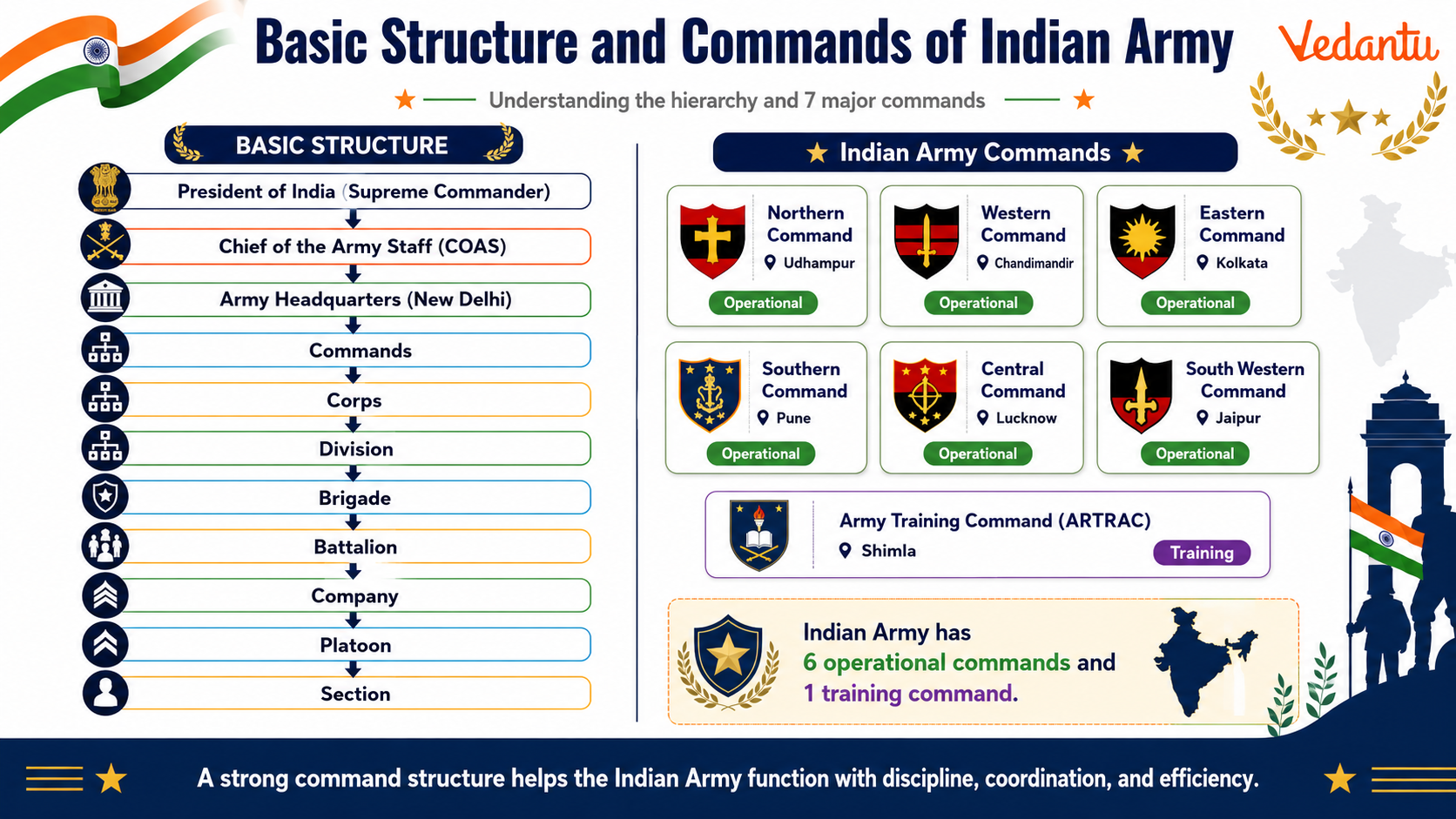
The Indian Army follows a well-defined hierarchical structure to ensure smooth functioning and effective command and control. The structure is divided into operational formations and administrative units.
1. Army Headquarters
The Army Headquarters is located in New Delhi and functions under the Chief of the Army Staff. It is responsible for policy-making, planning, training, and administration of the entire army.
2. Commands
The Indian Army is divided into geographical and functional commands. Each command is headed by a General Officer Commanding-in-Chief with the rank of Lieutenant General.
Commands of the Indian Army
| Command | Headquarters | Type |
|---|---|---|
| Northern Command | Udhampur | Operational |
| Western Command | Chandimandir | Operational |
| Eastern Command | Kolkata | Operational |
| Southern Command | Pune | Operational |
| Central Command | Lucknow | Operational |
| South Western Command | Jaipur | Operational |
| Army Training Command | Shimla | Functional |
There are six operational commands and one functional command. Operational commands are responsible for specific geographical areas, while the Army Training Command manages training policies and institutions.
Field Formation Structure
Below the command level, the Indian Army is structured into several field formations for operational efficiency.
- Corps - Headed by a Lieutenant General
- Division - Headed by a Major General
- Brigade - Headed by a Brigadier
- Battalion - Headed by a Colonel
- Company - Headed by a Major or Captain
- Platoon - Headed by a Lieutenant
- Section - Headed by a Junior Commissioned Officer or Non-Commissioned Officer
This hierarchical system ensures effective communication, discipline, and operational readiness during both war and peace time operations.
Rank Structure of the Indian Army
The rank system of the Indian Army is divided into Commissioned Officers, Junior Commissioned Officers, and Other Ranks.
Commissioned Officer Ranks
- Field Marshal
- General
- Lieutenant General
- Major General
- Brigadier
- Colonel
- Lieutenant Colonel
- Major
- Captain
- Lieutenant
Junior Commissioned Officers and Other Ranks
- Subedar Major
- Subedar
- Naib Subedar
- Havildar
- Naik
- Lance Naik
- Sepoy
Importance of Understanding the Basic Structure
Knowledge of the Indian Army's structure and commands is important for competitive exams and interviews. Questions are frequently asked about the number of commands, headquarters, rank hierarchy, and leadership positions. It also helps candidates understand how national defence operations are organized and managed efficiently.
- Helps in defence exam preparation
- Improves understanding of national security structure
- Strengthens General Knowledge section
- Useful for interviews and group discussions
Conclusion
The Basic Structure and Commands of the Indian Army reflect a highly organized and disciplined system designed to protect the sovereignty and integrity of India. From Army Headquarters to field formations like corps and battalions, every level has clearly defined roles and responsibilities. Understanding this structure not only enhances General Knowledge but also builds awareness about how one of the world's largest armies operates effectively in both peace and war conditions.
FAQs on Basic Structure and Commands of the Indian Army: Clear Student Notes
1. What is the basic structure of the Indian Army?
The basic structure of the Indian Army is organized into commands, corps, divisions, brigades, and battalions for efficient defense management.
• The Indian Army is headed by the Chief of Army Staff (COAS).
• It is divided into 7 operational commands and 1 training command.
• Each command is led by a General Officer Commanding-in-Chief (GOC-in-C).
• Below commands are Corps → Divisions → Brigades → Battalions.
This hierarchical military structure ensures national security, border protection, and operational readiness.
2. How many commands are there in the Indian Army?
The Indian Army currently has 7 operational commands and 1 training command to manage different regions of India.
• Northern Command – Udhampur
• Western Command – Chandimandir
• Eastern Command – Kolkata
• Southern Command – Pune
• Central Command – Lucknow
• South Western Command – Jaipur
• Army Training Command (ARTRAC) – Shimla
Each command plays a vital role in defense operations, military strategy, and border security.
3. Who is the head of the Indian Army?
The head of the Indian Army is the Chief of Army Staff (COAS), a four-star General.
• Appointed by the President of India.
• Responsible for operational control and administration.
• Works under the Ministry of Defence.
• Advises the government on military matters and national security.
The COAS plays a crucial role in strategic planning, command structure, and defense policy.
4. What are the main operational commands of the Indian Army?
The operational commands of the Indian Army manage defense activities in different geographical regions.
• Northern Command – Handles Jammu & Kashmir and border areas.
• Western Command – Guards Punjab and western borders.
• Eastern Command – Oversees northeastern states.
• Southern Command – Covers southern India.
• Central Command – Strategic reserve and central region.
• South Western Command – Rajasthan sector.
These commands ensure regional military preparedness and national defense coordination.
5. What is the role of a Corps in the Indian Army?
A Corps is a major field formation in the Indian Army responsible for large-scale military operations.
• Commanded by a Lieutenant General.
• Consists of 2–3 Divisions.
• Handles offensive and defensive operations.
• Operates under a specific Army Command.
The Corps structure strengthens battlefield coordination, strategic planning, and combat readiness.
6. What is the difference between a Division, Brigade, and Battalion?
Division, Brigade, and Battalion are hierarchical military units in the Indian Army.
• Division: Commanded by a Major General; includes 3–4 Brigades.
• Brigade: Commanded by a Brigadier; includes 3–4 Battalions.
• Battalion: Commanded by a Colonel; basic fighting unit with around 600–900 soldiers.
This layered structure ensures effective troop management and battlefield efficiency.
7. What are the main arms and services of the Indian Army?
The Indian Army consists of Arms and Services that support combat and logistics operations.
• Infantry – Main fighting force.
• Armoured Corps – Tank regiments.
• Artillery – Heavy guns and missile systems.
• Engineers – Combat engineering support.
• Army Service Corps (ASC) – Supplies and logistics.
• Army Medical Corps (AMC) – Medical services.
These divisions ensure operational efficiency, combat support, and military sustainability.
8. What is the role of the Army Training Command (ARTRAC)?
The Army Training Command (ARTRAC) is responsible for training and doctrinal development in the Indian Army.
• Established in 1991.
• Headquarters at Shimla.
• Develops military training policies and strategies.
• Oversees modernization and professional education.
ARTRAC strengthens skill development, leadership training, and future warfare preparedness.
9. What is the chain of command in the Indian Army?
The chain of command in the Indian Army ensures clear authority and disciplined operations.
• President of India – Supreme Commander.
• Chief of Defence Staff (CDS) – Military coordination.
• Chief of Army Staff (COAS) – Head of Army.
• Army Commanders – Regional heads.
• Corps → Division → Brigade → Battalion Commanders.
This structured leadership maintains discipline, accountability, and operational efficiency.
10. Why is understanding the structure of the Indian Army important for competitive exams?
The structure of the Indian Army is an important topic for GK, UPSC, NDA, CDS, and SSC exams.
• Frequently asked in General Knowledge and Defence Studies sections.
• Helps in understanding national security and military organization.
• Relevant for interviews and personality tests.
• Supports preparation for defence-related careers.
Knowledge of Indian Army commands, ranks, and structure improves exam performance and awareness of India’s defense system.
