






When and How President’s Rule Is Imposed Under Article 356 in India
Article 356 of the Indian Constitution deals with the imposition of President’s Rule in a state. It empowers the President of India to take over the governance of a state if the constitutional machinery in that state fails. This provision plays a crucial role in maintaining the unity and integrity of the nation, but it has also been one of the most debated articles due to its misuse in the past. Article 356 is an important topic for students, competitive exam aspirants, and anyone studying Indian Polity.
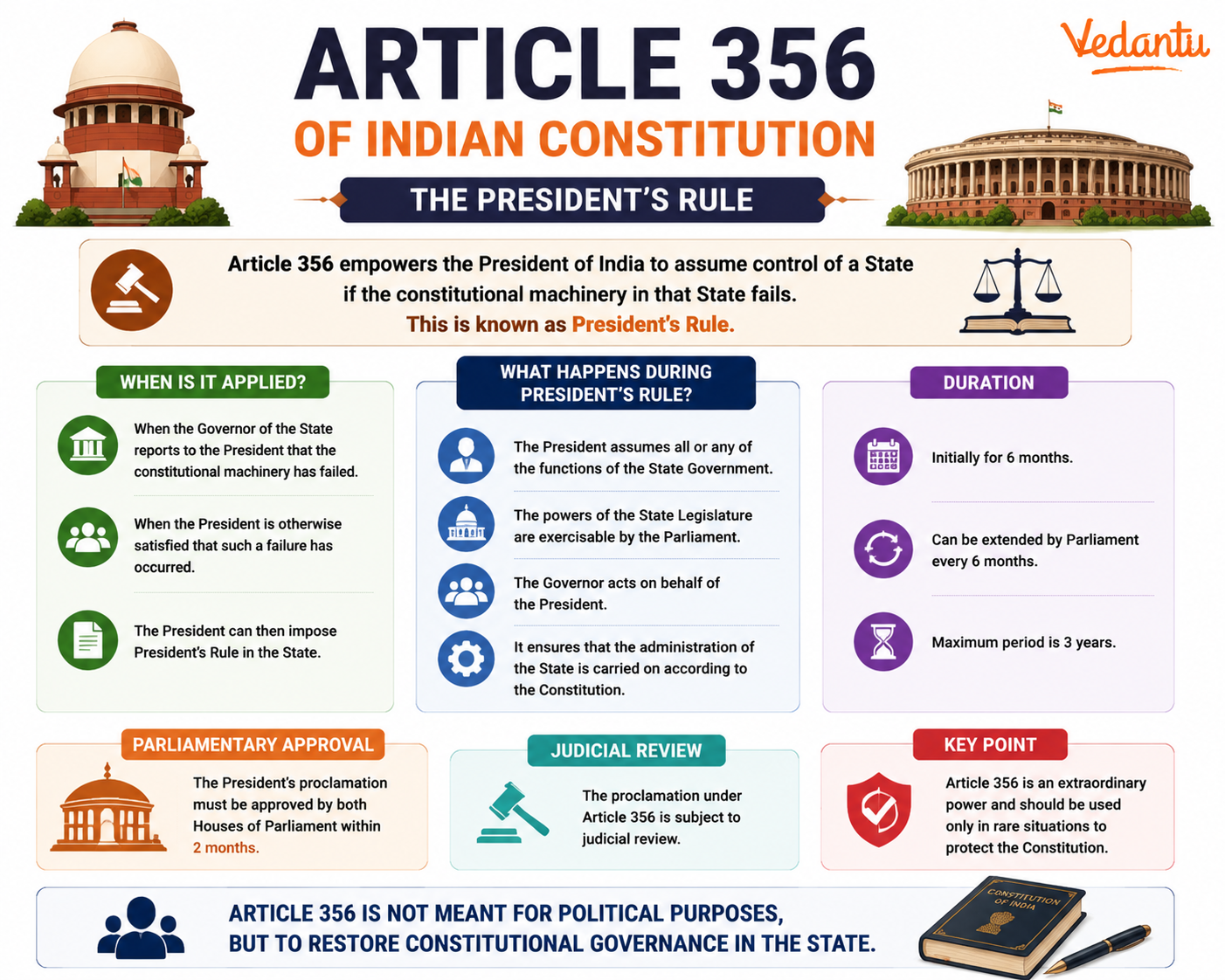
What is Article 356?
Article 356 is included in Part XVIII of the Indian Constitution, which deals with Emergency Provisions. It allows the President to assume control of a state’s administration if he or she is satisfied that the government of the state cannot be carried on in accordance with the provisions of the Constitution.
This situation is popularly known as President’s Rule or State Emergency. The President acts on the advice of the Union Council of Ministers, usually based on a report submitted by the Governor of the concerned state.
Constitutional Provisions Related to Article 356
- Article 355 - Duty of the Union to protect states against external aggression and internal disturbance.
- Article 356 - Imposition of President’s Rule in case of failure of constitutional machinery in a state.
- Article 365 - If a state fails to comply with directions of the Union, it may be considered that constitutional machinery has failed.
Grounds for Imposition of President’s Rule
The Constitution does not clearly define the exact situations that constitute failure of constitutional machinery. However, some common grounds include:
- Hung assembly where no party is able to form a stable government.
- Breakdown of law and order in the state.
- Loss of majority by the ruling party and inability to prove majority in the assembly.
- Failure to comply with constitutional provisions or Union directions.
Procedure for Imposition of President’s Rule
- The Governor submits a report to the President stating that the state government cannot function constitutionally.
- The President issues a proclamation under Article 356.
- The proclamation must be approved by both Houses of Parliament within two months.
- If approved, it remains in force for six months and can be extended up to a maximum of three years with parliamentary approval.
Effects of President’s Rule
- The President assumes all executive powers of the state government.
- The state legislature may be dissolved or kept under suspension.
- Parliament assumes the power to make laws for the state.
- The Governor administers the state on behalf of the President.
Key Features of Article 356
| Feature | Description | Duration |
|---|---|---|
| Imposition Authority | President of India | On advice of Union Council |
| Approval | Both Houses of Parliament | Within 2 months |
| Maximum Period | Up to 3 years | With conditions |
The extension beyond one year requires a national emergency to be in operation or certification by the Election Commission that elections cannot be conducted in the state.
Misuse and Criticism of Article 356
Article 356 has been criticized for being misused by the central government to dismiss opposition ruled state governments. In the past, it was invoked several times for political reasons rather than genuine constitutional breakdown.
Due to such misuse, the Supreme Court has laid down strict guidelines to prevent arbitrary use of this provision.
S.R. Bommai Case 1994
The S.R. Bommai vs Union of India case is a landmark judgment regarding Article 356. The Supreme Court held that:
- The imposition of President’s Rule is subject to judicial review.
- The majority of a government should be tested on the floor of the House.
- The power under Article 356 cannot be used for political purposes.
Importance of Article 356
Article 356 is essential to safeguard the Constitution and maintain federal balance. It ensures that governance in a state continues according to constitutional principles. At the same time, judicial safeguards have strengthened Indian federalism by limiting its misuse.
Understanding Article 356 is important for exams like UPSC, SSC, State PSC, and other competitive examinations. It forms a key part of Indian Polity and helps students grasp the working of emergency provisions in India.
Conclusion
Article 356 of the Indian Constitution provides for President’s Rule in a state when constitutional machinery fails. While it is a powerful tool to ensure constitutional governance, its misuse in the past has led to judicial safeguards and stricter interpretation. Today, it remains a significant but carefully monitored provision within India’s federal framework.
FAQs on Article 356 of the Indian Constitution: Meaning, Process and Impact
1. What is Article 356 of the Indian Constitution?
Article 356 of the Indian Constitution allows the imposition of President’s Rule in a state when its constitutional machinery fails. It empowers the President of India to take over the state’s governance if:
• The state government cannot function according to constitutional provisions.
• There is a breakdown of law and order.
• The Governor submits a report recommending central intervention.
This provision is commonly referred to as State Emergency or Constitutional Emergency, a key topic in Indian Polity and UPSC exams.
2. When can President’s Rule be imposed under Article 356?
President’s Rule can be imposed when there is a failure of constitutional machinery in a state. It may occur in situations such as:
• No political party securing a majority in the Legislative Assembly.
• Collapse of a coalition government.
• Breakdown of law and order.
• Loss of majority and refusal to resign.
The President acts based on the Governor’s report or other credible information under Article 356.
3. What happens during President’s Rule in a state?
During President’s Rule, the state government is suspended and the Centre takes control of administration. The following changes occur:
• The Chief Minister and Council of Ministers are dismissed.
• The State Legislative Assembly may be dissolved or kept under suspension.
• The Governor administers the state on behalf of the President.
This shifts executive powers to the Central Government temporarily.
4. How long can President’s Rule continue in a state?
President’s Rule can initially last for six months and may be extended with parliamentary approval. Key points include:
• It must be approved by both Houses of Parliament within two months.
• It can be extended every six months.
• The maximum duration is three years, with certain constitutional conditions under the 44th Amendment Act, 1978.
This ensures checks and balances in Indian federalism.
5. What is the role of the Governor in Article 356?
The Governor plays a crucial role by sending a report to the President recommending President’s Rule. The Governor:
• Assesses whether the state government has lost majority.
• Reports breakdown of constitutional governance.
• Acts as a constitutional head of the state.
However, misuse of this discretionary power has been debated in Indian politics.
6. Which landmark case is associated with Article 356?
The S.R. Bommai v. Union of India (1994) case is the most important judgment related to Article 356. The Supreme Court ruled that:
• The imposition of President’s Rule is subject to judicial review.
• Majority must be tested on the floor of the House.
• Arbitrary dismissal of state governments is unconstitutional.
This judgment strengthened Indian democracy and federal structure.
7. How is Article 356 different from National Emergency?
Article 356 (State Emergency) differs from Article 352 (National Emergency) in scope and impact. Key differences include:
• Article 356 applies to a specific state, while Article 352 applies to the entire country.
• Article 356 deals with constitutional breakdown; Article 352 deals with war, external aggression, or armed rebellion.
• Fundamental Rights are not automatically suspended under Article 356.
Understanding this distinction is vital for Indian Polity exams.
8. Has Article 356 been misused in India?
Article 356 has been criticized for alleged misuse for political reasons. In the past:
• It was imposed multiple times to dismiss opposition-led state governments.
• Political instability often led to central intervention.
• The S.R. Bommai judgment reduced arbitrary use.
Today, judicial safeguards limit misuse of President’s Rule.
9. How many times has President’s Rule been imposed in India?
President’s Rule has been imposed over 100 times since 1950 in various Indian states. Key facts include:
• States like Uttar Pradesh, Bihar, and Punjab have seen multiple instances.
• It was more frequent during the 1970s–1990s.
• Usage has declined after Supreme Court interventions.
This reflects evolving federal relations in India.
10. Why is Article 356 important in Indian Polity?
Article 356 is important because it safeguards constitutional governance in states while balancing federalism. Its significance includes:
• Ensuring states follow constitutional provisions.
• Allowing central intervention during political crises.
• Maintaining unity and integrity of India.
It remains a crucial topic for UPSC, SSC, and State PSC examinations and general knowledge studies.
