






Key Features, Route Map and Benefits of the Delhi-Mumbai Corridor
The Delhi Mumbai Expressway is one of the most ambitious infrastructure projects in India. It is a high-speed, access-controlled expressway designed to connect the national capital, Delhi, with the financial capital, Mumbai. The project aims to reduce travel time, boost economic growth, improve connectivity between major cities, and enhance logistics efficiency. Due to its scale and impact, the Delhi Mumbai Expressway is an important topic for General Knowledge, competitive exams, and infrastructure studies.
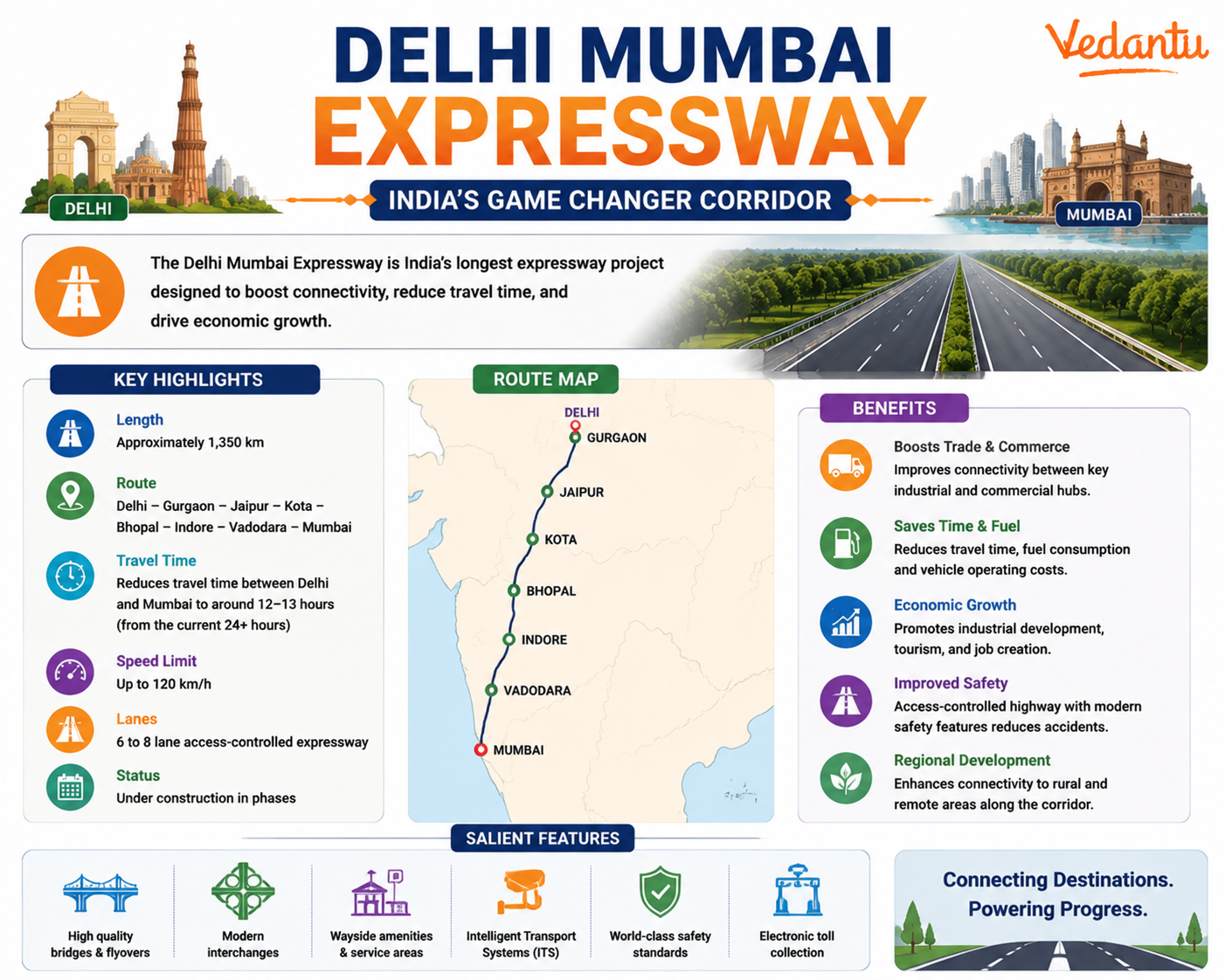
Overview of Delhi Mumbai Expressway
The Delhi Mumbai Expressway is a greenfield expressway developed under the Bharatmala Pariyojana by the National Highways Authority of India - NHAI. It is designed to be one of the longest expressways in India and will significantly reduce travel time between Delhi and Mumbai from around 24 hours to nearly 12 hours.
Key Facts about Delhi Mumbai Expressway
| Feature | Details | Importance |
|---|---|---|
| Total Length | Approximately 1,386 km | One of the longest expressways in India |
| Connecting Cities | Delhi to Mumbai | Links political and financial capitals |
| Implementing Agency | NHAI | Ensures national highway development |
The expressway passes through multiple states, improving connectivity in less developed regions and promoting balanced regional development.
States Covered by the Expressway
The Delhi Mumbai Expressway passes through six major states of India. This wide coverage enhances trade, tourism, and transportation networks.
- Delhi
- Haryana
- Rajasthan
- Madhya Pradesh
- Gujarat
- Maharashtra
Major Objectives of the Project
The expressway has been planned with several economic and developmental objectives in mind.
- Reduce travel time between Delhi and Mumbai
- Promote industrial corridors and economic zones
- Improve freight and logistics movement
- Generate employment opportunities
- Boost tourism and regional development
Key Features of Delhi Mumbai Expressway
The expressway incorporates modern engineering and safety standards to ensure efficient and safe travel.
- Access-controlled 8-lane expressway, expandable to 12 lanes
- Designed speed of up to 120 km per hour
- Wildlife crossings to protect animal habitats
- Dedicated corridors for electric vehicles in selected stretches
- Advanced traffic management systems
Economic and Strategic Importance
The Delhi Mumbai Expressway plays a crucial role in strengthening India's infrastructure backbone. It connects major industrial hubs and ports, which helps in reducing logistics costs. Lower logistics costs make Indian goods more competitive in global markets. The expressway is also expected to accelerate the development of smart cities, industrial nodes, and special economic zones along its route.
Strategically, the expressway enhances national connectivity and supports faster movement of goods and services across regions. It aligns with the government's focus on infrastructure-led growth and economic expansion.
Environmental and Social Considerations
The project includes measures to reduce environmental impact. Wildlife corridors and underpasses have been constructed in sensitive zones. Large-scale plantation drives are planned along the route to compensate for environmental loss.
In addition, the project has created employment during construction and is expected to generate long-term economic opportunities in transportation, logistics, hospitality, and retail sectors.
Why Delhi Mumbai Expressway is Important for GK and Competitive Exams
The Delhi Mumbai Expressway is frequently asked in competitive examinations due to its national importance. Questions may relate to its length, states covered, implementing agency, objectives, and economic significance.
Preparation Tips
- Remember the total length and number of states covered.
- Understand its role under Bharatmala Pariyojana.
- Focus on economic and logistical benefits.
- Revise key features like lanes and speed limit.
Conclusion
The Delhi Mumbai Expressway is a transformative infrastructure project that strengthens connectivity between two of India's most important cities. By reducing travel time, promoting economic growth, and improving logistics efficiency, it contributes significantly to national development. For students and competitive exam aspirants, understanding its features, objectives, and importance is essential for General Knowledge preparation.
FAQs on Delhi Mumbai Expressway: Complete Guide for Students
1. What is the Delhi Mumbai Expressway?
The Delhi Mumbai Expressway is a high-speed, access-controlled expressway connecting Delhi and Mumbai to reduce travel time and boost economic growth.
• Total length: around 1,386 km
• Developed by National Highways Authority of India (NHAI)
• Designed speed: up to 120 km/h
• Connects major states like Delhi, Haryana, Rajasthan, Madhya Pradesh, Gujarat, and Maharashtra
• Key project under the Bharatmala Pariyojana infrastructure scheme
2. What is the total length of the Delhi Mumbai Expressway?
The total length of the Delhi Mumbai Expressway is approximately 1,386 kilometers, making it India’s longest expressway.
• Shortens distance between Delhi and Mumbai by about 130 km
• Reduces travel time from 24 hours to around 12 hours
• One of the longest greenfield expressway projects in India
• Important for logistics, freight movement, and industrial corridors
3. Which states does the Delhi Mumbai Expressway pass through?
The Delhi Mumbai Expressway route passes through six major Indian states to improve regional connectivity.
• Delhi
• Haryana
• Rajasthan
• Madhya Pradesh
• Gujarat
• Maharashtra
This multi-state connectivity supports economic corridors, industrial zones, and smart cities.
4. What is the objective of the Delhi Mumbai Expressway?
The main objective of the Delhi Mumbai Expressway project is to enhance transport efficiency and economic development.
• Reduce travel time and fuel consumption
• Boost trade, logistics, and tourism
• Promote industrial development along the corridor
• Support the Bharatmala Project vision of modern highways
• Generate employment opportunities
5. What is special about the Delhi Mumbai Expressway?
The Delhi Mumbai Expressway is special because it is India’s most advanced and eco-friendly highway project.
• India’s first expressway with wildlife crossings and animal overpasses
• Includes electric vehicle (EV) charging stations
• Equipped with intelligent traffic management systems (ITMS)
• Designed as an 8-lane expandable expressway
• Features wayside amenities and emergency response systems
6. How much time will the Delhi Mumbai Expressway save?
The Delhi Mumbai Expressway will reduce travel time between Delhi and Mumbai from about 24 hours to nearly 12 hours.
• Average speed allowed: up to 120 km/h
• Reduced congestion compared to NH-48
• Faster movement of passenger vehicles and freight trucks
• Improved road safety due to access-controlled design
7. Under which project is the Delhi Mumbai Expressway developed?
The Delhi Mumbai Expressway is developed under the flagship Bharatmala Pariyojana programme.
• Launched by the Government of India
• Implemented by NHAI
• Focuses on economic corridors and border roads
• Aims to modernize India’s national highway network
8. What is the estimated cost of the Delhi Mumbai Expressway?
The estimated cost of the Delhi Mumbai Expressway project is around ₹1 lakh crore, making it one of India’s costliest infrastructure projects.
• Funded through government and private investments
• Built in multiple construction packages
• Major investment in infrastructure and connectivity
• Expected long-term economic benefits
9. Why is the Delhi Mumbai Expressway important for India?
The Delhi Mumbai Expressway is important because it strengthens India’s economic backbone and transport network.
• Connects the political capital Delhi with financial capital Mumbai
• Boosts industrial corridors and smart cities
• Enhances export-import logistics via ports in Maharashtra and Gujarat
• Supports national growth and infrastructure development
10. When was the Delhi Mumbai Expressway inaugurated?
The first phase of the Delhi Mumbai Expressway was inaugurated on 12 February 2023 by Prime Minister Narendra Modi.
• Initial stretch opened between Delhi and Dausa (Rajasthan)
• Remaining sections are being completed in phases
• Part of India’s rapid highway expansion programme
• Significant milestone in modern Indian infrastructure
