






New Iron Ore Mines in Odisha: Locations, Capacity and Impact
Iron ore is one of the most important minerals for the development of a country’s industrial sector. It is the basic raw material for the production of iron and steel, which are essential for infrastructure, construction, automobiles, railways, and defense industries. India is among the leading producers and exporters of iron ore in the world. The state of Odisha plays a dominant role in India’s iron ore reserves and production. In recent years, new mines in Odisha have significantly boosted output and strengthened India’s mineral economy. This article provides detailed General Knowledge about iron ore reserves and production in India, along with new mining developments in Odisha.
Iron Ore - Meaning and Types
Iron ore is a naturally occurring mineral from which metallic iron can be extracted economically. The quality of iron ore is determined by its iron content and the presence of impurities.
Main Types of Iron Ore in India
- Hematite - Contains 60 to 70 percent iron and is the most important type found in India.
- Magnetite - Contains up to 72 percent iron and has magnetic properties.
- Limonite - Lower iron content and less economically important.
- Siderite - Contains lower iron percentage and limited industrial use.
Iron Ore Reserves in India
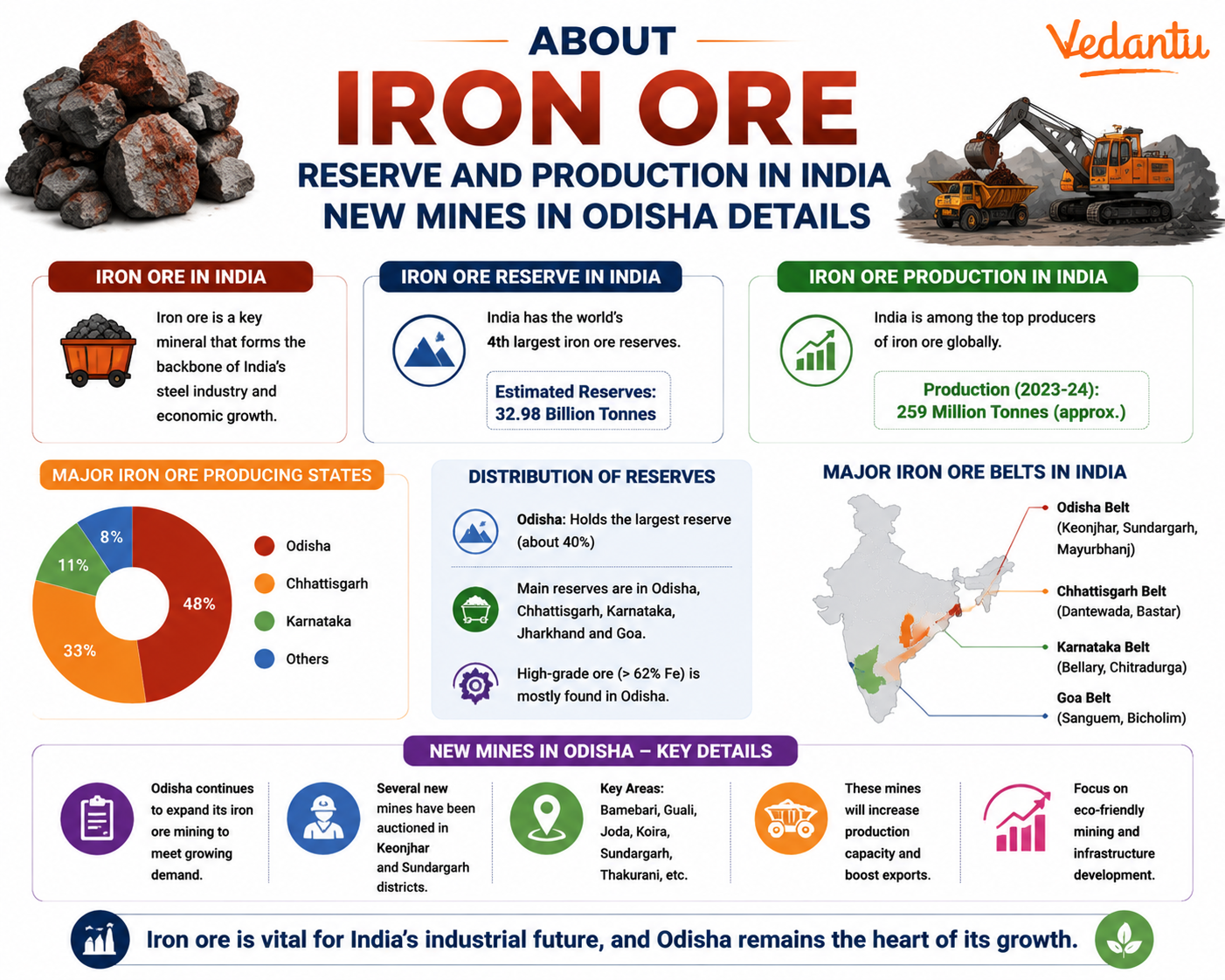
India has vast iron ore reserves, mainly in the form of hematite and magnetite. According to geological assessments, India has billions of tonnes of iron ore resources, making it one of the top countries globally in terms of reserves.
Major Iron Ore Producing States
- Odisha - Largest producer and holder of maximum reserves.
- Chhattisgarh - Known for high-grade hematite deposits.
- Karnataka - Important producer, especially in the Bellary region.
- Jharkhand - Significant deposits in Singhbhum district.
- Goa - Mainly exports low-grade iron ore.
Top Iron Ore Producing States in India
| State | Major Districts | Key Features |
|---|---|---|
| Odisha | Keonjhar, Sundargarh, Mayurbhanj | Largest reserves and production share |
| Chhattisgarh | Durg, Bastar | High-grade hematite deposits |
| Karnataka | Ballari, Chitradurga | Major mining and export hub |
Odisha contributes the highest percentage of India’s total iron ore production. The abundance of high-quality hematite ore makes it the backbone of India’s steel industry.
Iron Ore Production in India
India is consistently ranked among the top iron ore producing countries in the world. Production levels have increased in recent years due to policy reforms, auction of mining leases, and rising demand from domestic steel plants.
Factors Influencing Production
- Government policies and mining lease auctions.
- Environmental clearances and regulatory approvals.
- Domestic demand from steel industries.
- Export demand and international market prices.
New Iron Ore Mines in Odisha - Recent Developments
Odisha has witnessed the opening and operationalization of several new iron ore mines after the auction of mineral blocks under the Mines and Minerals Development and Regulation Act. These new mines have significantly enhanced production capacity and ensured a steady supply of raw material to steel plants.
Key Features of New Mines in Odisha
- Auction-based allocation to private and public sector companies.
- Located mainly in Keonjhar and Sundargarh districts.
- Adoption of modern mining technology and improved safety standards.
- Increased state revenue through royalties and premiums.
- Boost to local employment and infrastructure development.
Impact of New Mines
- Strengthened raw material security for Indian steel plants.
- Enhanced mineral revenue for Odisha government.
- Improved contribution to India’s GDP and export earnings.
- Support to the Make in India and infrastructure development initiatives.
Economic Importance of Iron Ore in India
Iron ore is the foundation of the steel industry, which is a core sector of the Indian economy. The availability of large reserves reduces dependence on imports and promotes self-reliance. States like Odisha benefit through employment generation, royalty income, and industrial growth. The development of new mines ensures long-term sustainability of the steel sector and supports national infrastructure projects.
Environmental Concerns and Sustainable Mining
While iron ore mining contributes to economic growth, it also raises environmental concerns such as deforestation, land degradation, and pollution. The government has introduced strict environmental regulations, mandatory clearances, and rehabilitation measures. Sustainable mining practices, afforestation programs, and scientific waste management are being promoted in new mining projects in Odisha.
Key Points for Competitive Exams
- Odisha is the largest producer of iron ore in India.
- Hematite is the most important type of iron ore in India.
- Keonjhar district in Odisha is a major iron ore mining region.
- New mines were allocated through auction under mining reforms.
- Iron ore is essential for steel production and infrastructure growth.
Conclusion
Iron ore reserves and production play a crucial role in India’s industrial and economic development. Odisha stands at the forefront with the highest reserves and production capacity. The opening of new iron ore mines in Odisha has strengthened the supply chain for the steel industry, increased government revenue, and supported regional development. Understanding these aspects is important for students and competitive exam aspirants, as questions related to mineral resources and major producing states are frequently asked in General Knowledge examinations.
FAQs on About Iron Ore Reserves and Production in India: Latest Data and Odisha Mines
1. What are the total iron ore reserves in India?
India has vast iron ore reserves, making it one of the top producers globally. According to recent estimates:
• India holds around 33–35 billion tonnes of iron ore resources.
• Major types include Hematite (Fe2O3) and Magnetite (Fe3O4).
• Hematite ore accounts for nearly 70% of total reserves and is mainly found in eastern India.
These reserves play a crucial role in steel production, mining industry growth, and economic development.
2. Which state has the largest iron ore reserves in India?
The state of Odisha has the largest share of iron ore reserves in India. Key points include:
• Odisha contributes over 50% of India’s total iron ore production.
• Major mining districts: Keonjhar, Sundargarh, and Mayurbhanj.
• Other important states: Chhattisgarh, Jharkhand, Karnataka, and Goa.
Odisha is therefore known as the iron ore hub of India.
3. What is the current production of iron ore in India?
India is among the world’s top iron ore producers with high annual output. Production highlights:
• Annual production is around 250–260 million tonnes (recent years).
• Odisha alone produces more than half of this total.
• India exports iron ore to countries like China and Japan.
This production supports the Indian steel industry and infrastructure development.
4. What are the new iron ore mines in Odisha?
Several new iron ore mines in Odisha have been auctioned and operationalized to boost supply. Important details:
• Mines auctioned under the Mines and Minerals (Development and Regulation) Act reforms.
• Key blocks include mines in Keonjhar and Sundargarh districts.
• Operated by companies like OMC (Odisha Mining Corporation) and private steel firms.
These new mines increase production capacity and ensure raw material security.
5. Why is Odisha important for iron ore production?
Odisha is crucial because it holds the highest quality and quantity of hematite iron ore. Reasons include:
• Rich mineral belt in the Eastern Ghats.
• Well-developed mining infrastructure.
• Proximity to major steel plants like Rourkela Steel Plant.
Odisha significantly contributes to India’s mineral economy and steel exports.
6. What are the types of iron ore found in India?
India mainly produces two types of iron ore used in metallurgy and steel manufacturing:
• Hematite – High iron content (60–70%), major share in production.
• Magnetite – Lower iron content but higher magnetic properties.
Hematite is widely used in blast furnaces and steel plants across India.
7. How do new iron ore mines impact India’s economy?
New iron ore mining projects strengthen India’s industrial growth and revenue. Economic impacts include:
• Increased steel production capacity.
• Higher government revenue through royalties and auctions.
• Employment generation in mining regions.
• Boost to infrastructure and exports.
Thus, mining expansion supports economic development and industrialization.
8. Which districts in Odisha have major iron ore mines?
The major iron ore mining districts of Odisha are concentrated in mineral-rich zones. These include:
• Keonjhar – Largest producer.
• Sundargarh – Significant reserves.
• Mayurbhanj – High-grade hematite deposits.
These districts form part of India’s important mineral belt region.
9. What is the role of the MMDR Act in new iron ore mines?
The Mines and Minerals (Development and Regulation) Act (MMDR Act) regulates mining activities in India. Its role includes:
• Auction-based allocation of mining leases.
• Ensuring transparency and fair competition.
• Promoting sustainable and scientific mining.
The Act has enabled the opening of new iron ore mines in Odisha and other states.
10. Why is iron ore important for India’s steel industry?
Iron ore is the primary raw material for the steel industry, making it strategically important. Key reasons:
• Essential for producing pig iron and crude steel.
• Supports infrastructure projects like railways, bridges, and buildings.
• Strengthens India’s position as a leading global steel producer.
Therefore, abundant iron ore reserves and new mines in Odisha ensure long-term industrial growth.
