







What Is a Slash Definition Rules Types and Examples
What is a Slash English Literature?
The slash (/) is a punctuation mark used to indicate alternatives, fractions, and connections between words. It helps to create a visual distinction between elements in a sentence, providing clarity and precision.
Examples:
Use in options: The meeting will be held on Monday/Tuesday.
Use in fractions: 3/4 of the class attended the session.
Use in dates: The event is scheduled for 12/08/2024.
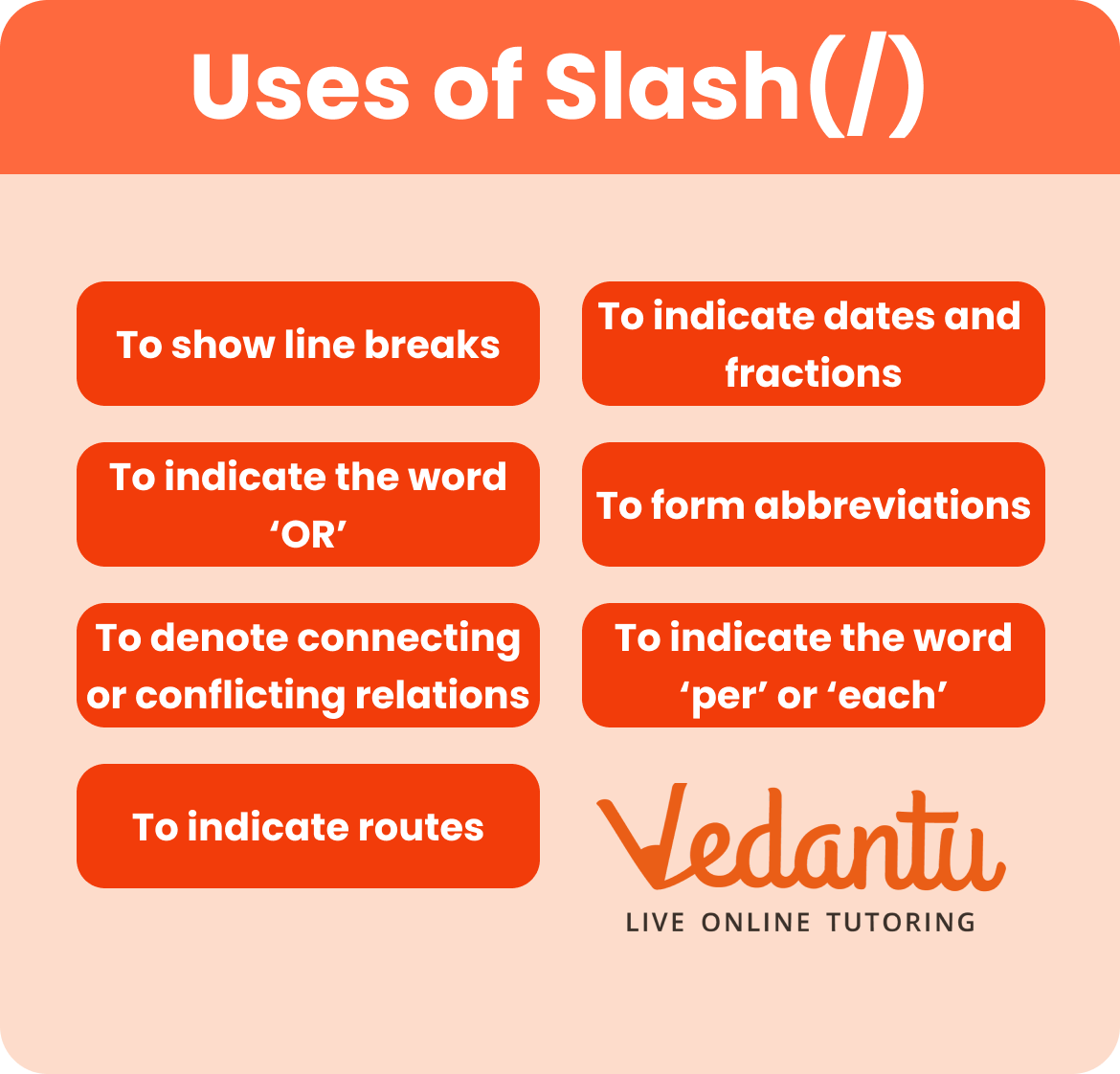
The below illustrations state the Uses of Slash:
Common Confusions:
Slash vs. Hyphen: A slash is used to indicate alternatives or fractions, while a hyphen is used to join words or split them at the end of a line.
Slash vs. Backslash: The slash (/) is used in writing and web addresses, while the backslash () is used in computing, especially in file paths.
Tips for Mastery:
Practice using the slash in different contexts to become familiar with its versatility.
Pay attention to the context in which a slash is used to avoid confusing it with other punctuation marks.
Test Your Understanding of the Topic by Completing the Following Tasks:
Select the Correct Option Where the Slash is Used Appropriately.
1. The meeting will be held on:
a) Monday/Tuesday
b) Monday/ Tuesday
c) Monday /Tuesday
2. The fraction representing three-fourths is:
a) 3-4
b) 3/4
c) 3:4
3. The correct format for the date is:
a) 12/08/2024
b) 12-08-2024
c) 12:08:2024
4. Which of the following uses of the slash is correct?
a) Either/or
b) Either/or
c) Either or/
5. To separate a file path correctly, you should use:
a) C:\Users\Documents
b) C:/Users/Documents
c) C;Users;Documents
Check your Answers:
a) Monday/Tuesday – The slash is correctly used to show options.
b) 3/4 – The slash is correctly used to indicate a fraction.
a) 12/08/2024 – The slash is correctly used to separate the date.
a) Either/or – The slash is correctly used to show alternatives.
b) C:/Users/Documents – The slash is correctly used to separate file paths.
Exercise To Solve
Exercise 1: Fill in the Blanks with the Appropriate Use of a Slash.
1. The restaurant is open from 9 AM ___ 9 PM.
2. You can use your phone ___ laptop for this task.
3. The project is due on 01/09/2024 ___ 02/09/2024.
4. She completed ___ and handed in her assignment on time.
5. The document is saved in the folder C: ___Documents___Files.
Exercise 2: Identify the Error
Identify the error in the use of slashes in the following sentences and correct them.
1. The train will depart at 5:30/PM.
2. The student scored 7/10 in the test/ exam.
3. The event will take place on 15th/July.
4. Please choose your preferred time: morning/afternoon/night.
5. The file is located in C:/Users/Documents.
Answers Key
Exercise 1: Fill in the Blanks
The restaurant is open from 9 AM / 9 PM.
You can use your phone/laptop for this task.
The project is due on 01/09/2024 / 02/09/2024.
She completed/handed in her assignment on time.
The document is saved in the folder C:**/Documents/**Files.
Exercise 2: Identify the Error
Incorrect: The train will depart at 5:30/PM.
Correct: The train will depart at 5:30 PM.
Incorrect: The student scored 7/10 in the test/ exam.
Correct: The student scored 7/10 in the test/exam.
Incorrect: The event will take place on 15th/July.
Correct: The event will take place on 15th July.
Incorrect: Please choose your preferred time: morning/afternoon/night.
Correct: Please choose your preferred time: morning/afternoon/night.
Incorrect: The file is located in C:/Users/Documents.
Correct: The file is located in C:/Users/Documents.
Takeaways from the Topic “Slash ”
Understanding the slash in grammar helps improve clarity and precision in writing.
By mastering its uses, students can enhance their writing skills and avoid common errors.
Explore Vedantu’s resources to deepen your understanding and practice more with the provided examples.
FAQs on Slash in English Grammar and Punctuation
1. What is a slash in English grammar?
A slash (/) is a punctuation mark used to show alternatives, connections, fractions, or line breaks in English writing.
- It is also called a forward slash.
- It often means “or” in informal contexts (e.g., and/or).
- It appears in dates, abbreviations, URLs, and poetry.
2. When should you use a slash in a sentence?
You should use a slash (/) to show alternatives, paired terms, or specific technical formats.
- Alternatives: bring your laptop/tablet.
- Paired roles: writer/director.
- Fractions: 3/4.
- Dates: 17/06/2026.
3. What is the difference between a slash and a backslash?
A slash (/) leans forward, while a backslash (\) leans backward and is mainly used in computing.
- Slash (/): used in writing, dates, fractions, and alternatives.
- Backslash (\): used in file paths and programming.
4. Is it correct to use “and/or” in formal writing?
The expression and/or is grammatically correct but often discouraged in formal writing.
- It can sound vague or awkward.
- Formal style usually prefers rewriting the sentence for clarity.
- Example revision: “Students may submit essays or projects, or both.”
5. How is a slash used in poetry?
In poetry, a slash (/) shows a line break when lines are written in a single sentence.
- Example: “The woods are lovely, dark and deep / But I have promises to keep.”
- It preserves the original line structure without rewriting the poem in separate lines.
6. Can you use a slash instead of “or”?
Yes, a slash (/) can replace “or” to show alternatives, especially in informal writing.
- Example: pass/fail.
- Example: yes/no question.
7. What are common mistakes when using a slash?
Common mistakes with a slash (/) include overuse, ambiguity, and incorrect spacing.
- Using it too frequently in formal essays.
- Creating unclear meanings (e.g., “teacher/student responsibility”).
- Adding unnecessary spaces (standard form is usually word/word).
8. Is there a space before and after a slash?
In most cases, there is no space before or after a slash when connecting single words.
- Correct: and/or, pass/fail.
- In longer phrases, spacing may be added for readability (e.g., input / output).
9. How is a slash used in dates and numbers?
A slash (/) is used in dates and fractions to separate numbers clearly.
- Dates: 06/17/2026 (American format) or 17/06/2026 (British format).
- Fractions: 1/2, 5/8.
10. Why is the slash important in English writing?
The slash (/) is important because it efficiently shows alternatives, relationships, and formatting in modern English.
- It shortens expressions like and/or.
- It appears in technical writing, URLs, and file paths.
- It helps preserve poetic line breaks in literary analysis.
