



Solve Class 4 Maths Chapter 12 Important Questions on Clocks and Calendars
Explore these 14 questions to practise reading clocks, working with calendars and solving everyday problems involving time. Check the step-by-step solutions after each question and download the Class 4 Maths Chapter 12 Important Questions PDF to continue practising at home.
Class 4 Maths Chapter 12 Important Questions MCQ (Multiple Choice Questions)
1. How many days are there in a leap year?
(a) 364 days
(b) 365 days
(c) 366 days
(d) 367 days
Answer: (c) 366 days
2. Which of the following years is a leap year?
(a) 2025
(b) 2026
(c) 2027
(d) 2028
Answer: (d) 2028
Explanation: Leap years generally occur every four years. The year 2028 is a leap year and has 29 days in February.
3. What is 8:00 PM in the 24-hour clock format?
(a) 08:00 hours
(b) 18:00 hours
(c) 20:00 hours
(d) 22:00 hours
Answer: (c) 20:00 hours
Explanation: For a PM time other than 12 PM, add 12 to the hour.
8 + 12 = 20
Therefore, 8:00 PM = 20:00 hours.
4. How many minutes are there in three-quarters of an hour?
(a) 15 minutes
(b) 30 minutes
(c) 45 minutes
(d) 60 minutes
Answer: (c) 45 minutes
Explanation:
One hour = 60 minutes.
Three-quarters of an hour = (60 ÷ 4) × 3 = 45 minutes.
Class 4 Maths Chapter 12 Important Questions – Very Short Answer
5. How many days are there in February 2024 and February 2025?
Answer:
February 2024: 29 days
February 2025: 28 days
2024 was a leap year, while 2025 was not.
6. If today is Wednesday, what day will it be the day after tomorrow?
Answer:
Tomorrow will be Thursday, and the day after tomorrow will be Friday.
Answer: Friday
7. Convert the following times into the 24-hour clock format.
(a) 9:45 AM
(b) 3:00 PM
(c) 5:20 PM
(d) 11:45 PM
Answer:
(a) 09:45 hours
(b) 15:00 hours
(c) 17:20 hours
(d) 23:45 hours
Class 4 Maths Chapter 12 Ticking Clocks and Turning Calendar – Short Answer Questions
8. Look at the calendars for February 2024 and February 2025 and answer the questions.
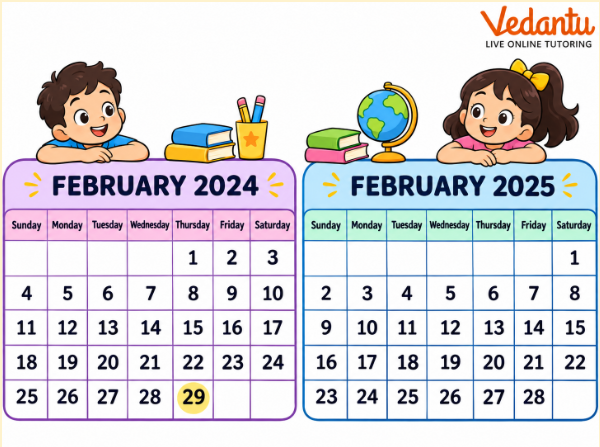
Questions:
(a) Which year has 29 days in February?
(b) On which day of the week did 29 February 2024 fall?
(c) How many more days did February 2024 have than February 2025?
Answer:
(a) February 2024 has 29 days.
(b) 29 February 2024 was a Thursday.
(c) February 2024 had 29 days and February 2025 had 28 days.
29 − 28 = 1 day
Therefore, February 2024 had one extra day.
9. Raghav leaves home at 8:20 AM to buy milk and returns at 8:35 AM. How long does he take?
Answer:
Starting time = 8:20 AM
Returning time = 8:35 AM
Time taken = 35 − 20 = 15 minutes
Therefore, Raghav takes 15 minutes to buy milk and return home.
10. Look at the clocks and write the time shown by each clock.
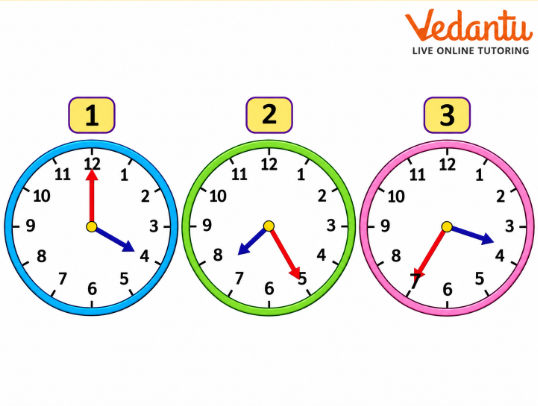
Questions:
(a) What time does Clock 1 show?
(b) What time does Clock 2 show?
(c) What time does Clock 3 show?
Answer:
(a) Clock 1 shows 4:00.
(b) Clock 2 shows 7:25.
(c) Clock 3 shows 3:35.
The shorter hand shows the hour, and the longer hand shows the minutes.
11. Laali was born on 04/07/2014, and Chotu was born on 04/12/2019. Who is older, and by how much?
Answer:
Laali's date of birth = 4 July 2014
Chotu's date of birth = 4 December 2019
Difference in years = 2019 − 2014 = 5 years
Difference in months = December − July = 5 months
Therefore, Laali is older than Chotu by 5 years and 5 months.
Class 4 Maths Chapter 12 Important Questions – Long Answer Questions
12. Look at Akira's school activity timetable and calculate the missing times.
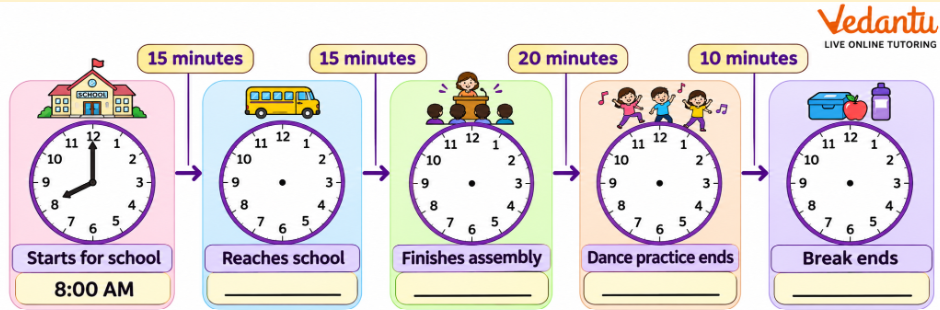
Questions:
(a) At what time does Akira reach school?
(b) At what time does the school assembly finish?
(c) When does dance practice end?
(d) At what time does the break end?
(e) How much total time passes from leaving home to the end of the break?
Answer:
(a) Akira leaves at 8:00 AM and takes 15 minutes to reach school.
8:00 + 15 minutes = 8:15 AM
(b) The assembly finishes after another 15 minutes.
8:15 + 15 minutes = 8:30 AM
(c) Dance practice lasts another 20 minutes.
8:30 + 20 minutes = 8:50 AM
(d) The break ends after another 10 minutes.
8:50 + 10 minutes = 9:00 AM
(e) Total time:
15 + 15 + 20 + 10 = 60 minutes
Therefore, Akira spends 1 hour from 8:00 AM to 9:00 AM.
13. A doctor wakes up at 6:00 AM and follows the schedule below. Calculate the duration of each activity and the total time.
Questions:
(a) How many hours does the doctor spend getting ready?
(b) How long does the doctor work at the hospital?
(c) How many hours does the doctor rest?
(d) How many hours does the doctor sleep?
(e) How many hours are there in a complete day?
Answer:
(a) Getting ready:
8:00 AM − 6:00 AM = 2 hours
(b) Working at the hospital:
9:00 AM to 12:00 noon = 3 hours
12:00 noon to 4:00 PM = 4 hours
Total = 3 + 4 = 7 hours
(c) Resting:
6:00 PM − 5:00 PM = 1 hour
(d) Sleeping:
10:00 PM to midnight = 2 hours
Midnight to 6:00 AM = 6 hours
Total = 2 + 6 = 8 hours
(e) One complete day has 24 hours.
14. Raghav starts his homework at 10:20 AM and takes 25 minutes to complete it. Muneera starts reading a story at 4:15 PM and takes 45 minutes to finish. Find their finishing times and compare the durations.
Answer:
Part A: Raghav's homework
Starting time = 10:20 AM
Time taken = 25 minutes
20 + 25 = 45 minutes
Finishing time = 10:45 AM
Part B: Muneera's reading
Starting time = 4:15 PM
Time taken = 45 minutes
15 + 45 = 60 minutes = 1 hour
Finishing time = 5:00 PM
Part C: Compare the durations
Muneera's reading time = 45 minutes
Raghav's homework time = 25 minutes
Difference = 45 − 25 = 20 minutes
Therefore, Muneera spent 20 minutes more on reading than Raghav spent on his homework.
Practise Time and Calendar Problems with Vedantu's Class 4 Maths Chapter 12 PDF
Reading a clock is only the beginning. Students also need to calculate how much time an activity takes, understand calendar dates, and convert time between AM/PM and 24-hour formats. Vedantu's Class 4 Maths Chapter 12 important questions CBSE practice helps children develop these skills through everyday examples.
Students can use these questions to:
Read clocks accurately: Identify hours and minutes on analogue clocks and understand digital time.
Calculate time intervals: Solve problems involving school activities, homework, reading and daily routines.
Understand calendars: Identify leap years, compare the days in February and calculate dates and ages.
Practise time conversions: Convert AM/PM times into 24-hour format and work with half-hour and quarter-hour intervals.
Improve problem-solving: Follow step-by-step solutions to understand how each answer is calculated.
Vedantu's Class 4 Maths Chapter 12 important questions and answers PDF includes the same 14 solved questions available on this page, along with picture-based practice. Students can use the PDF to prepare for classroom tests and strengthen their understanding of time and calendars.
CBSE Class 4 Maths Chapter 12 Study Materials
Explore the following study materials to understand Ticking Clocks and Turning Calendar.
CBSE Class 4 Maths Chapter-wise Important Questions
Other Important Study Materials for CBSE Class 4 Maths
FAQs on Important Questions for Class 4 Maths (Math-Mela) Chapter 12 Ticking Clocks and Turning Calendar | 2026-27
1. What are the important questions for Class 4 Maths Chapter 12 Ticking Clocks and Turning Calendar?
Important questions from Chapter 12 cover leap years, calendar dates, reading analogue and digital clocks, converting AM/PM times and calculating time intervals. Students should also practise questions involving daily activities, school timetables and the relationship between hours and minutes.
2. How can I solve Class 4 Maths Chapter 12 question answers easily?
Start by identifying whether the question involves dates, clock reading or time calculations. For time intervals, write the starting and ending times before calculating the difference. For calendar problems, count days or weeks carefully. Vedantu provides step-by-step solutions to help students understand each calculation.
3. How do you convert PM time into 24-hour clock time?
For PM times from 1:00 PM to 11:59 PM, add 12 to the hour and keep the minutes unchanged. For example, 3:00 PM becomes 15:00 hours, and 5:20 PM becomes 17:20 hours. Remember that 12:00 PM is 12:00 hours, while 12:00 AM is 00:00 hours.
4. What are some important MCQs for Class 4 Maths Chapter 12?
Class 4 Maths Chapter 12 important questions MCQ topics include identifying leap years, finding the number of days in February, converting digital time and calculating fractions of an hour. For example, students may be asked how many minutes are in a quarter hour or how to write 8:00 PM in 24-hour format.
5. How can I download the Class 4 Maths Chapter 12 important questions PDF?
Students can use Vedantu's chapter-wise PDF download option to access 14 solved questions from Ticking Clocks and Turning Calendar. The PDF covers MCQs, short calculations, calendar problems and picture-based clock questions for practice at home.
6. What is the difference between a normal year and a leap year?
A normal year has 365 days, while a leap year has 366 days. February has 28 days in a normal year and 29 days in a leap year. The chapter uses February 2024 and February 2025 to help students understand this difference.
7. How many minutes are there in half an hour and a quarter hour?
One hour has 60 minutes. Half an hour is 30 minutes, while a quarter hour is 15 minutes. Three-quarters of an hour equals 45 minutes. Students use these relationships to calculate how long different activities take.
8. Why is learning to read clocks and calendars important for Class 4 students?
Reading clocks and calendars helps children organise daily activities, get to school on time, calculate how long tasks take, and understand important dates. These skills are useful in everyday life and help students solve Maths problems involving time and dates.
