



Class 4 Maths Chapter 13 Important Questions to Practise Multiplication and Division
Practise these Class 4 Maths Chapter 13 important questions and answers to strengthen multiplication and division skills through new transport-based problems. Solve the MCQs and written questions, check the step-by-step solutions and use the PDF for practice at home.
Class 4 Maths Chapter 13 Important Questions MCQ (Multiple Choice Questions)
1. A transport museum has 16 rows of model cars, with 10 cars in each row. How many model cars are there altogether?
(a) 106
(b) 160
(c) 260
(d) 1,600
Answer: (b) 160
Solution:
16 × 10 = 160
Therefore, the museum has 160 model cars.
2. Which multiplication gives the same answer as 6 × 18?
(a) (6 × 10) + (6 × 8)
(b) (6 × 10) + 8
(c) (6 × 20) + 8
(d) (6 × 8) + 10
Answer: (a) (6 × 10) + (6 × 8)
Solution:
6 × 18 = (6 × 10) + (6 × 8)
= 60 + 48 = 108
3. A minibus can carry 24 passengers. How many passengers can travel in 5 such minibuses?
(a) 100
(b) 110
(c) 120
(d) 125
Answer: (c) 120
Solution:
24 × 5 = (20 × 5) + (4 × 5)
= 100 + 20 = 120 passengers
4. A museum guide divides 95 visitors equally into groups of 12. How many visitors will remain after making the maximum number of complete groups?
(a) 7
(b) 9
(c) 11
(d) 12
Answer: (c) 11
Solution:
12 × 7 = 84
95 − 84 = 11 visitors
Class 4 Maths Chapter 13 The Transport Museum – Very Short Answer Questions
5. Find the missing numbers.
(a) 13 × 20 = _____
(b) 17 × 100 = _____
(c) 900 ÷ 10 = _____
(d) 2,400 ÷ 100 = _____
Answer:
(a) 260
(b) 1,700
(c) 90
(d) 24
6. A toy shop packs 144 toy wheels equally into 12 boxes. How many wheels are packed in each box?
Answer:
144 ÷ 12 = 12 wheels
Each box contains 12 wheels.
7. Find the quotient and remainder when 157 is divided by 15.
Answer:
15 × 10 = 150
157 − 150 = 7
Quotient = 10
Remainder = 7
Class 4 Maths Chapter 13 Important Questions – Short Answer Questions
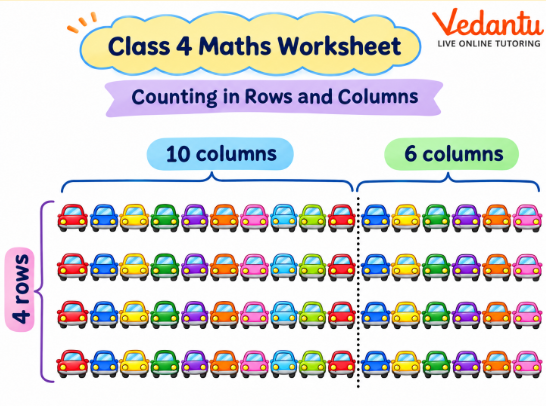
8. Look at the arrangement of toy vehicles and find the total number using the splitting method.
Questions:
(a) How many rows are shown?
(b) How many toy cars are there in each row?
(c) Find the total number of toy cars by splitting 16 into 10 and 6.
Answer:
(a) 4 rows
(b) 16 toy cars
(c) Total cars = 4 × 16
= (4 × 10) + (4 × 6)
= 40 + 24
= 64 toy cars
9. A vehicle repair centre has 9 shelves, with 18 spare parts on each shelf. Find the total number of spare parts using two equal groups.
Answer:
Total spare parts = 9 × 18
Split 18 into two equal groups of 9.
9 × 18 = (9 × 9) + (9 × 9)
= 81 + 81
= 162 spare parts
10. A school has 285 students going on an educational trip. Each bus can carry 40 students. How many buses are required to take everyone?
Answer:
Total students = 285
Capacity of each bus = 40 students
285 ÷ 40 = 7 remainder 5
7 buses can carry:
7 × 40 = 280 students
Remaining students = 285 − 280 = 5
One additional bus is required for these 5 students.
Total buses = 7 + 1 = 8 buses
11. A museum sells 26 entry tickets every hour. How many tickets will it sell in 15 hours if the number sold remains the same each hour?
Answer:
Tickets sold in one hour = 26
Number of hours = 15
Total tickets = 26 × 15
Split 15 into 10 and 5.
= (26 × 10) + (26 × 5)
= 260 + 130
= 390 tickets
Class 4 Maths Chapter 13 The Transport Museum – Long Answer Questions
12. A transport company has 18 vans. Each van can carry 16 passengers. Find the total seating capacity. If 275 passengers need to travel, will the vans be enough?
Answer:
Step 1: Find the total seating capacity.
Number of vans = 18
Passengers per van = 16
Total capacity = 18 × 16
Split 16 into 10 and 6.
= (18 × 10) + (18 × 6)
= 180 + 108
= 288 passengers
Step 2: Compare the capacity with the passengers.
Total capacity = 288
Passengers travelling = 275
Empty seats = 288 − 275 = 13
Final Answer: Yes, all 275 passengers can travel in the 18 vans, and 13 seats will remain empty.
13. Look at the transport ticket chart and calculate the total cost of the school trip.
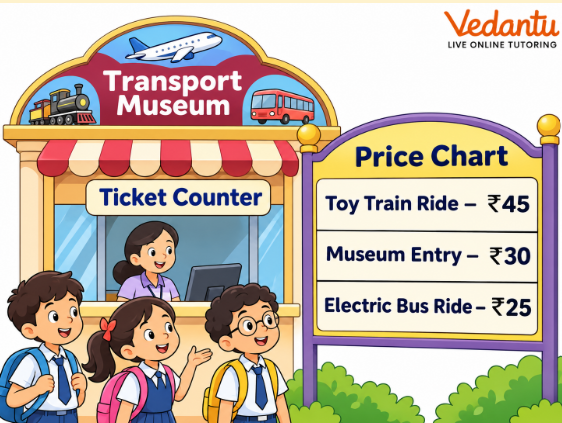
A group of 12 students visits the museum. Every student buys one museum entry ticket, one toy train ticket and one electric bus ticket.
Questions:
(a) What is the total ticket cost for one student?
(b) How much will 12 students pay altogether?
(c) If the teacher pays ₹1,500, how much change should the teacher receive?
Answer:
Step 1: Find the cost for one student.
Museum entry = ₹30
Toy train ride = ₹45
Electric bus ride = ₹25
Total = 30 + 45 + 25 = ₹100
Step 2: Find the cost for 12 students.
12 × 100 = ₹1,200
Step 3: Calculate the change.
Amount paid = ₹1,500
Total cost = ₹1,200
Change = 1,500 − 1,200 = ₹300
Final Answer: The cost per student is ₹100, the total for 12 students is ₹1,200, and the teacher receives ₹300 as change.
Improve Multiplication and Division Skills with Vedantu's Class 4 Maths Chapter 13 Questions
The Transport Museum introduces multiplication and division through practical situations such as counting vehicle wheels, finding passenger capacity and calculating travel expenses. Vedantu's Class 4 Maths Chapter 13 important questions and CBSE practice help students understand these calculations instead of simply memorising answers.
Students can use the questions to:
Build multiplication tables: Practise tables from 11 to 20 using splitting, grouping and doubling.
Solve transport problems: Calculate how many people can travel in buses, toy trains and aeroplanes.
Understand division with remainders: Learn why an extra coach may be required when passengers do not divide into equal groups.
Practise larger calculations: Multiply numbers by 10, 20, 100 and other multiples using simple methods.
Learn through pictures: Use arrays, train coaches and vehicle-capacity illustrations to understand multiplication and division.
Vedantu's Class 4 Maths Chapter 13 important questions PDF download provides the same 14 solved questions from this page. Students can use these examples to practise calculations independently and prepare for school assessments.
CBSE Class 4 Maths Chapter 13 Study Materials
Explore the following study materials to understand The Transport Museum.
CBSE Class 4 Maths Chapter-wise Important Questions
Practise important questions from the other chapters of the Math-Mela textbook.
Other Important Study Materials for CBSE Class 4 Maths
FAQs on Important Questions for Class 4 Maths (Math-Mela) Chapter 13 The Transport Museum | 2026-27
1. What are the important questions for Class 4 Maths Chapter 13 The Transport Museum?
Important questions focus on multiplication tables, splitting numbers into groups, multiplication by 10 and 100, division with remainders and passenger-capacity calculations. Students should practise word problems involving toy trains, buses, aeroplanes and money.
2. How can students solve multiplication problems using the splitting method?
The splitting method breaks a larger number into smaller parts. For example, to calculate 15 × 14, split 14 into 10 and 4. Then multiply 15 × 10 = 150 and 15 × 4 = 60. Add both products to get 210. This method helps students understand larger multiplications.
3. What are some important MCQs for Class 4 Maths Chapter 13?
Class 4 Maths Chapter 13 important questions MCQ practice covers multiplication tables, multiples of 10 and 100, division and remainders. For example, students may be asked to find 15 × 10, calculate how many passengers fit into a train or identify the remainder when 125 is divided by 15.
4. Why is the remainder important in division problems involving transport?
A remainder tells us how many passengers are left after filling equal groups or vehicles. For example, 324 ÷ 14 gives 23 remainder 2.
Although 23 coaches can seat 322 children, the remaining 2 children need another coach. Therefore, 24 coaches are required.
5. What is the multiplication problem about the Vande Bharat Mission in Chapter 13?
The textbook presents a problem in which 64 flights carry 152 passengers each. Students calculate the total using 64 × 152 = 9,728. The question helps them practise multiplication by splitting numbers into hundreds, tens and ones.
6. Where can I find Class 4 Maths Chapter 13 question answers for The Transport Museum?
Vedantu provides Class 4 Maths Chapter 13 question answers for The Transport Museum, with solved MCQs, multiplication exercises, division problems, and real-life examples. Students can follow the calculations to understand how each answer is obtained.
7. How can I download the Class 4 Maths Chapter 13 question answer PDF?
Students can use Vedantu's Class 4 Maths Chapter 13 question answer PDF download section to download the solved practice questions. The PDF includes the same 13 questions and answers shown on the page, including picture-based exercises and worked calculations.
