








An Overview of Class 12 Chemistry Volumetric Analysis Viva Questions With Answers Experiment
Chemical analysis is essential to study the components of a substance. Chemical analysis may be qualitative or quantitative. Volumetric analysis entails measuring the quantity of the reacting substances. The weight of a required component is indirectly obtained by measuring the amount of a solution containing an unknown amount of the required constituent that needs to react with a solution of known composition. This can be achieved with the help of titration.c
Table of Content
Aim
Apparatus Required
Theory
Procedure
Observation
Result
Precautions
Aim
To study the concept of volumetric analysis.y
Apparatus Required
Graduated-burette
Pipette
Measuring flasks
Measuring cylinders
Titration flasks
Beaker
Tile
Glass-rod
Funnel
Weighing bottle
Wash bottle
A chemical balance
Theory
A volumetric analysis measures the volumes of the solutions involved in the chemical reaction to determine the quantities of the constituents present in the given unknown solution. In this analysis, titration is the key process, which involves determining how much of a reagent is needed to complete a certain reaction. When strong acids are titrated with strong bases, they become chemically equivalent at the endpoint; this is known as a neutralization reaction. The pH of the solution suddenly changes near the endpoint. After the endpoint, even a small amount of base or acid would result in a mildly alkaline or acidic solution.
Procedure
Burettes are thoroughly washed before filling with a solution to remove any greasy matter.
Ensure that a clean burette has no drops adhering to its inner wall.
Put a small amount of solution into the burette, close the top mouth with your thumb, and hold it in a horizontal position. Rotate the burette so that it wets every inch of the inside. Use the stop-cock to reject this solution. This process is called rinsing.
A funnel is inserted at the top of the burette to fill it. This solution is known as titrant. Once the burette has been filled, the funnel must be removed.
After removing the parallax, the burette should be carefully read, because it forms the most important aspect of the experiment.
To read the burette, hold a sheet of a white paper called an anti-parallax card, behind the level of the liquid, so that it illuminates the surface of the liquid.
Make an anti-parallax card by folding a rectangular piece of paper in half, making two cuts, opening the fold, and mounting it to the burette. Place your eye directly in front of the solution's meniscus and read the burette.
A pipette is used to precisely measure the amount of a solution. It is a long tube with a jet at the lower end, and a cylindrical bulb in the middle.
There is a circular mark on the upper part of the stem. Using the thumb and middle finger of the right hand, the upper end of the pipette is held, the lower end is dipped into the liquid, and the solution is drawn into the pipette until it reaches the mark about 2 cm above the liquid level. The solution is allowed to move gradually until the lower border of the meniscus touches the mark. Then it is released into the titration flask.
Pipette out 10 ml of the solution into a conical flask that has been washed and dried, add 1-2 drops of indicator to the flask, and place it over the glazed tile.
The solution can be titrated with a titrant solution until a very faint color is obtained.
In the burette, read the lower meniscus again and record it as the final result. Repeat the procedure and take three concordant readings.
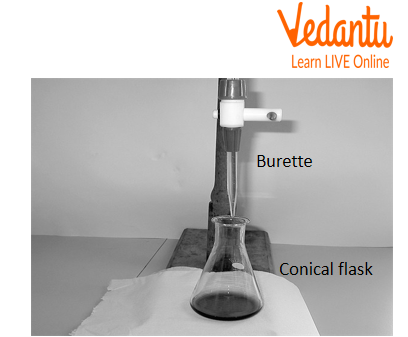
Volumetric analysis
Observations
The color change is observed and the burette readings are noted down.
To calculate the molarity of a solution, use the equation: a1M1V1 = a2M2V2
Where M1 and V1 are the molarity and volume of the titrand. M2 and V2 are the molarity and volume of the titrant, and a1 and a2 are the basicity of the titrand and acidity of the titrant respectively.
Result
The concentration of the solution is ___ g/ml.
Precautions
Ensure that no air bubbles are remaining in the narrow bottom tip of the burette. Using a stop-cock, the liquid is allowed to run rapidly out of the beaker or flask to remove the air.
The funnel should always be removed from the burette before noticing the readings and no drops should be hanging from the burette's nozzle.
The level is read from the lower meniscus in the case of colorless solutions, and the upper meniscus in the case of colored solutions.
Make sure the lower end of the pipette is always submerged in the liquid while sucking the liquid out, and don't pipette hot or corrosive solutions out.
Lab Manual Questions
1. What is the purpose of rinsing the burette and pipette with the solution that is being filled?
Ans: There will be very small amounts of liquid remaining after rinsing the burette and pipette with this solution. These tiny amounts will not affect the concentration of the solution. So it is necessary to rinse the burette and pipette with the respective solutions.
2. Why is the level read from the upper meniscus in the case of colored solutions?
Ans: The level is read from the upper meniscus in the case of colored solutions because colored solutions do not clearly show the lower meniscus.
3. What is an endpoint?
Ans: An endpoint is a point at which the amount of reactant necessary to complete a reaction has been added to a solution during the titration.
4. Why do you need to take a concordant reading?
Ans: Concordant readings are taken to ensure the accuracy of the final results of the titration since there are chances of errors during the titration.
Viva Questions
1. What are indicators?
Ans: Indicators are chemical compounds that change color when they are exposed to an acid or base.
2. What is the equivalent mass of crystalline oxalic acid?
Ans: The equivalent mass of crystalline oxalic acid is 63 g.
3. What is molarity?
Ans: Molarity is defined as the number of moles of a solute per liter of solution.
4. What is a 0.1M solution?
Ans: The solution which has one mole of solute per liter of solution is called 0.1M solution.
5. Define titration.
Ans: A typical laboratory technique for quantitative chemical analysis to ascertain the concentration of a specific analyte is titration.
6. What is molality?
Ans: The molality of a solution is the number of moles of solute per 1 kg or 1000 g of solvent.
7. Why do you use a funnel to fill the burette?
Ans: Funnel is used as a safety measure to prevent any liquid from the flask from spilling into the burette and interfering with the measurements.
8. What is a standard solution?
Ans: The solution of accurately known concentration is called a standard solution.
9. What is acidity?
Ans: The tendency of a compound to donate H+ is known as acidity.
10. How do you calculate molarity?
Ans: The molarity of a solution is calculated by the equation: a1M1V1 = a2M2V2.
Practical Based Questions
In an acid medium, how many moles of oxalic acid are oxidized by one mole of KMnO4?
A) 3
B) 4
C) 2.5
D) 2
Ans: C) 2.5
The amount of solute in gram-equivalents per liter of solution is called ___.
A) Molarity
B) Molality
C) Normality
D) Molecular mass
Ans: C) Normality
The point where the interaction between titrant and titrate is just about finished is called
A) Endpoint
B) Equivalence point
C) Titration point
D) None of the above
Ans: B) Equivalence point
What procedure is utilized to assess the strength of a specific solution?
A) Volumetric analysis
B) Chromatography
C) Calorimetry
D) Spectrophotometry
Ans: A) Volumetric analysis
The titration that includes both oxidation and reduction is called ___.
A) Acid-base titration
B) Redox titration
C) Complexometric titration
D) Precipitation titration
Ans: B) Redox titration
When titrating sodium carbonate against hydrochloric acid, which indicator is used?
A) Phenolphthalein
B) Starch
C) Methyl orange
D) Iodine
Ans: C) Methyl orange
The number of hydrogen atoms that can be replaced in an acid molecule is called
A) Basicity of a base
B) Basicity of an acid
C) Acidity of a base
D) Acidity of an acid
Ans: B) Basicity of an acid
Which of the following is an auto catalyst in a titration of oxalic acid vs. KMnO4?
A) Mn2+
B) O4
C) K+
D) Mn2-
Ans: A) Mn2+
Which color is produced by the phenolphthalein indicator in a basic medium?
A) Orange
B) Red
C) Pink
D) Blue
Ans: C) Pink
What kind of reaction does acid-alkali titration involve?
A) Neutralization
B) Precipitation
C) Decomposition
D) Mineralization
Ans: A) Neutralization
Summary
Volumetric analysis entails measuring the quantity of the reacting substances. In this analysis, titration is the key process, which involves determining how much of a reagent is needed to complete a certain reaction. Pipette out 10 ml of the solution into a conical flask and add 1-2 drops of indicator. The solution can be titrated with a titrant solution until a very faint color is obtained. The color change is observed and the burette readings are noted down.


FAQs on Class 12 Chemistry Volumetric Analysis Viva Questions With Answers Experiment
1. What are the most important precautions a student must take during a volumetric analysis experiment for the Class 12 board practicals?
To ensure accuracy in the CBSE Class 12 practical exam, several precautions are crucial in volumetric analysis:
- Apparatus Cleaning: Always rinse the burette with the titrant solution and the pipette with the analyte solution. The conical flask should only be rinsed with distilled water.
- Burette Setup: Ensure there are no air bubbles in the burette nozzle before starting. Remove the funnel from the top of the burette after filling it.
- Reading Measurements: Always read the lower meniscus for colourless solutions (like oxalic acid) and the upper meniscus for coloured solutions (like KMnO₄). Use an anti-parallax card to avoid reading errors.
- Titration Process: Add the titrant drop by drop near the endpoint, constantly swirling the conical flask for proper mixing.
2. How is the molarity of an unknown solution determined using the titration formula in volumetric analysis?
The molarity of an unknown solution is a key calculation in volumetric analysis, determined using the molarity equation based on the balanced chemical reaction. For a general reaction, the formula is: a₁M₁V₁ = a₂M₂V₂. Here:
- M₁ and V₁ are the molarity and volume of the solution in the conical flask (analyte).
- M₂ and V₂ are the molarity and volume of the solution in the burette (titrant).
- a₁ and a₂ are the stoichiometric coefficients (number of moles) of the analyte and titrant, respectively, from the balanced chemical equation.
By measuring the volume of titrant (V₂) required to reach the endpoint, and knowing the other values, the unknown molarity (e.g., M₁) can be calculated.
3. What is the difference between a primary and a secondary standard solution? Provide an example for each relevant to Class 12 Chemistry.
Understanding the difference is an important concept for the exam:
- A primary standard is a highly pure, stable compound that does not absorb moisture or CO₂ from the air. Its solution's concentration is stable and can be determined accurately by weighing the substance and dissolving it in a known volume of solvent. Example: Crystalline Oxalic Acid ((COOH)₂·2H₂O).
- A secondary standard is a substance whose solution concentration is determined by standardising it against a primary standard. These substances are often less pure or reactive with the atmosphere. Example: Potassium permanganate (KMnO₄) or Sodium Hydroxide (NaOH).
4. In the titration of potassium permanganate (KMnO₄) against oxalic acid, why is the solution heated and dilute sulphuric acid added?
This is a common question testing conceptual understanding. Both steps are crucial for the reaction:
- Heating: The reaction between permanganate ions and oxalate ions is very slow at room temperature. Heating the oxalic acid solution to about 60-70°C provides the necessary activation energy to speed up the reaction rate, allowing the titration to be completed in a reasonable time.
- Adding Dilute H₂SO₄: The oxidation by KMnO₄ requires an acidic medium (H⁺ ions). Dilute H₂SO₄ is used specifically because it is a strong acid that does not interfere with the reaction. HCl is avoided as KMnO₄ can oxidise Cl⁻ ions to Cl₂, and HNO₃ is avoided as it is an oxidising agent itself.
5. Explain the concept of an 'auto-catalyst' with reference to the KMnO₄ vs. oxalic acid titration.
An auto-catalyst is a product of a reaction that also acts as a catalyst for that same reaction. In the titration of KMnO₄ with oxalic acid, the reaction is initially slow. As KMnO₄ is reduced, Manganese(II) ions (Mn²⁺) are formed. These Mn²⁺ ions then catalyse the subsequent reaction between permanganate and oxalate ions, causing the rate of reaction to increase as the titration proceeds. This is why the first drop of KMnO₄ takes longer to decolourise than the subsequent drops.
6. What is the fundamental difference between the 'endpoint' and the 'equivalence point' in a titration?
While often used interchangeably, these terms have distinct meanings, which is a key concept for viva questions.
- The equivalence point is a theoretical point where the moles of the titrant added are stoichiometrically equal to the moles of the analyte in the solution. It is the exact point of reaction completion.
- The endpoint is the practical, observable point in the titration where a physical change occurs, typically a colour change from an indicator, signifying that the reaction is complete.
Ideally, the endpoint should be as close as possible to the equivalence point for an accurate result.
7. How do you select the correct indicator for an acid-base titration? For example, which indicator is suitable for titrating sodium carbonate with hydrochloric acid?
The correct indicator is chosen based on its pH range of colour change. This range must coincide with the sharp pH change that occurs at the equivalence point of the titration. For the titration of a strong acid (HCl) with a weak base (Na₂CO₃), the equivalence point lies in the acidic range (pH < 7). Therefore, methyl orange, which changes colour in the pH range of 3.1 to 4.4, is the suitable indicator. Phenolphthalein would not be suitable as its pH range (8.2-10) is in the basic region.
8. Why is the burette rinsed with the titrant solution, but the conical flask is not rinsed with the analyte solution?
This procedural question tests the core principle of measurement in titration.
- The burette is rinsed with the titrant (e.g., KMnO₄) to remove any water droplets that would otherwise dilute the titrant, changing its accurately known concentration and leading to an incorrect reading.
- The conical flask should not be rinsed with the analyte (e.g., oxalic acid solution) because doing so would add an unknown, unmeasured amount of the analyte to the flask. This would mean more titrant is required to neutralise it, leading to a significant error in the final calculation. The flask is only rinsed with distilled water.
9. Does adding distilled water to the conical flask during titration affect the final result? Explain why or why not.
No, adding distilled water to the conical flask during a titration does not affect the final result. The calculation (a₁M₁V₁ = a₂M₂V₂) depends on the initial number of moles of the analyte taken in the flask (calculated from M₁ and V₁ of the solution measured by the pipette). Adding water only increases the total volume and decreases the analyte's concentration, but it does not change the actual amount (moles) of the substance that needs to be neutralised. The volume of titrant required from the burette will remain the same.
