






Whale Shark Size, Diet, Habitat, and Fun Facts for Kids
The Whale Shark is one of the most fascinating sea creatures on Earth. Even though its name includes “whale,” it is actually a fish—and the largest fish in the world! Known for its huge size and beautiful white spots, the Whale Shark is calm and harmless to humans. In this page, explore exciting Whale Shark facts, its habitat, diet, characteristics, life cycle, and why it is so important to marine ecosystems.
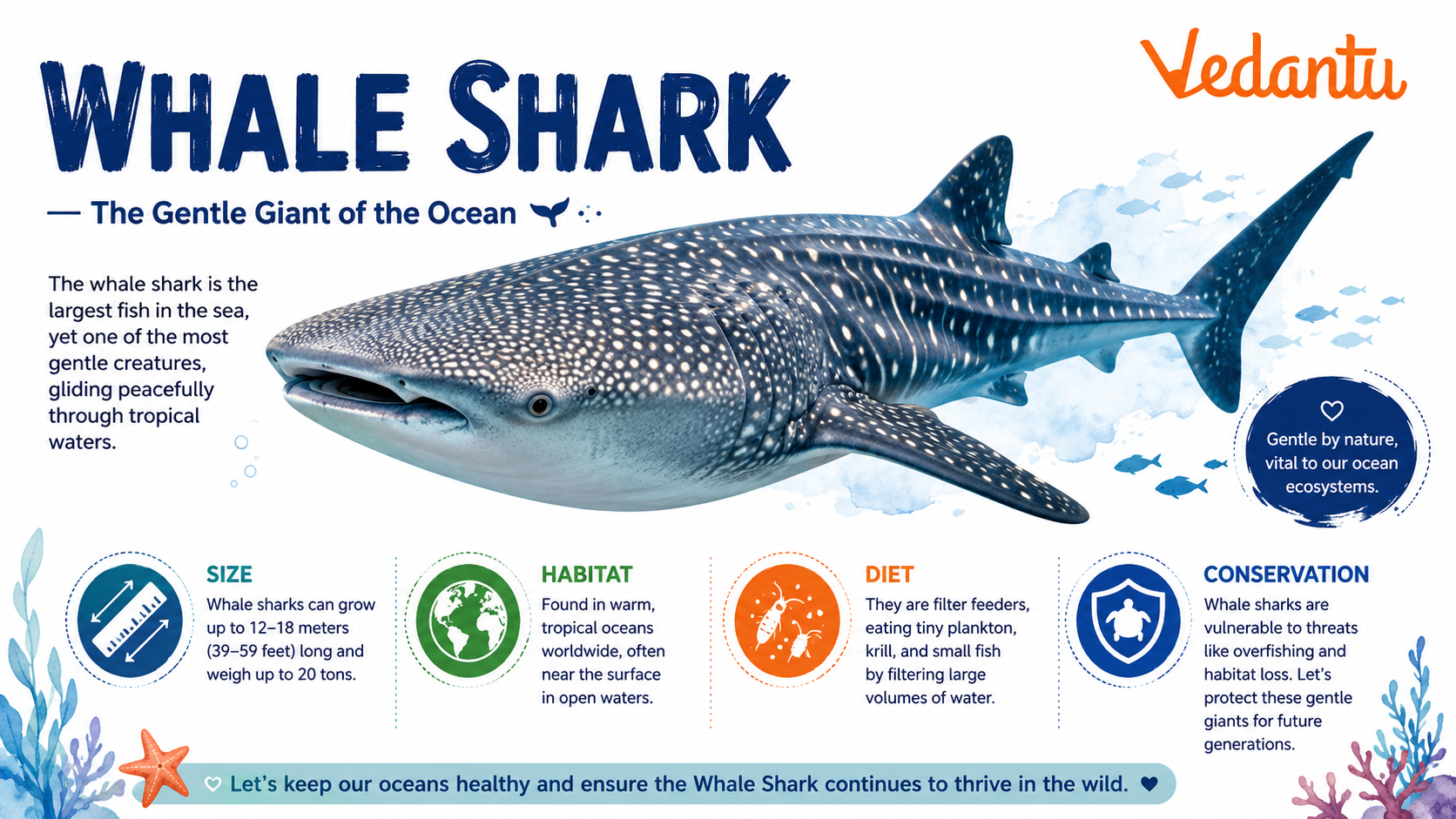
Quick Facts and Statistics
| Feature | Details |
|---|---|
| Common Name | Whale Shark |
| Scientific Name | Rhincodon typus |
| Animal Group | Fish (Shark) |
| Size | Up to 12–18 metres long |
| Weight | Up to 20 tons or more |
| Lifespan | 70–100 years (estimated) |
| Diet | Plankton, small fish, shrimp |
| Habitat | Warm tropical oceans |
| Conservation Status | Endangered |
Appearance and Physical Characteristics
- Huge, wide body with a flat head.
- Dark grey or bluish colour with white spots and stripes.
- Very large mouth that can be up to 1.5 metres wide.
- Tiny teeth (more than 3,000!), but not used for biting large prey.
- Five large gill slits on each side of the head.
Whale Shark Habitat and Distribution
- Found in warm tropical and subtropical oceans.
- Common in the Indian Ocean, Pacific Ocean, and Atlantic Ocean.
- Often seen near coral reefs and coastal areas.
- Prefer water temperatures between 21°C and 30°C.
Diet and Feeding Habits
The Whale Shark diet mainly includes tiny sea organisms. It is a filter feeder, which means it filters food from the water.
- Plankton
- Small fish
- Fish eggs
- Shrimp and other tiny sea animals
Behaviour and Lifestyle
- Mostly solitary (live alone).
- Very slow swimmers.
- Calm and non-aggressive towards humans.
- Sometimes gather in groups where food is plentiful.
- Migrate long distances across oceans.
Whale Shark Life Cycle
- Egg Development: Eggs hatch inside the mother’s body.
- Birth: Babies (called pups) are born alive.
- Young Stage: Pups are about 40–60 cm long at birth.
- Growth: They grow slowly and take many years to become adults.
- Adult Stage: Fully grown adults can reach over 12 metres.
The Whale Shark life cycle is slow, which makes it difficult for their population to grow quickly.
What Makes Whale Sharks Special?
Importance and Role in Nature
Amazing Whale Shark Facts
- They can weigh more than 20,000 kilograms.
- Their mouths are big enough for a human to fit inside.
- They have over 3,000 tiny teeth.
- They are called “whale” sharks because of their size.
- They can live up to 100 years.
- They migrate thousands of kilometres every year.
Fun Facts for Kids
FAQs on Whale Shark: The Gentle Giant of the Ocean
1. What is a Whale Shark?
A Whale Shark is the largest fish in the world and is known for its gentle nature and spotted body.
- Scientific name: Rhincodon typus
- Belongs to the shark family, not whales
- Has a wide, flat head and a huge mouth
- Covered in white spots and stripes for unique identification
- Often called a gentle giant of the ocean
2. How big can a Whale Shark grow?
A Whale Shark can grow as long as a school bus and weigh as much as several elephants.
- Average length: 18–32 feet (5–10 meters)
- Maximum length: up to 40 feet (12 meters) or more
- Weight: around 20 tons
- Largest living fish species on Earth
3. What do Whale Sharks eat?
Despite their huge size, Whale Sharks eat tiny sea creatures using a method called filter feeding.
- Main food: plankton
- Also eat small fish, shrimp, and fish eggs
- Open their big mouths to filter water
- Can filter thousands of gallons of water per hour
4. Where do Whale Sharks live?
Whale Sharks live in warm oceans around the world, especially in tropical seas.
- Found in the Pacific, Atlantic, and Indian Oceans
- Prefer tropical and warm waters
- Often seen near coral reefs and coastal areas
- Migrate long distances for food and breeding
5. Are Whale Sharks dangerous to humans?
No, Whale Sharks are harmless and friendly toward humans.
- They do not attack people
- Have tiny teeth that are not used for biting
- Swim slowly and calmly
- Popular for eco-tourism and snorkeling experiences
6. Why are Whale Sharks called “Whale” Sharks?
They are called Whale Sharks because of their huge size, similar to whales.
- They are actually fish, not mammals
- Breathe through gills, not lungs
- Lay eggs (ovoviviparous species)
- Share size similarities with large whales
7. How long do Whale Sharks live?
Whale Sharks can live for many decades in the ocean.
- Estimated lifespan: 70–100 years
- Grow slowly over time
- Reach maturity around 25–30 years
- Considered a long-living marine species
8. Are Whale Sharks endangered?
Yes, Whale Sharks are classified as endangered due to human activities.
- Status: Endangered (IUCN Red List)
- Threats include fishing and boat strikes
- Harmed by plastic pollution
- Protected in many countries worldwide
9. How do Whale Sharks reproduce?
Whale Sharks reproduce by laying eggs that hatch inside the mother’s body.
- Method: Ovoviviparous reproduction
- Babies are born alive
- Can give birth to over 300 pups at once
- Newborns are about 2 feet long
10. What makes Whale Sharks special?
Whale Sharks are special because they are the biggest fish and have beautiful star-like spots.
- Each shark has a unique spot pattern
- Known as the gentle giant of the sea
- Play an important role in the marine ecosystem
- Inspire ocean conservation and marine biology studies
