






What Do Tiger Sharks Eat and Where Do They Live?
The Tiger Shark is one of the most fascinating and powerful predators in the ocean. Known for the dark, tiger-like stripes on its body, this large shark is a skilled hunter found in warm seas around the world. Tiger Shark facts reveal that it is strong, adaptable, and plays a very important role in keeping marine ecosystems balanced. Let’s explore the Tiger Shark habitat, diet, characteristics, life cycle, and why this amazing shark truly stands out in the underwater world.
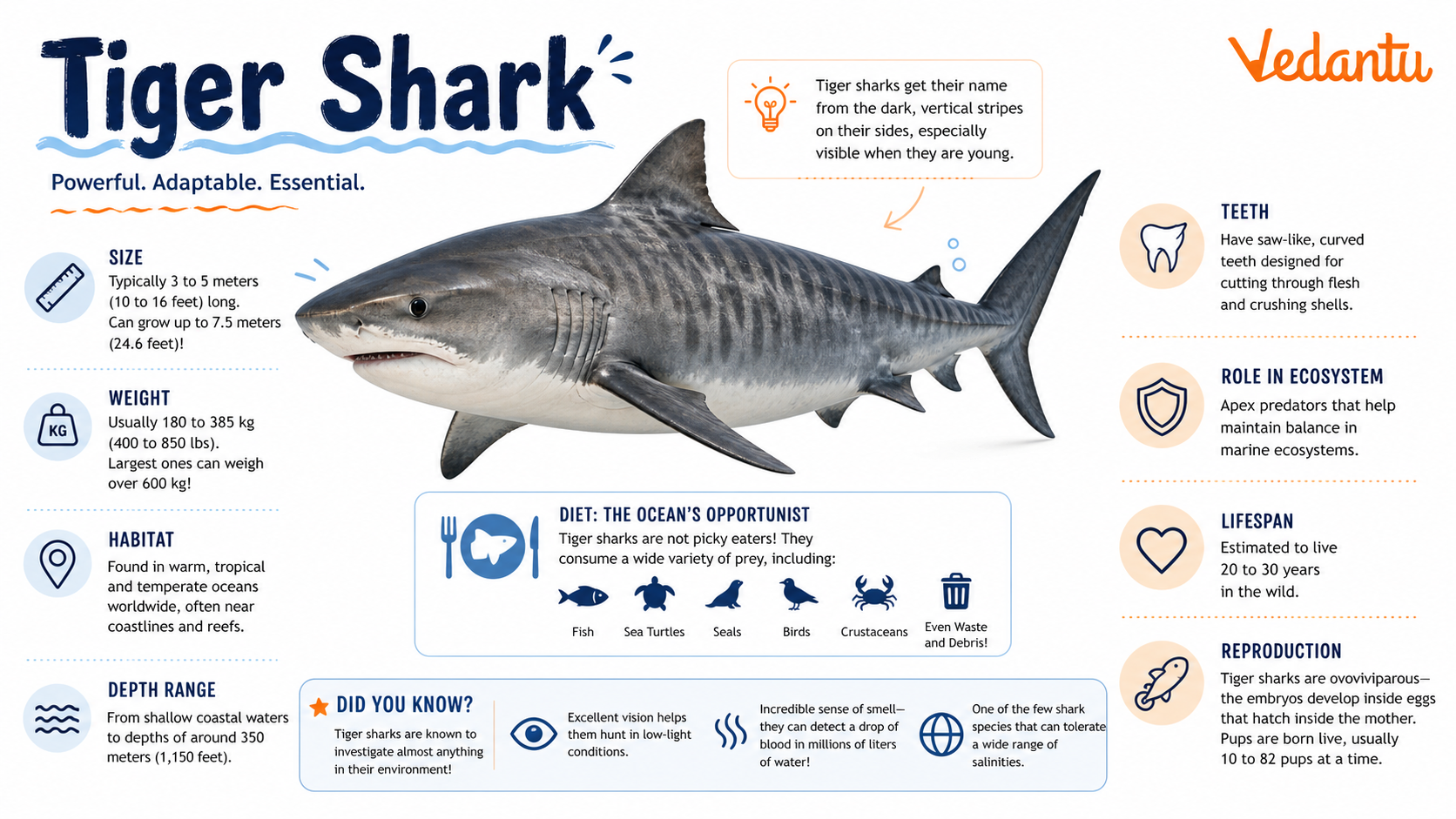
Quick Facts About Tiger Shark
| Feature | Details |
|---|---|
| Common Name | Tiger Shark |
| Scientific Name | Galeocerdo cuvier |
| Animal Group | Fish (Cartilaginous Fish) |
| Size | Up to 5 meters long |
| Weight | Up to 600–900 kg |
| Lifespan | 20–30 years |
| Habitat | Warm tropical and subtropical oceans |
| Diet | Carnivore |
| Conservation Status | Near Threatened |
Appearance and Physical Characteristics
- Large, strong, and heavy body.
- Dark vertical stripes on young sharks, like a tiger.
- Grey to bluish-green back and white belly.
- Wide, blunt nose and powerful tail.
- Sharp, serrated teeth designed for cutting.
One of the most interesting Tiger Shark characteristics is its unique striped pattern. These stripes fade as the shark grows older but are clearly visible in young sharks.
Tiger Shark Habitat and Distribution
- Found in tropical and warm temperate oceans.
- Common in the Atlantic, Pacific, and Indian Oceans.
- Often seen near islands, coral reefs, and coastal areas.
- Can swim in deep waters but also near shore.
The Tiger Shark habitat usually includes warm ocean waters. They prefer areas where food is easily available, such as near coral reefs and coastal regions.
Diet and Feeding Habits
The Tiger Shark diet helps control populations of many marine animals. This keeps the ocean ecosystem balanced.
Behaviour and Lifestyle
- Mostly solitary animals.
- More active at night (nocturnal hunters).
- Strong and steady swimmers.
- Use excellent senses to detect vibrations and smells in water.
Tiger Sharks are calm swimmers but powerful predators. They quietly approach their prey before attacking.
Tiger Shark Life Cycle
- Internal Fertilisation: The female carries fertilised eggs inside her body.
- Live Birth: Tiger Sharks give birth to live young.
- Pups: A female can give birth to 10–80 pups at a time.
- Growth: Young sharks grow independently without parental care.
- Adult Stage: They become mature after several years.
The Tiger Shark life cycle is unique because the babies hatch inside the mother and are born alive.
What Makes Tiger Shark Special?
Importance and Role in Nature
- Maintain balance in marine food chains.
- Control populations of weaker or sick animals.
- Help keep coral reef ecosystems healthy.
The Tiger Shark importance in the ocean is very high. As top predators, they prevent overpopulation of other species and help maintain a healthy marine ecosystem.
Amazing Tiger Shark Facts
Interesting Facts About Tiger Shark
- They are sometimes called the “dustbin of the sea” because of their wide diet.
- Tiger Sharks can grow longer than a small bus.
- They have excellent night vision.
- Young Tiger Sharks have clearer stripes than adults.
Fun Facts for Kids
FAQs on Tiger Shark: Size, Diet, Habitat & Behavior Explained
1. What is a Tiger Shark?
A Tiger Shark is a large, powerful ocean predator known for its striped body and strong hunting skills.
- Scientific name: Galeocerdo cuvier
- Named for the dark tiger-like stripes on young sharks
- Belongs to the requiem shark family
- Found in warm tropical and subtropical oceans
- One of the largest and most famous shark species
2. Why are Tiger Sharks called “garbage eaters”?
Tiger Sharks are called “garbage eaters” because they eat almost anything they find in the ocean.
- Diet includes fish, sea turtles, seals, and seabirds
- They also swallow unusual items like license plates or plastic
- Have a very strong stomach acid to digest tough food
- Known for being opportunistic predators
3. Where do Tiger Sharks live?
Tiger Sharks live in warm coastal waters around the world.
- Common in the Pacific Ocean, Atlantic Ocean, and Indian Ocean
- Often found near coral reefs, islands, and shorelines
- Prefer tropical and subtropical seas
- Sometimes swim close to beaches
4. How big can a Tiger Shark grow?
A Tiger Shark can grow very large, making it one of the biggest shark species in the ocean.
- Average length: 10–14 feet (3–4.5 meters)
- Can weigh over 1,400 pounds (635 kg)
- Females are usually larger than males
- Ranked among the largest predatory sharks
5. Are Tiger Sharks dangerous to humans?
Tiger Sharks can be dangerous, but attacks on humans are rare.
- Considered one of the top three sharks involved in attacks
- Usually attack out of curiosity or confusion
- Humans are not their natural prey
- Most encounters happen in coastal waters
6. What do Tiger Sharks eat?
Tiger Sharks have a very wide diet and are known as ocean scavengers.
- Eat fish, squid, and crustaceans
- Hunt sea turtles, dolphins, and seals
- Sometimes consume dead animals (carrion)
- Use sharp, serrated teeth to cut through shells and bones
7. How do Tiger Sharks hunt?
Tiger Sharks are skilled hunters that use stealth and strong senses to catch prey.
- Hunt mostly at night
- Use excellent smell and vision
- Have special sensors called electroreceptors to detect movement
- Swim quietly before making a fast attack
8. How long do Tiger Sharks live?
Tiger Sharks can live for several decades in the wild.
- Average lifespan: 20–30 years
- Grow slowly compared to smaller fish
- Reach maturity around 7–10 years old
- Lifespan depends on environment and food supply
9. Are Tiger Sharks endangered?
Tiger Sharks are currently listed as Near Threatened due to human activities.
- Threatened by overfishing and shark finning
- Often caught accidentally as bycatch
- Affected by ocean pollution
- Protected in some marine conservation areas
10. How are Tiger Sharks different from Great White Sharks?
Tiger Sharks and Great White Sharks are both large predators but have key differences.
- Tiger Sharks have dark stripes and a varied diet
- Great White Sharks are gray with a white belly
- Tiger Sharks eat almost anything, while Great Whites prefer seals and fish
- Both are powerful apex predators in marine ecosystems
