






What Is a Portuguese Man Of War and How Dangerous Is Its Sting?
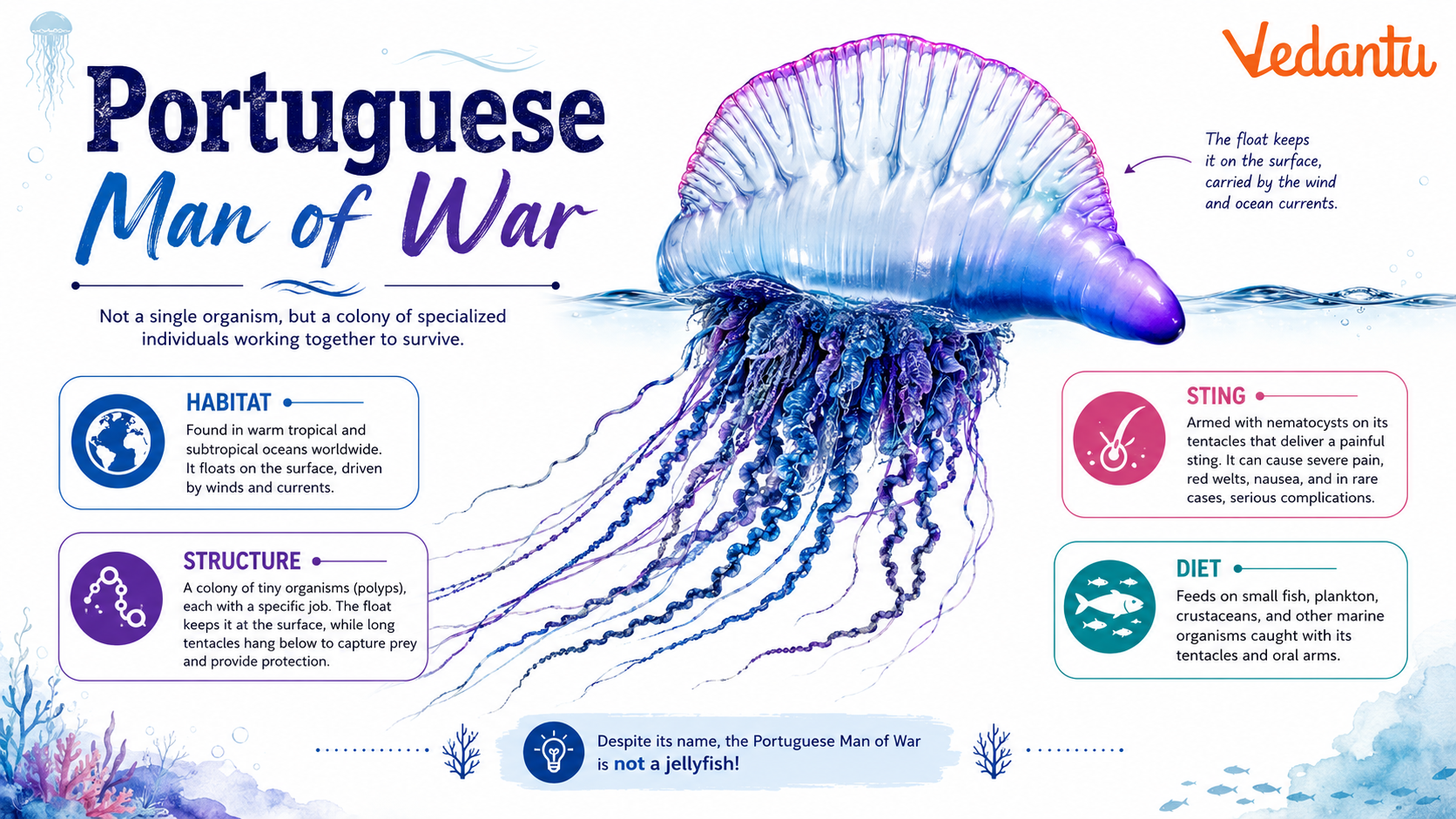
The Portuguese Man Of War is one of the most fascinating and misunderstood ocean creatures. It looks like a jellyfish, but it is actually a colony of tiny animals working together as one! Known for its bright floating balloon and long stinging tentacles, this marine drifter is both beautiful and dangerous. Let’s explore amazing Portuguese Man Of War facts, including its habitat, diet, characteristics, life cycle, and importance in the ocean ecosystem.
Quick Facts and Statistics
| Feature | Details |
|---|---|
| Common Name | Portuguese Man Of War |
| Scientific Name | Physalia physalis |
| Animal Group | Cnidarian (related to jellyfish and corals) |
| Type | Colonial organism (siphonophore) |
| Float Size | Up to 30 cm long |
| Tentacle Length | Up to 30 meters in some cases |
| Habitat | Warm ocean waters worldwide |
| Diet | Small fish and plankton |
| Movement | Drifts with wind and currents |
Appearance and Physical Characteristics
- Has a gas-filled float that looks like a blue or purple balloon.
- The float sits above water like a small sail.
- Long, thin tentacles hang below in the water.
- Tentacles are covered with venom-filled stinging cells.
- Colour ranges from blue and purple to pink.
Portuguese Man Of War Habitat
- Found in warm tropical and subtropical oceans.
- Common in the Atlantic, Pacific, and Indian Oceans.
- Often seen floating near the surface of the sea.
- Sometimes washes up on beaches after strong winds.
The Portuguese Man Of War habitat mainly includes open ocean waters. It does not swim actively. Instead, it floats and moves wherever ocean currents and winds carry it.
Diet and Feeding Habits
Carnivore (meat-eater)
Small fish, fish larvae, and plankton
Uses long venomous tentacles to sting and paralyse prey.
Both predator and prey in the marine ecosystem.
The tentacles contain special cells called nematocysts. When touched, they release venom that stuns prey instantly. The captured food is then passed to feeding zooids for digestion.
Behaviour and Lifestyle
- Not a strong swimmer – depends on wind like a sailboat.
- Lives in groups called fleets.
- Can deliver a painful sting to humans.
- Sting remains active even if the animal is dead.
Even though it looks delicate, the Portuguese Man Of War is a powerful predator. It spends its entire life drifting on the ocean surface.
Portuguese Man Of War Life Cycle
- Reproduction: Special reproductive zooids release eggs and sperm into the water.
- Fertilisation: Eggs develop into tiny larvae in the ocean.
- Colony Formation: The larvae grow into a floating colony with different zooids.
- Adult Stage: Fully formed colony drifts and feeds in open water.
What Makes the Portuguese Man Of War Special?
Importance and Role in Nature
- Controls populations of small fish and plankton.
- Serves as food for sea turtles and certain fish.
- Part of the delicate marine food web.
- Helps scientists study colonial organisms.
Amazing Portuguese Man Of War Facts
- It is often mistaken for a jellyfish but belongs to a different group.
- Its sting can cause intense pain in humans.
- The float is filled with carbon monoxide and other gases.
- Some fish are immune to its venom.
- It can form large groups called armadas.
- Its tentacles can detach and still sting.
Fun Facts for Kids
FAQs on Portuguese Man Of War: Fascinating Ocean Drifter Explained
1. What is a Portuguese Man O' War?
The Portuguese Man O' War is a floating marine animal known for its painful sting and bright blue color.
- It is not a true jellyfish, but a siphonophore made of many tiny animals working together.
- It floats on the ocean surface using a gas-filled blue-purple sail.
- It has long, venomous tentacles used to catch fish.
- It is commonly found in warm ocean waters.
2. Is the Portuguese Man O' War a jellyfish?
The Portuguese Man O' War looks like a jellyfish but is actually a different type of sea creature.
- It belongs to a group called siphonophores.
- It is made up of many tiny organisms called zooids.
- Each zooid has a special job like feeding or reproduction.
- True jellyfish are single animals, not colonies.
3. Where do Portuguese Man O' War live?
The Portuguese Man O' War lives in warm ocean waters around the world.
- Common in the Atlantic Ocean, Pacific Ocean, and Indian Ocean.
- Often found near tropical and subtropical beaches.
- Floats on the surface and moves with wind and ocean currents.
- Sometimes washes ashore after storms.
4. How dangerous is a Portuguese Man O' War sting?
A Portuguese Man O' War sting is very painful but usually not deadly.
- Its tentacles contain strong venom.
- Stings can cause sharp pain, redness, and swelling.
- Some people may have allergic reactions.
- Medical help is needed if breathing problems occur.
5. What should you do if you get stung by a Portuguese Man O' War?
If stung by a Portuguese Man O' War, act quickly and carefully.
- Rinse the area with salt water (not fresh water).
- Carefully remove visible tentacles with tweezers.
- Soak the area in hot water to reduce pain.
- Seek medical help if symptoms are severe.
6. What do Portuguese Man O' War eat?
The Portuguese Man O' War eats small sea animals using its long tentacles.
- Feeds on small fish and plankton.
- Uses venom to paralyze its prey.
- Brings food to special feeding polyps.
- Is an important part of the marine food chain.
7. How long are Portuguese Man O' War tentacles?
The tentacles of a Portuguese Man O' War can grow extremely long.
- They can reach up to 30 meters (100 feet) in length.
- Most are usually around 10 meters long.
- Even broken tentacles can still sting.
- They trail behind the floating blue sail.
8. Why is it called Portuguese Man O' War?
The Portuguese Man O' War is named after old Portuguese warships.
- Its blue sail looks like the sail of a 16th-century warship.
- The name compares its floating shape to a Man-of-War ship.
- It is sometimes called a bluebottle.
- The scientific name is Physalia physalis.
9. Can a dead Portuguese Man O' War still sting?
Yes, a dead Portuguese Man O' War can still sting for days.
- Its venom cells remain active after death.
- Detached tentacles on the beach are still dangerous.
- Never touch one, even if it looks dried out.
- Warn others if you see one ashore.
10. What animals eat the Portuguese Man O' War?
Some ocean animals are natural predators of the Portuguese Man O' War.
- The loggerhead sea turtle eats it safely.
- The blue sea slug (Glaucus atlanticus) feeds on it.
- Some fish species are immune to its venom.
- These predators help balance the marine ecosystem.
