



Key Benefits of One-on-One Math and Science Support for IB Learners
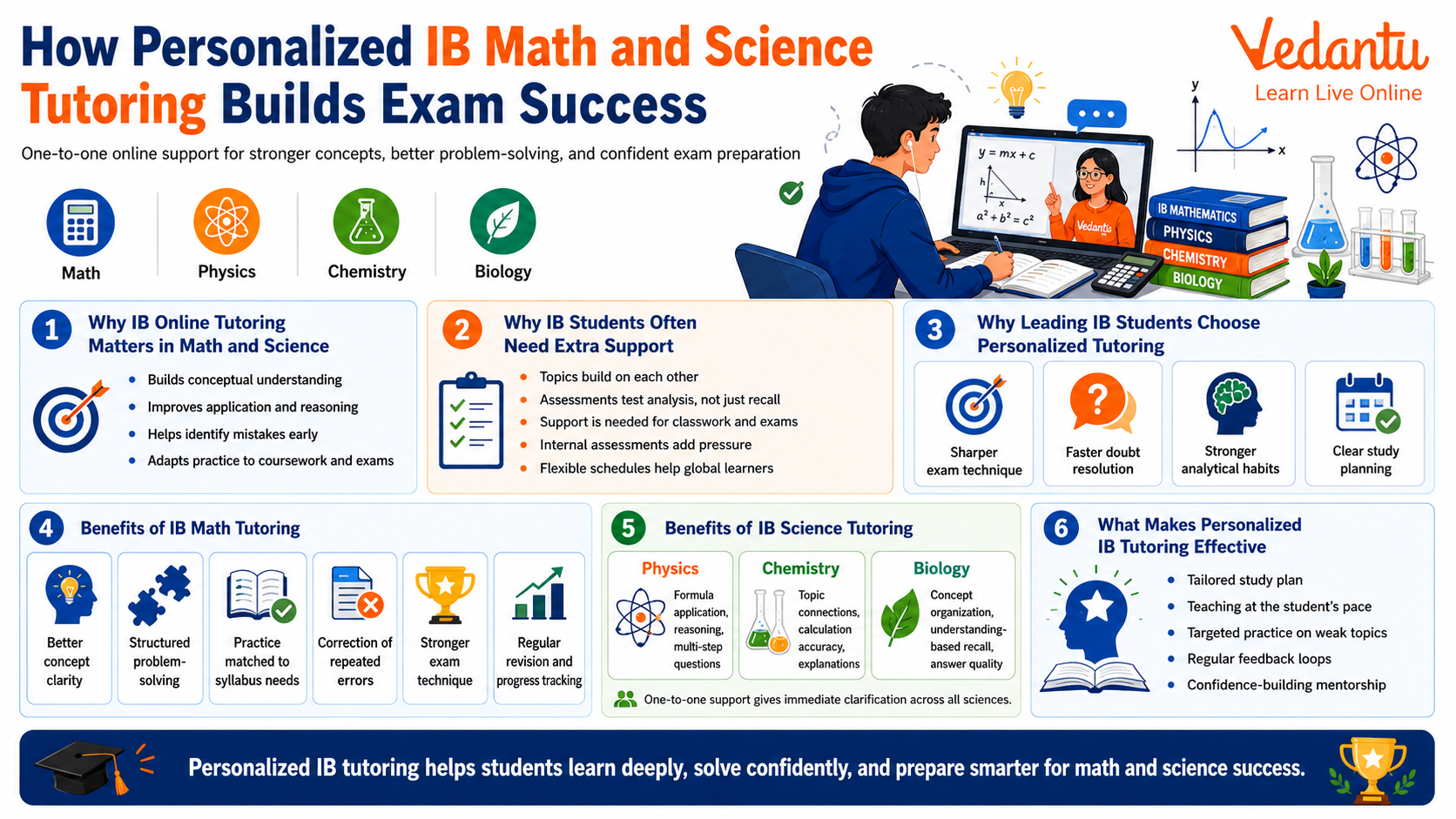
High-achieving IB students can benefit from personalised online maths and science tutoring because it targets the gap between understanding a lesson and applying it independently. Focused feedback helps students uncover hidden misconceptions, tackle unfamiliar problems and make revision more purposeful. The advantage comes from the teaching and practice, not simply from being online. For students and parents, the important decision is whether the support matches the learner’s IB course, current difficulties and goals without replacing independent work.
Find the Best Online Maths tuition for class 12 Achieve Higher Scores with Online Science Tuition
Why Strong IB Students Still Benefit from Targeted Support
Strong classroom performance does not mean every skill is equally secure. A student may handle familiar calculations confidently but struggle to select a method in an unfamiliar context. Another may understand a scientific process yet lose clarity when explaining how evidence supports a conclusion. Personalised tutoring is useful when it identifies these specific differences rather than repeating an entire chapter.
This is particularly relevant in the IB Diploma Programme, which is the focus of the course examples below. Mathematics and science learning involves reasoning, interpretation and application alongside subject knowledge. Tutoring can strengthen those skills, but it is neither essential for every high achiever nor a guarantee of higher grades.
- For a student with uneven foundations: revisit the prerequisite that blocks progress, such as rearranging equations before working on physics calculations.
- For a confident student seeking greater depth: use unfamiliar problems that require choosing and defending a method.
- For a student whose test performance fluctuates: separate conceptual errors from question-reading, notation and time-management problems.
How Personalisation Turns Mistakes into Better Reasoning
Effective personalisation starts with evidence from the student’s work. Instead of asking only which topics feel difficult, a tutor can examine an attempted question and ask the learner to explain each decision. The point where the explanation breaks down often reveals more than the final answer.
- Diagnose: attempt a short set of questions without hints, including one that combines earlier and recent learning.
- Identify the cause: distinguish missing knowledge from an unsuitable method, a calculation slip or an incomplete explanation.
- Teach the missing idea: use a diagram, contrasting examples or a simpler case rather than immediately supplying a full solution.
- Apply independently: solve a related question with different numbers or a different context.
- Revisit later: include the skill in mixed practice to check whether the improvement lasts.
For example, a student who repeatedly chooses the wrong physics equation may not need more formula memorisation. They may need practice identifying the physical model and its assumptions first. Success means recognising that situation in a new question without the tutor’s prompt.
Check Our IB Online Tuition Classes
IB Maths Tutoring Must Match the Course and Level
Diploma students study Mathematics: Analysis and Approaches (AA) or Mathematics: Applications and Interpretation (AI), at Standard Level (SL) or Higher Level (HL). Both require mathematical understanding, but their emphases differ. AA places greater emphasis on analytical methods and mathematical reasoning, while AI emphasises applications, modelling and technology. Lesson planning should match the exact course and level rather than treating “IB maths” as one syllabus.
A useful lesson connects a procedure to its meaning. In calculus, for instance, finding a derivative is only part of the task: the student may also need to interpret its sign, explain a rate of change or decide whether a result makes sense in context. Repeating differentiation exercises alone will not address every one of these needs.
- Method selection: explain why an algebraic, graphical, numerical or statistical approach fits the problem.
- Clear working: show intermediate reasoning and define variables so the solution can be followed.
- Technology use: practise suitable calculator functions where permitted, then interpret the output rather than simply copying it.
- Checking: test whether an answer respects the domain, units and real-world conditions.
For a high achiever, greater challenge should mean deeper reasoning, not just longer calculations. Comparing two valid solutions or explaining why an apparently plausible method fails can expose gaps that routine practice misses.
Science Tutoring Should Develop Explanation and Evidence Skills
Physics, Chemistry and Biology need different teaching approaches. Across all three, students benefit from connecting scientific ideas with calculations, observations and data. A personalised lesson should therefore include explanation and interpretation, not only a review of notes.
Physics: Choose the Model Before the Equation
Students can practise defining the system, drawing a diagram and identifying assumptions before calculating. For example, a constant-acceleration equation is appropriate only when that model fits the motion. Checking units and the physical meaning of the answer then provides a second line of defence against mistakes.
Chemistry: Connect Calculations with Particle-Level Understanding
A student may calculate concentrations correctly but confuse reaction rate with equilibrium position. Targeted questioning can separate these ideas before more difficult problems are introduced. In quantitative work, the tutor can also check whether errors arise from the balanced equation, mole ratios, unit conversion or interpretation of the result.
Biology: Build Explanations Rather Than Lists of Keywords
Biology tutoring can help students organise a causal explanation: what changes, which process is affected and why the outcome follows. When interpreting an unfamiliar graph, students should distinguish what the data show from what they infer. Accurate terminology matters, but keywords cannot replace a clear connection between evidence and explanation.
Choose Your IB Home Tutoring for Success
What the Online Format Adds—and What It Does Not
Online tutoring removes the journey to a lesson and can make it easier to maintain support during travel or relocation, provided schedules and connectivity allow. Where available, shared writing tools let a tutor observe working as it develops. However, online delivery alone does not ensure personalisation: the tutor still needs to notice errors, adjust teaching and leave room for independent attempts.
| Learning Option | Useful For | Main Trade-Off |
|---|---|---|
| Personalised live online tutoring | Discussing individual errors and adapting practice during a lesson. | Requires a suitable tutor, reliable connectivity and agreed lesson times. |
| In-person individual tutoring | Direct interaction for learners who concentrate better face to face. | Location and travel can constrain tutor choice and scheduling. |
| Group lessons | Structured coverage and discussion with peers. | Individual attention depends on group size and lesson design. |
| Recorded lessons and self-study | Revisiting explanations and practising at a chosen time. | Students must identify their own misconceptions or seek feedback separately. |
A student who already studies independently may need occasional targeted sessions rather than a heavy weekly schedule. Someone with several connected gaps may benefit from steadier support. In either case, tutoring should complement school teaching and practical science work, not replace them.
A Practical Routine for Lasting Progress
The most useful tutoring routine includes work before and after the lesson. The following is an illustrative cycle; adjust it around school deadlines and the student’s workload.
- Before the session: send one attempted question and identify the exact step that caused difficulty.
- During the session: explain the original approach, correct the underlying misunderstanding and attempt a new problem without continuous hints.
- Within the next two days: complete a short practice set and record any recurring error.
- Later in the week: retry the skill within mixed questions, without notes, to test retention and method selection.
Track progress through fewer repeated errors, clearer explanations and less dependence on prompts—not simply the number of lessons completed. Before examinations, add timed practice using materials appropriate to the course and assessment session. After each attempt, separate knowledge gaps from avoidable execution errors and practise the relevant skill again.
Confidence becomes more useful when it rests on evidence: “I can now solve this independently.” Vedantu’s discussion of personalised online tuition and student confidence offers further perspective on this connection. Reassurance helps, but independent performance is the stronger test of progress.
Visit Our Vedantu Learning Centres Near You📍
Keep Internal Assessment Support Within Academic Integrity Boundaries
Internal assessment work must remain the student’s own. Tutoring should build general skills, such as understanding uncertainty, evaluating a method or interpreting a graph, rather than producing assessed work. Students should follow their school’s and the IB’s academic integrity requirements and ask their teacher what outside assistance is permitted.
A tutor should not write or rewrite the submission, generate results or fabricate data. A safer approach is to practise the underlying technique on an unrelated example, leaving the student to make and explain decisions in their own investigation.
How Vedantu Can Help Families Evaluate Personalised Support
Vedantu’s resource on one-to-one online tuition for IB maths and science is a relevant starting point for families considering individual support. Use it to frame a practical discussion about the learner’s difficulties and the kind of feedback they need. Reading guidance can help with that decision, but it does not replace a tutor observing and responding to the student’s work.
If considering lessons through Vedantu, confirm current support for the exact IB subject, course and level, along with the teaching format, schedule and fees. Compare the proposed arrangement with group lessons, in-person tutoring and self-study using the same question: will it address a demonstrated learning need while leaving enough time to practise independently?
Summary
Personalised online tutoring can help IB students succeed by uncovering specific gaps, improving reasoning and turning feedback into independent practice. Its value depends on course alignment, thoughtful teaching and the student’s follow-through—not the online format alone. Start with a recent piece of work to identify the support needed, then monitor whether mistakes recur. Vedantu’s relevant learning resources can help families evaluate one-to-one support before choosing an arrangement that fits the student’s goals and workload.
FAQs on How Personalized Online Tutoring Empowers IB Students in Math and Science
1. How does personalized online math and science tutoring help IB students succeed?
Personalized online tutoring tailors instruction to each student’s specific strengths, weaknesses, and learning style, helping IB students excel. Key benefits include:
- Individual attention to target tricky topics quickly.
- Flexible learning pace to master the IB syllabus before assessments.
- Interactive sessions using technology and digital resources.
- Feedback and strategies specific to IB curriculum and exam formats.
2. What subjects in math and science can IB students get help with online?
IB students can receive online tutoring in a wide range of math and science subjects such as:
- Mathematics: Analysis & Approaches and Applications & Interpretation
- Physics, Chemistry, and Biology
- Other IB Science electives including Computer Science and Environmental Systems
- Support available for standard level (SL) and higher level (HL) topics
3. Are online IB math and science tutors experienced with the 2026-27 IB exam pattern?
Yes, top online IB tutors are well-versed with the latest 2026-27 IB syllabus and exam pattern. They use:
- Current IB curriculum materials and past papers
- Up-to-date marking schemes and question types
- Exam strategies for both internal assessments and final exams
4. Can personalized tutoring improve IB predicted grades and internal assessment scores?
Personalized tutoring can significantly boost both predicted grades and internal assessment (IA) scores by offering:
- Focused attention on student’s weak areas
- Guided practice in IA research, calculations, and presentation
- Expert feedback on drafts and project work
5. How are Vedantu’s IB tutors selected for math and science subjects?
Vedantu’s IB tutors are chosen through a rigorous process that includes:
- Subject matter expertise in IB-level math and science
- Demonstrated teaching experience with IB students
- Regular training in current IB standards and teaching methods
6. Is personalized online tutoring suitable for students at both SL and HL in IB?
Yes, personalized online tutoring effectively supports both Standard Level (SL) and Higher Level (HL) IB students, providing targeted content and practice suitable for each level’s complexity and requirements.
7. Can IB students access flexible scheduling for online math and science tutoring?
Flexible scheduling is a key advantage of online tutoring. IB students can:
- Book sessions that fit their school and activity timetable
- Arrange extra sessions before exams
- Access help on weekends and evenings
8. How does progress tracking work in personalized online IB tutoring?
Progress tracking is achieved through:
- Regular assessments and topic quizzes
- Session reports highlighting strengths and areas for improvement
- Goal setting aligned to the IB exam schedule
9. What technology or tools are used in IB math and science online sessions?
Online IB tutoring uses digital tools such as:
- Interactive whiteboards for real-time problem-solving
- Screen sharing for working through textbook questions
- Resource libraries with IB practice papers and worksheets
10. Can online IB tutoring help with extended essay planning in science or math?
Yes, experienced tutors guide students in extended essay (EE) planning by providing:
- Topic selection aligned with IB guidelines
- Advice on research methodology and structuring
- Feedback on drafts to meet assessment criteria
11. How can parents track their child’s improvement with Vedantu’s IB online tutoring?
Parents can monitor progress through:
- Session summaries from tutors
- Regular feedback on strengths and areas to improve
- Progress reports aligned to IB subject targets
12. What are the main advantages of choosing personalized online tutoring for IB exam preparation?
Personalized online tutoring offers several advantages for IB exam preparation, including:
- Customized learning plans per student’s needs
- Instant doubt resolution
- In-depth practice of IB question types
- Flexible timing and access to expert resources



