






What Is a Newt? Habitat, Diet, Life Cycle, and Types Explained
Newts are small, colourful amphibians that spend their lives both in water and on land. They are closely related to salamanders and are famous for their smooth skin and amazing ability to regrow lost body parts. From quiet ponds to damp forests, the newt habitat is usually cool and moist. Let’s explore exciting Newt facts, their characteristics, diet, life cycle, and why they are important in nature.
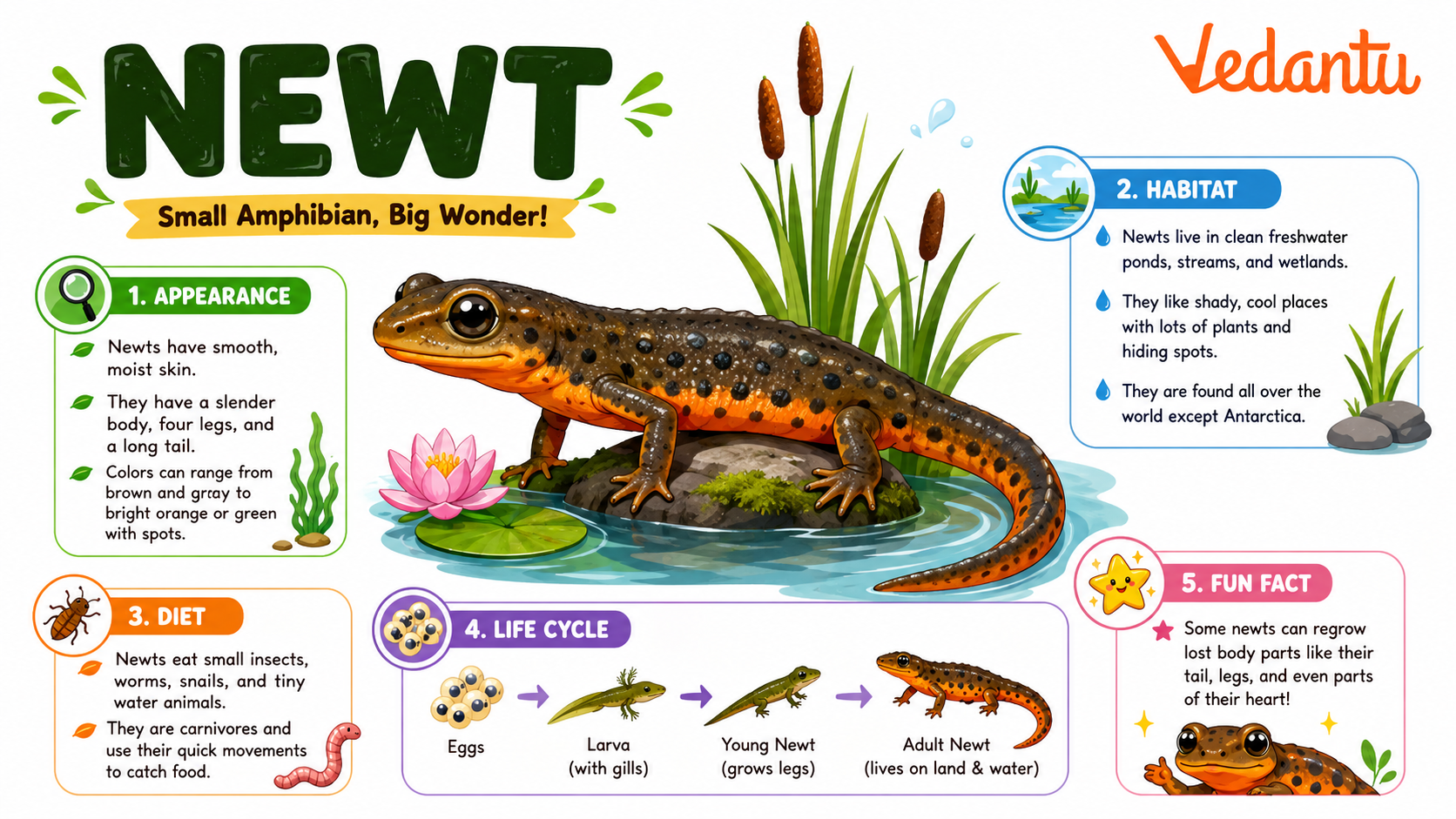
Quick Facts About Newt
| Feature | Details |
|---|---|
| Common Name | Newt |
| Animal Group | Amphibian |
| Scientific Family | Salamandridae |
| Size | 7–15 cm (varies by species) |
| Lifespan | 10–15 years (some live longer) |
| Habitat | Ponds, lakes, marshes, damp forests |
| Diet | Carnivore (insects, worms, small aquatic animals) |
| Special Feature | Can regenerate limbs and even parts of the heart |
| Conservation Status | Varies by species (some threatened) |
Appearance and Physical Characteristics
- Small, slender body with a long tail.
- Smooth or slightly rough, moist skin.
- Bright colours like orange, yellow, brown, or green.
- Some species have spotted or striped patterns.
- Four short legs and a flat tail for swimming.
Newt Habitat and Distribution
- Found in North America, Europe, and parts of Asia.
- Prefer freshwater habitats like ponds and slow-moving streams.
- Also live in damp forests and grasslands.
- Need moist environments to keep their skin healthy.
The newt habitat changes during its life. They usually return to water during the breeding season and spend the rest of the year on land under logs, rocks, or leaves.
Diet and Feeding Habits
Newts are carnivores.
Eat insects, worms, and small spiders.
Feed on small fish, tadpoles, and aquatic insects.
Catch prey quickly using their sticky tongue.
Behaviour and Lifestyle
- Mostly solitary animals.
- Active during the night (nocturnal).
- Move slowly but swim well.
- Release mild toxins from their skin for protection.
- Hibernate during very cold weather.
Newt Life Cycle
- Egg Stage: Female lays eggs in water, attaching them to plants.
- Larva Stage: Baby newts hatch with gills and live fully in water.
- Juvenile Stage: Undergo metamorphosis and develop lungs.
- Adult Stage: Live both on land and in water and reproduce.
The Newt life cycle is similar to frogs because both undergo metamorphosis from water-breathing larvae to air-breathing adults.
What Makes Newt Special?
Importance and Role in Nature
- Control insect populations by eating pests.
- Serve as food for birds, fish, and snakes.
- Help scientists study regeneration and medical research.
- Indicate clean and healthy freshwater ecosystems.
Amazing Newt Facts
Interesting Facts About Newt
- Baby newts are sometimes called “efts.”
- Some species have rough skin while others are very smooth.
- Newts communicate using chemical signals in water.
- They can change habitats depending on season.
Fun Facts for Kids
FAQs on Newt: Fascinating Facts About This Unique Amphibian
1. What is a newt?
A newt is a small amphibian that lives both in water and on land.
- Newts belong to the salamander family.
- They have smooth or slightly rough skin and long tails.
- Newts are found in ponds, lakes, forests, and wetlands.
- They are known for their ability to regrow body parts like tails and legs.
2. Where do newts live?
Newts live in both water and on land depending on their life stage.
- They lay eggs in freshwater ponds and lakes.
- Young newts (larvae) live fully in water.
- Adult newts often move to forests, grasslands, and wetlands.
- During breeding season, they return to the water.
3. What do newts eat?
Newts are carnivores that eat small animals and insects.
- They feed on worms, insects, and slugs.
- In water, they eat small fish, tadpoles, and aquatic insects.
- Baby newts eat tiny water creatures like daphnia.
4. Are newts poisonous?
Some newts are poisonous and can release toxins to protect themselves.
- They produce toxins through their skin glands.
- The bright colors of some species warn predators.
- The rough-skinned newt is one of the most toxic species.
5. How do newts reproduce?
Newts reproduce by laying eggs in water during breeding season.
- Males perform a courtship dance to attract females.
- Females lay eggs on aquatic plants.
- Eggs hatch into larvae with gills.
- Larvae grow into adults through metamorphosis.
6. What is the life cycle of a newt?
The life cycle of a newt includes egg, larva, juvenile, and adult stages.
- Egg: Laid in freshwater.
- Larva: Lives in water with gills.
- Juvenile (eft stage): Moves to land.
- Adult: Returns to water to breed.
7. Can newts regrow body parts?
Yes, newts can regrow lost body parts through regeneration.
- They can regrow tails and legs.
- Some species can even repair parts of their heart and spinal cord.
- This ability helps them survive predator attacks.
8. What is the difference between a newt and a salamander?
All newts are salamanders, but not all salamanders are newts.
- Newts usually have rougher skin.
- They spend more time in water during adulthood.
- Salamanders can live fully on land or in water.
9. How long do newts live?
Newts can live for many years, often between 6 to 15 years.
- Some species live up to 20 years in the wild.
- Lifespan depends on species, habitat, and predators.
- Pet newts may live longer with proper care.
10. Are newts good pets?
Newts can be pets, but they need special care and a proper habitat.
- They require a clean tank with water and land areas.
- Water must be dechlorinated and kept cool.
- They eat live food like worms and insects.
- Handling should be limited because of their delicate skin.
