






Lamprey Life Cycle, Habitat, Diet, and Surprising Facts
Lampreys are unusual, eel-like fish known for their round, sucker-shaped mouths filled with tiny teeth. These ancient creatures have existed for more than 360 million years, even before dinosaurs! Found in both freshwater and oceans, lampreys are famous for their unique feeding style and fascinating life cycle. Learning about Lamprey facts, Lamprey habitat, Lamprey diet, and Lamprey characteristics helps us understand how these primitive fish survive and why they are important to aquatic ecosystems.
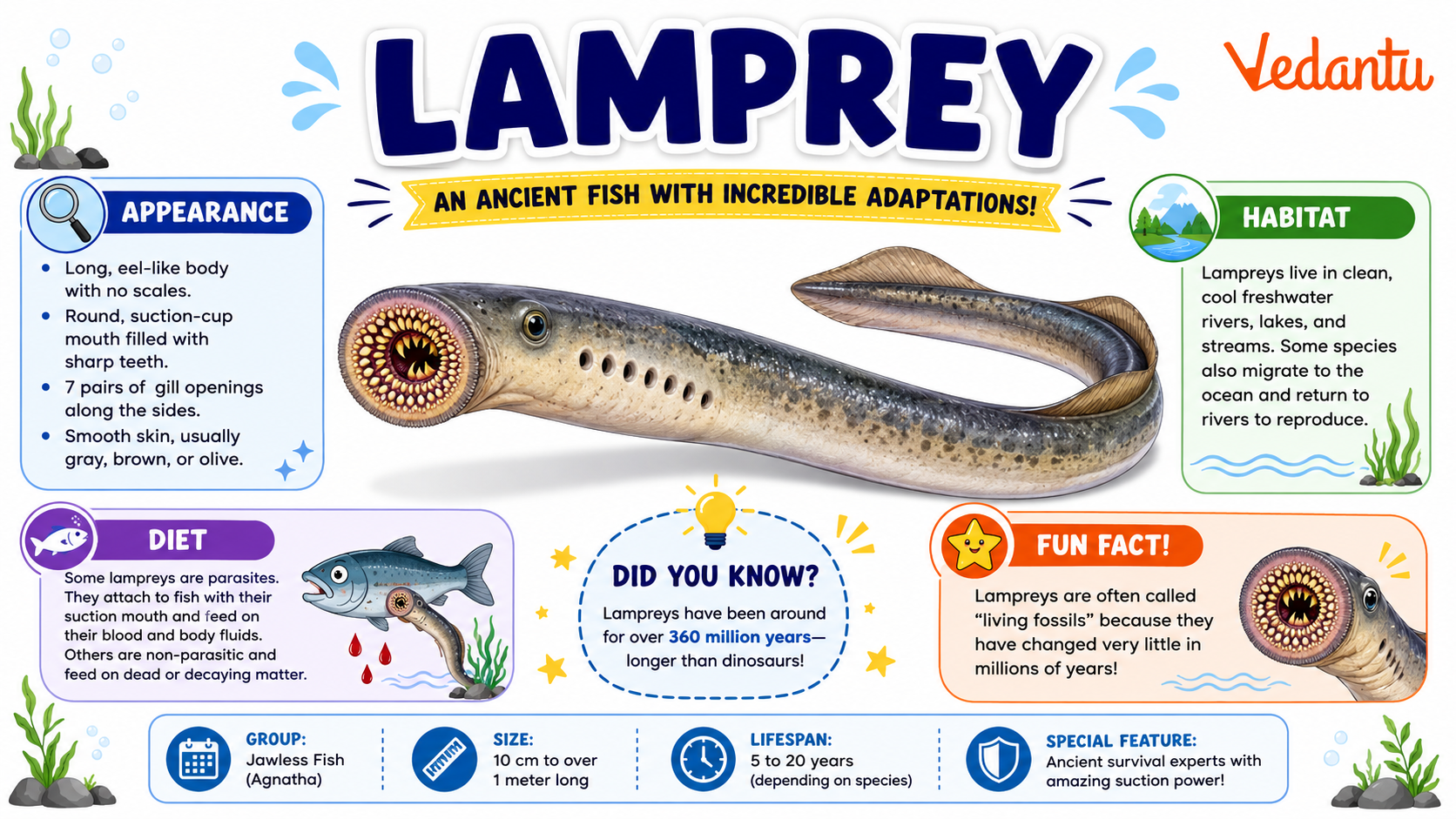
Quick Facts About Lamprey
| Feature | Details |
|---|---|
| Common Name | Lamprey |
| Scientific Group | Petromyzontiformes |
| Animal Group | Jawless Fish (Agnatha) |
| Size | 13–100 cm (depending on species) |
| Lifespan | Up to 20 years |
| Habitat | Freshwater rivers, lakes, and oceans |
| Diet | Blood and body fluids of fish (many species) |
| Special Feature | Round suction mouth with rows of teeth |
Appearance and Physical Characteristics
- Long, eel-like body without scales.
- No jaws – instead, they have a circular mouth.
- Mouth is filled with many small, sharp teeth.
- Smooth, slimy skin.
- No paired fins like most fish.
- Seven gill openings on each side of the body.
Lamprey Habitat and Distribution
- Some live only in freshwater rivers and lakes.
- Others live in the ocean but return to rivers to reproduce.
- Found in North America, Europe, Asia, and parts of the Southern Hemisphere.
- Prefer cold to moderate water temperatures.
During their early life stage, young lampreys stay buried in soft mud or sand at the bottom of streams, where they are safe from predators.
Lamprey Diet and Feeding Habits
The Lamprey diet plays an important role in the aquatic food chain. However, in some regions like the Great Lakes, invasive lampreys have harmed fish populations.
Behaviour and Lifestyle
- Mostly active at night.
- Swim in a snake-like movement.
- Use their suction mouth to attach to rocks or fish.
- Some species migrate long distances to reproduce.
- Adults usually die after spawning.
Lamprey Life Cycle
- Egg Stage: Females lay thousands of eggs in nests built in riverbeds.
- Larva (Ammocoete): Blind, worm-like larvae live buried in mud for several years.
- Metamorphosis: Body changes into adult form with developed eyes and mouth.
- Adult Stage: Migrate to oceans or lakes to feed.
- Spawning: Return to freshwater to reproduce, then die.
What Makes Lamprey Special?
Importance and Role in Nature
- Serving as food for birds, mammals, and larger fish.
- Helping recycle nutrients in rivers.
- Supporting scientific research on evolution.
- Indicating water quality in freshwater systems.
Amazing Lamprey Facts
Fun Facts for Kids
- Lampreys look like eels but are not true eels.
- Baby lampreys live hidden in mud.
- Some adults stop eating completely.
- They breathe through small holes behind their eyes.
- They are sometimes called “vampire fish.”
FAQs on Lamprey: Complete Guide to This Ancient Jawless Fish
1. What is a lamprey?
A lamprey is a long, eel-like fish that has no jaws and a round, suction-cup mouth.
- It belongs to a group of ancient fish called jawless fish
- It has a skeleton made of cartilage, not bone
- It is sometimes called a parasitic fish
- It has existed for over 360 million years
2. Are lampreys dangerous to humans?
Lampreys are generally not dangerous to humans.
- They mostly attach to fish, not people
- They use their suction mouth to feed on fish blood
- Human attacks are extremely rare
- They are more harmful to commercial fish populations
3. Where do lampreys live?
Lampreys live in both freshwater and saltwater environments.
- Some species live in oceans
- Others live in rivers and lakes
- They often return to freshwater to spawn (lay eggs)
- The sea lamprey is common in the Great Lakes
4. What do lampreys eat?
Most lampreys feed by attaching to fish and sucking their blood and body fluids.
- They use a round suction-cup mouth
- They have sharp, horn-like teeth
- Some species do not eat as adults
- Young lampreys feed on tiny microscopic plants and animals
5. How are lampreys different from eels?
Lampreys look like eels, but they are very different animals.
- Lampreys have no jaws, while eels do
- Lampreys have a round sucking mouth
- Eels are true bony fish
- Lampreys are more ancient than eels
6. How do lampreys reproduce?
Lampreys reproduce by laying eggs in freshwater streams.
- Adults build a small nest in gravel
- Females lay thousands of tiny eggs
- Larvae are called ammocoetes
- Many adults die after spawning
7. Why are sea lampreys a problem in the Great Lakes?
The sea lamprey is considered an invasive species in the Great Lakes.
- They attack valuable fish like trout and salmon
- They reduce fish populations
- They affect commercial fishing industries
- Control programs are used to manage them
8. How big do lampreys grow?
Lampreys can grow from a few inches to over three feet long.
- Small species may be about 6 inches
- Larger species can reach 3 feet (1 meter)
- Size depends on the species and habitat
- Sea lampreys are among the largest
9. Do lampreys have bones?
Lampreys do not have true bones; they have a skeleton made of cartilage.
- Cartilage is softer than bone
- It is similar to what sharks have
- They also have a simple backbone structure
- This makes them part of the primitive fish group
10. How long have lampreys existed on Earth?
Lampreys have lived on Earth for more than 360 million years.
- They appeared before dinosaurs
- They are one of the oldest living vertebrates
- Fossils show little change over time
- They survived several mass extinctions
