






Gayal Habitat, Diet, Behavior, and Cultural Importance Explained
The Gayal is a large and powerful wild cattle species found mainly in the hilly forests of South and Southeast Asia. It looks similar to a bison or gaur but has its own unique identity. Known for its strength and calm nature, the Gayal plays an important role in forest ecosystems and local tribal cultures. Learning about Gayal facts, Gayal habitat, Gayal diet, and Gayal characteristics helps us understand this rare and fascinating animal better.
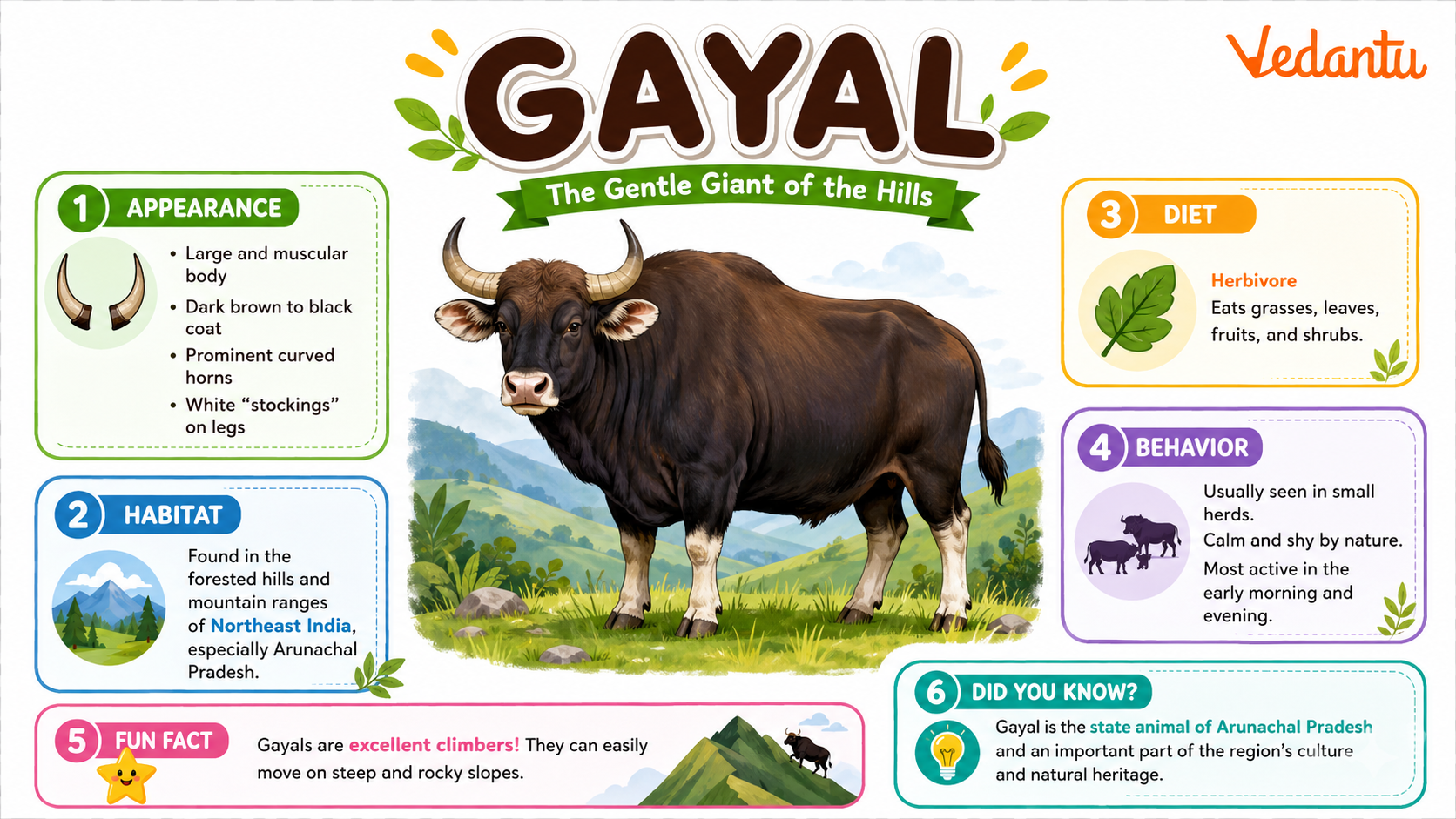
Quick Facts About Gayal
| Feature | Details |
|---|---|
| Common Name | Gayal |
| Scientific Name | Bos frontalis |
| Animal Group | Mammal |
| Family | Bovidae (Cattle family) |
| Height | Up to 1.7–1.9 meters at the shoulder |
| Weight | 600–1000 kg |
| Diet | Herbivore (grass, leaves, shrubs) |
| Habitat | Hilly forests and grasslands |
| Found In | India, Myanmar, Bangladesh, Bhutan |
| Young One | Calf |
Appearance and Physical Characteristics
- Large, muscular body with a strong build.
- Dark brown to black coat.
- White “stocking-like” markings on lower legs.
- Broad chest and slightly raised back.
- Short but strong curved horns in both males and females.
- Large head with a wide forehead.
Gayal Habitat and Distribution
- Lives in forested hills and mountainous regions.
- Prefers tropical and subtropical climates.
- Often found in open forest clearings and grassy slopes.
- Usually stays near water sources like streams.
The Gayal habitat mainly includes the northeastern states of India such as Arunachal Pradesh, Nagaland, and Mizoram. It is also found in Myanmar, Bangladesh, and Bhutan. In some areas, Gayals are semi-domesticated and cared for by local tribal communities.
Diet and Feeding Habits
Type: Herbivore
- Feeds mainly on grasses.
- Eats leaves, shrubs, and forest plants.
- Sometimes grazes in open fields.
As a plant-eating mammal, the Gayal diet helps maintain forest balance. By grazing and browsing, it controls plant growth and supports a healthy ecosystem.
Behaviour and Lifestyle
Life Cycle of Gayal
- Birth: Female gives birth to one calf after a gestation period of about 9 months.
- Calf Stage: The calf stays close to its mother for protection and feeding.
- Growth: Young Gayals grow rapidly and start grazing within a few months.
- Adult Stage: They reach maturity in about 2–3 years.
The Gayal life cycle is similar to other cattle species, with strong maternal care during early stages.
What Makes Gayal Special?
Temperament and Human Relationship
- Generally calm when raised by humans.
- Used in traditional ceremonies and cultural events.
- Valued as a symbol of wealth in some tribal societies.
- Requires large open spaces and natural grazing areas.
Importance and Role in Nature
Amazing Facts About Gayal
- Gayal is sometimes called the “Mithun” in India.
- It is the state animal of Arunachal Pradesh.
- Can weigh nearly as much as a small car.
- Has strong legs adapted for climbing slopes.
- Closely related to domestic cattle and gaur.
- Its white leg markings make it easy to identify.
- Plays a major role in tribal festivals and traditions.
Fun Facts for Kids
FAQs on Gayal (Bos frontalis): Complete Guide to This Rare Mountain Bovine
1. What is a Gayal?
Gayal is a large domesticated bovine animal found mainly in South and Southeast Asia.
- The Gayal (Bos frontalis) is also called the Mithun.
- It belongs to the cattle family and is related to the Gaur (Indian bison).
- Gayals are strong, gentle animals raised by tribal communities.
- They are important for culture, farming, and food.
2. Where is the Gayal found?
The Gayal is mainly found in the hilly forests of South and Southeast Asia.
- Common in Northeast India (Arunachal Pradesh, Nagaland, Mizoram, Manipur).
- Also found in Myanmar, Bangladesh, and Bhutan.
- Lives in forested hills and grasslands.
- Prefers cool, green areas with plenty of plants.
3. What does a Gayal look like?
A Gayal is a large, muscular animal with a strong body and curved horns.
- Has a dark brown or black coat.
- Features white “stocking” legs.
- Both males and females have short, thick horns.
- Has a broad chest and powerful legs.
4. What do Gayals eat?
The Gayal is a herbivore, which means it eats only plants.
- Feeds on grass, leaves, shrubs, and bamboo.
- Grazes in forests and open fields.
- Drinks plenty of fresh water.
- Helps maintain the forest ecosystem by grazing.
5. Is the Gayal different from a cow?
Yes, the Gayal is different from a regular cow, although both belong to the cattle family.
- The Gayal is larger and more muscular than most domestic cows.
- It is closely related to the wild Gaur (Indian bison).
- Gayals are mainly raised in tribal regions.
- They are less common than normal farm cattle.
6. Why is the Gayal important to people?
The Gayal is very important for cultural, social, and economic reasons.
- Considered a symbol of wealth and pride among tribal communities.
- Used in traditional ceremonies and festivals.
- Provides meat and other resources.
- Represents cultural heritage in Northeast India.
7. What is the scientific name of the Gayal?
The scientific name of the Gayal is Bos frontalis.
- It belongs to the Bovidae family.
- Closely related to Gaur (Bos gaurus).
- Sometimes called Mithun cattle.
- Classified as a domesticated bovine species.
8. How big can a Gayal grow?
A Gayal can grow very large and strong compared to regular cattle.
- Can weigh between 600 to 1,000 kilograms.
- Stands about 1.5 to 1.7 meters tall at the shoulder.
- Males are usually bigger and heavier than females.
- Has a strong, muscular build.
9. Is the Gayal endangered?
The Gayal is not fully endangered, but its population is limited and needs protection.
- Numbers are smaller compared to common cattle breeds.
- Threatened by habitat loss and crossbreeding.
- Protected and valued in Northeast India.
- Conservation helps preserve its genetic diversity.
10. What is another name for Gayal?
Another common name for the Gayal is Mithun.
- Known as Mithun cattle in India.
- Scientifically called Bos frontalis.
- Sometimes linked with the Indian bison due to its relation to Gaur.
- Respected as a state animal of Arunachal Pradesh and Nagaland.
