






What Makes the Frigate Bird Unique? Size, Red Pouch, Diet & Habitat Explained
The Frigate Bird is one of the most fascinating seabirds in the world. Famous for its long wings, forked tail, and the bright red throat pouch of males, this bird is built for life in the sky. It can glide for hours over oceans without flapping much! Known for stealing food from other birds mid-air, the Frigate Bird has earned the nickname “pirate of the sea.” Let’s explore amazing Frigate Bird facts, habitat, diet, characteristics, and life cycle in a fun and simple way.
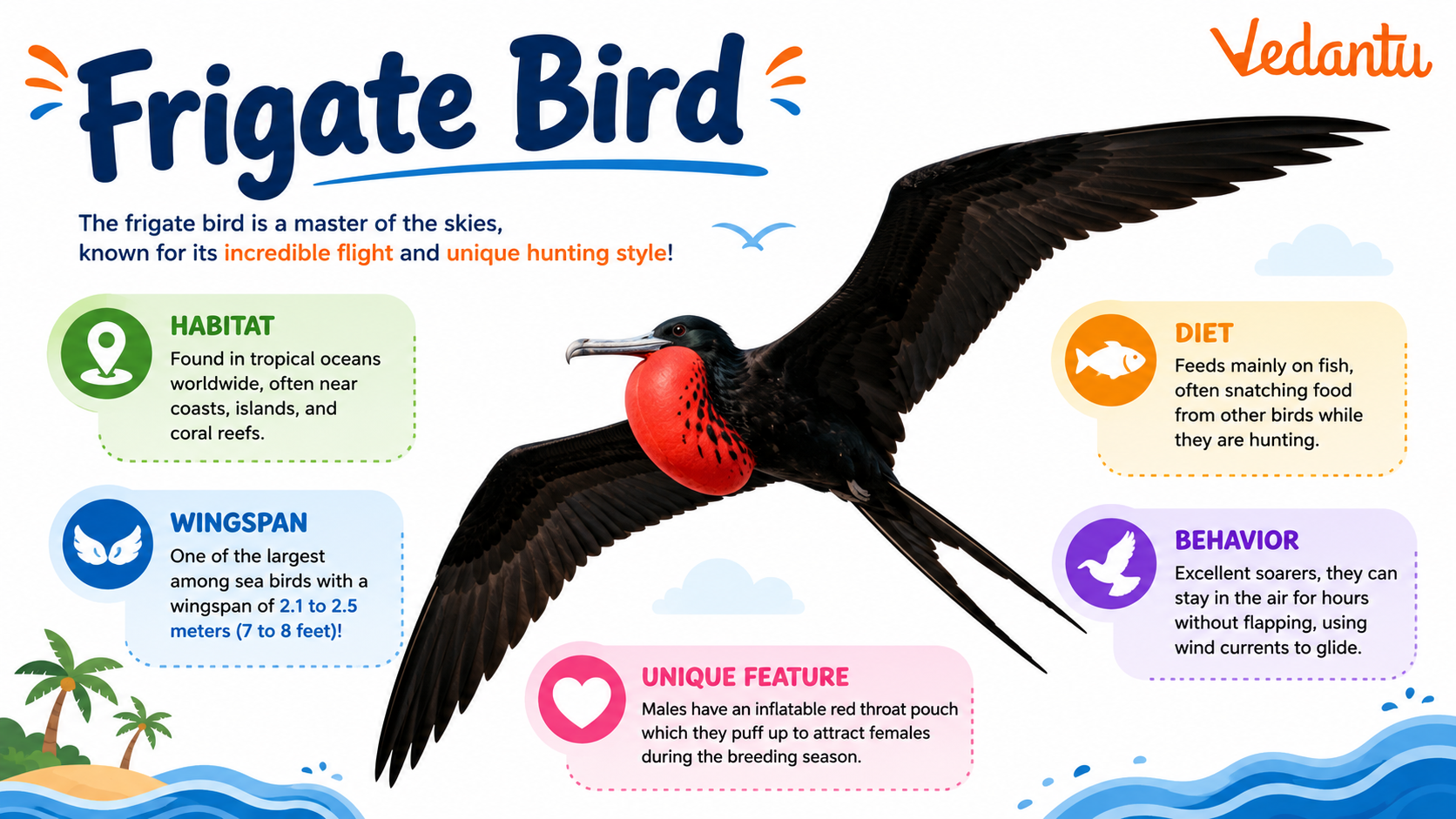
Quick Facts and Statistics
| Feature | Details |
|---|---|
| Common Name | Frigate Bird |
| Scientific Name | Fregata (Genus) |
| Animal Group | Bird (Seabird) |
| Wingspan | Up to 2.3 metres |
| Weight | 1–1.8 kg |
| Lifespan | 25–30 years |
| Habitat | Tropical and subtropical oceans |
| Diet | Fish, squid, and stolen prey |
| Conservation Status | Mostly Least Concern (varies by species) |
Appearance and Physical Characteristics
- Very long, narrow wings for gliding.
- Deeply forked tail for balance and steering.
- Lightweight body.
- Males have a bright red throat pouch called a gular sac.
- Females are larger and have white patches on their chest.
Habitat and Distribution
The Frigate Bird habitat mainly includes warm ocean regions. They are true seabirds and rarely land on water.
- Found in tropical and subtropical oceans.
- Common near islands and coastal regions.
- Nest on trees or low bushes on islands.
- Prefer warm climates with strong sea winds.
They are seen in parts of the Pacific Ocean, Atlantic Ocean, and Indian Ocean.
Diet and Feeding Habits
The Frigate Bird diet is mainly carnivorous.
Small fish, squid, and marine animals near the ocean surface.
They chase other birds and force them to drop their food in mid-air.
They grab prey from the water surface without landing.
They help control fish and squid populations.
Behaviour and Lifestyle
- Spend most of their life flying over the ocean.
- Can stay in the air for weeks.
- Social birds during nesting season.
- Rarely swim because their feathers are not waterproof.
- Strong and skilled aerial hunters.
Life Cycle and Reproduction
- Nesting: Build nests on trees or shrubs on islands.
- Egg: Female lays one egg at a time.
- Chick: Both parents feed the chick.
- Growth: Chicks take many months to learn flying.
- Adult: Reach maturity after several years.
The Frigate Bird life cycle is slower than many other birds because chicks depend on parents for a long time.
Flight Adaptations
Perfect for soaring and gliding with little effort.
Helps them stay in the air longer.
Provides excellent control while flying.
Support powerful wing movement.
Types and Diversity
There are five main species of Frigate Birds:
- Magnificent Frigatebird
- Great Frigatebird
- Lesser Frigatebird
- Christmas Island Frigatebird
- Ascension Frigatebird
Importance and Role in Nature
Amazing Facts About Frigate Bird
- They have one of the largest wingspans compared to body weight.
- They cannot swim like many other seabirds.
- Males display bright red throat pouches.
- They can fly over 400 km in a single day.
- They are sometimes called “Man-of-War birds.”
- They are expert gliders using warm air currents.
Interesting Facts About Frigate Bird
- They rarely land on the ocean surface.
- Their feathers are not waterproof.
- Females are larger than males.
- They can stay airborne for weeks.
Fun Facts for Kids
FAQs on Frigate Bird: Amazing Facts About This Ocean Sky Hunter
1. What is a Frigate Bird?
A Frigate Bird is a large tropical seabird famous for its long wings and bright red throat pouch.
- Belongs to the family Fregatidae
- Found over tropical oceans and islands
- Has very long, narrow wings for soaring
- Often called the "pirate bird" because it steals food from other birds
- Related search terms: seabirds, ocean birds, tropical birds
2. Where do Frigate Birds live?
Frigate Birds live in warm tropical and subtropical ocean regions around the world.
- Common in the Pacific Ocean, Indian Ocean, and Atlantic Ocean
- Nest on remote tropical islands
- Prefer warm climates near the equator
- Rarely land on water despite living near oceans
- People also ask: Where are frigatebirds found? Do they live near beaches?
3. Why is the Frigate Bird called the "pirate bird"?
The Frigate Bird is called the "pirate bird" because it steals food from other seabirds in mid-air.
- This behavior is called kleptoparasitism
- Chases birds like boobies and tropicbirds
- Forces them to drop fish
- Catches the falling food before it hits the water
- Semantic keywords: food stealing birds, seabird behavior, ocean predators
4. Can Frigate Birds swim?
Frigate Birds cannot swim and avoid landing on water.
- They have very small legs and feet
- Their feathers are not fully waterproof
- If they land on water, they may struggle to take off
- Instead, they catch fish near the surface while flying
- People also search: Do frigatebirds float? Why don’t frigate birds land on water?
5. What do Frigate Birds eat?
Frigate Birds mainly eat fish and squid caught from the ocean surface.
- Catch flying fish while soaring
- Steal food from other seabirds
- Sometimes eat small turtles or eggs
- Feed in warm tropical waters
- Related terms: seabird diet, marine food chain, ocean wildlife
6. What is special about the male Frigate Bird’s red pouch?
The male Frigate Bird has a bright red throat pouch used to attract females during mating season.
- Called a gular pouch
- Inflates it like a balloon
- Waves wings and makes sounds to impress females
- Bright color signals health and strength
- People also ask: Why do frigatebirds puff up? What is the red balloon on a frigate bird?
7. How big is a Frigate Bird?
Frigate Birds are large seabirds with one of the longest wingspans compared to their body weight.
- Wingspan can reach up to 7.5 feet (2.3 meters)
- Lightweight body helps them soar for hours
- Forked tail helps with steering
- Five main species, including the Magnificent Frigatebird
- Semantic keywords: large seabird, wingspan, soaring bird
8. How long can Frigate Birds stay in the air?
Frigate Birds can stay in the air for days or even weeks without landing.
- Use warm air currents called thermals
- Sleep briefly while gliding
- Rarely touch the ground except to nest
- Energy-efficient soaring flight
- People also search: Do frigatebirds sleep while flying? Longest flying birds
9. How do Frigate Birds reproduce?
Frigate Birds reproduce by nesting in colonies on tropical islands and caring for one chick at a time.
- Lay usually one egg
- Both parents help incubate the egg
- Chicks take many months to grow
- One of the longest parenting periods among birds
- Related terms: seabird nesting, bird colonies, island wildlife
10. Are Frigate Birds endangered?
Most Frigate Bird species are not endangered, but they face environmental threats.
- Threats include habitat loss and climate change
- Pollution affects ocean food sources
- Protected in many wildlife reserves
- Conservation helps keep seabird populations stable
- People also ask: Are frigatebirds protected? What threatens tropical seabirds?
