






Where Do Cod Fish Live, What Do They Eat, and Why Are They Important?
Cod fish are large, powerful marine fish found in cold oceans around the world. Known for their tasty white meat, cod are also very important in marine ecosystems. These fish are strong swimmers and have special adaptations that help them survive in deep, chilly waters. Let’s explore fascinating Cod Fish facts, their habitat, diet, life cycle, characteristics, and why they matter so much to nature and humans.
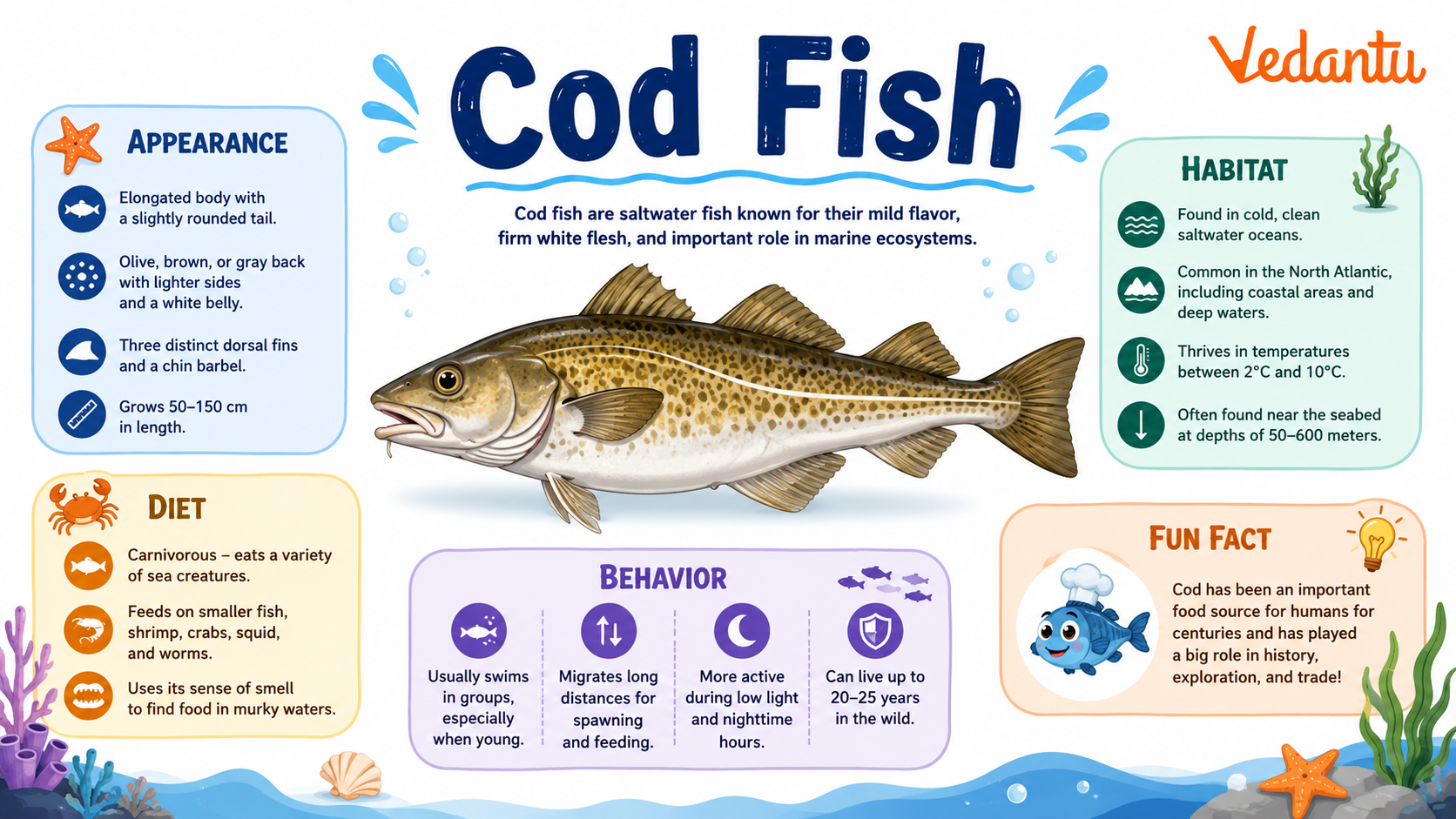
Quick Facts About Cod Fish
| Feature | Details |
|---|---|
| Common Name | Cod Fish |
| Scientific Name | Gadus morhua (Atlantic Cod) |
| Animal Group | Fish |
| Habitat | Cold ocean waters |
| Diet | Small fish, crabs, worms |
| Average Length | 60–130 cm |
| Lifespan | Up to 25 years |
| Conservation Status | Vulnerable (some populations) |
Appearance and Physical Characteristics
- Long, thick body with a slightly rounded shape.
- Usually greenish-brown or grey with light spots.
- White or pale belly.
- Has three dorsal fins on its back.
- A small barbel (whisker-like feeler) under the chin.
Cod Fish Habitat and Distribution
- Found in the North Atlantic Ocean.
- Common near Canada, Greenland, Iceland, and Northern Europe.
- Prefer cold, deep waters.
- Usually live close to the sea floor.
The Cod Fish habitat includes rocky seabeds, sandy ocean floors, and deep offshore waters. They can swim in both shallow coastal areas and deep sea regions depending on the season.
Diet and Feeding Habits
Cod fish eat other animals.
Small fish like herring and capelin.
Crabs, worms, shrimp, and squid.
Uses its barbel to find food near the seabed.
In the food chain, cod are both predators and prey. Bigger cod eat smaller fish, while seals and sharks hunt cod.
Behaviour and Lifestyle
- Strong and steady swimmers.
- Often travel in groups called schools.
- Migrate seasonally for breeding.
- Active during both day and night.
Cod Fish Life Cycle
- Egg Stage: Females lay millions of tiny eggs in open water.
- Larva Stage: Eggs hatch into tiny transparent larvae.
- Juvenile Stage: Young cod grow and move closer to the seabed.
- Adult Stage: Mature cod reproduce and continue the cycle.
The Cod Fish life cycle is interesting because a single female can lay up to 5 million eggs at one time!
What Makes Cod Fish Special?
Importance and Role in Nature
- Maintain balance in marine food chains.
- Control populations of smaller fish and invertebrates.
- Provide food for larger marine animals.
- Support fishing industries and coastal economies.
Amazing Cod Fish Facts
Fun Facts for Kids
- Cod have three back fins instead of one.
- They use a tiny chin “whisker” to find food.
- Cod eggs float in water.
- They live in very cold seas.
- Cod are one of the most famous fish in history.
FAQs on Cod Fish: Fascinating Facts About This Ocean Species
1. What is a cod fish?
A cod fish is a large saltwater fish that lives in cold oceans and is popular as seafood.
- Scientific group: Belongs to the genus Gadus
- Habitat: Cold waters of the Atlantic Ocean and Pacific Ocean
- Color: Usually brown, green, or gray with spots
- Famous types: Atlantic cod and Pacific cod
- Uses: Commonly eaten in dishes like fish and chips
2. Where do cod fish live?
Cod fish live in cold, deep ocean waters mostly in the Northern Hemisphere.
- Main regions: North Atlantic Ocean and North Pacific Ocean
- Water temperature: Prefer cold, icy waters
- Ocean floor: Often found near the seabed
- Countries nearby: Canada, Norway, Iceland, and the United States
- Habitat type: Marine saltwater environments
3. What do cod fish eat?
Cod fish are carnivores that eat smaller sea animals.
- Diet: Small fish like herring and capelin
- Sea creatures: Crabs, shrimp, and squid
- Young cod: Eat plankton and tiny crustaceans
- Role in food chain: Important ocean predator
- Feeding style: Hunt near the ocean floor
4. How big can a cod fish grow?
A cod fish can grow very large depending on its species and environment.
- Average length: 2 to 4 feet long
- Maximum length: Up to 6 feet
- Average weight: 10 to 25 pounds
- Lifespan: Can live over 20 years
- Largest species: Atlantic cod
5. Why is cod fish important to people?
Cod fish are important because they provide food and support fishing industries around the world.
- Seafood staple: Used in fish sticks and fish and chips
- Nutrition: Rich in protein, vitamin B12, and omega-3 fatty acids
- Fishing industry: Supports coastal communities
- Historical importance: Key fish during early Atlantic trade
- Cod liver oil: Used as a health supplement
6. What is the difference between Atlantic cod and Pacific cod?
The main difference between Atlantic cod and Pacific cod is where they live and slight body features.
- Location: Atlantic cod live in the Atlantic Ocean; Pacific cod live in the Pacific Ocean
- Size: Atlantic cod are usually larger
- Population: Atlantic cod have faced overfishing problems
- Appearance: Slight differences in color and body shape
- Scientific names: Gadus morhua (Atlantic), Gadus macrocephalus (Pacific)
7. Are cod fish endangered?
Some cod fish populations are threatened due to overfishing and environmental changes.
- Atlantic cod: Severely reduced in some areas
- Main threat: Overfishing
- Other risks: Climate change and habitat damage
- Protection efforts: Fishing limits and marine conservation laws
- Conservation status: Varies by region
8. How do cod fish reproduce?
Cod fish reproduce by laying millions of eggs in the ocean water.
- Spawning season: Late winter to early spring
- Eggs laid: Millions at one time
- Fertilization: Happens externally in water
- Baby cod: Called larvae
- Survival rate: Only a small number reach adulthood
9. What does cod fish taste like?
Cod fish has a mild, slightly sweet taste that many people enjoy.
- Flavor: Light and not too fishy
- Texture: Flaky and firm white meat
- Cooking methods: Baked, fried, grilled, or steamed
- Popular dishes: Fish and chips, fish tacos, fish sticks
- Family-friendly seafood: Often recommended for kids
10. What are some fun facts about cod fish?
Cod fish have interesting features and a long history in human culture.
- Chin barbel: A whisker-like organ to find food
- Historical trade: Important during the Viking Age
- Swimming bladder: Helps them float at different depths
- Large schools: Often swim in big groups
- Nickname: Sometimes called the “bread of the sea”
