






Why Did the Cave Bear Go Extinct and How Big Was It?
The Cave Bear was a huge prehistoric bear that lived during the Ice Age. It roamed across Europe thousands of years ago and often rested inside deep caves, which is how it got its name. Known for its massive size and powerful body, the Cave Bear is one of the most fascinating extinct mammals ever discovered. Let’s explore Cave Bear facts, habitat, diet, characteristics, life cycle, and interesting details about this ancient giant.
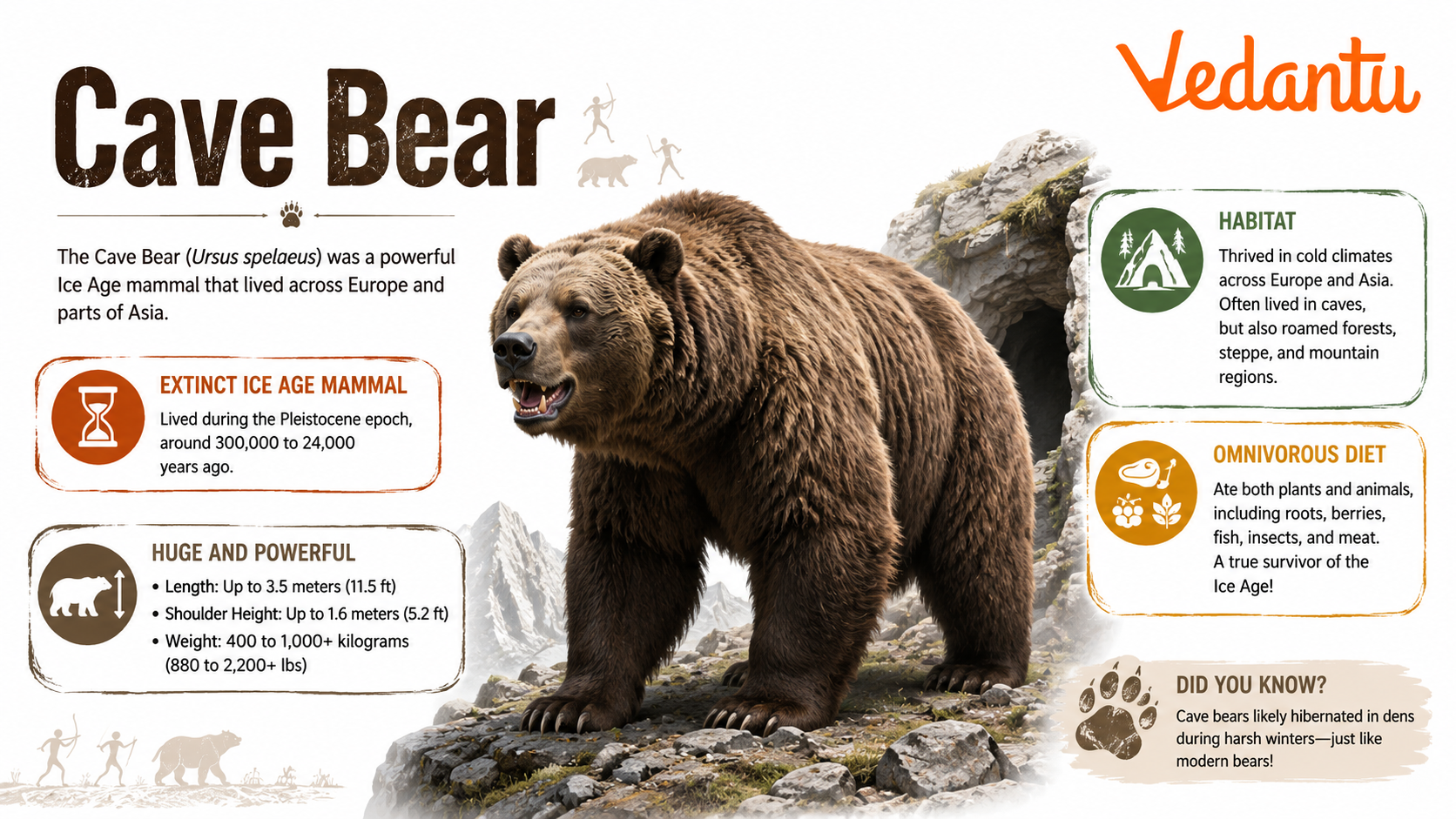
Quick Facts About Cave Bear
| Feature | Details |
|---|---|
| Common Name | Cave Bear |
| Scientific Name | Ursus spelaeus |
| Animal Group | Mammal |
| Time Period | Pleistocene Epoch (Ice Age) |
| Length | Up to 3.5 meters when standing |
| Weight | 400–1000 kg |
| Diet | Mainly Herbivore |
| Habitat | Caves and forested regions of Europe |
| Status | Extinct (around 24,000 years ago) |
Appearance and Physical Characteristics
- Very large and bulky body structure.
- Long, shaggy fur to survive cold weather.
- Massive skull with a steep forehead.
- Strong legs and large paws.
- Sharp claws for digging and defence.
Cave Bear Habitat and Distribution
- Lived mainly in Europe.
- Preferred mountainous and forest areas.
- Used caves for shelter and hibernation.
- Adapted to cold climates.
Fossils of Cave Bears have been found in countries like Germany, France, Austria, Italy, and Romania. Large numbers of bones discovered inside caves show that they spent a lot of time resting and hibernating there.
Cave Bear Diet and Feeding Habits
- Ate grasses, roots, berries, and plants.
- Strong teeth helped grind tough vegetation.
- May have occasionally eaten small animals.
Their flat molars were perfect for crushing plants, which supports the idea that the Cave Bear diet was mostly plant-based.
Behaviour and Lifestyle
- Likely solitary animals.
- Spent winters hibernating in caves.
- Moved slowly due to their heavy body.
- Used caves for protection from predators and harsh weather.
During winter, they entered deep hibernation. Many fossils show that some Cave Bears died inside caves during long winters.
Cave Bear Life Cycle
- Birth: Cubs were born inside caves during winter.
- Young Stage: Cubs stayed with their mother for protection.
- Growth: Slowly grew into massive adults.
- Adult Stage: Fully grown bears became powerful and large.
Like modern bears, mothers probably took care of their cubs for several months. The Cave Bear life cycle was similar to other large bear species.
What Made the Cave Bear Special?
Importance and Role in Nature
Amazing Cave Bear Facts
- Cave Bears lived alongside early humans.
- They became extinct around 24,000 years ago.
- Some caves contain thousands of Cave Bear bones.
- Their skull shape was different from modern brown bears.
- They were bigger than most bears alive today.
- Scientists believe climate change affected their survival.
Interesting Facts About Cave Bear
- Early humans may have hunted them.
- Some ancient cave paintings may represent bears.
- Their extinction may have been caused by climate change and human competition.
- They are related to today’s brown bears.
Fun Facts for Kids
FAQs on Cave Bear: The Giant Ice Age Mammal
1. What is a Cave Bear?
The Cave Bear was a giant prehistoric bear that lived during the Ice Age and is now extinct.
- The scientific name of the Cave Bear is Ursus spelaeus.
- It lived in Europe around 300,000 to 24,000 years ago.
- It is called a “cave” bear because many fossils were found in caves.
- It is one of the most famous prehistoric animals discovered by scientists.
2. When did the Cave Bear live?
The Cave Bear lived during the Pleistocene Epoch of the last Ice Age.
- It appeared about 300,000 years ago.
- It became extinct around 24,000 years ago.
- It lived at the same time as early humans and Neanderthals.
- Its extinction happened near the end of the last Ice Age period.
3. How big was a Cave Bear?
The Cave Bear was much larger than most modern bears.
- It could grow up to 3.5 meters (11 feet) tall when standing.
- It weighed between 600–1,000 kilograms.
- Male Cave Bears were bigger than females.
- It was larger than today’s Brown Bear in many cases.
4. What did Cave Bears eat?
The Cave Bear was mostly a plant-eater despite its large size.
- It mainly ate plants, berries, roots, and grasses.
- Some evidence shows it may have eaten insects or small animals.
- Its strong molars were perfect for grinding vegetation.
- It is often described as a mostly herbivorous prehistoric bear.
5. Why did the Cave Bear become extinct?
The Cave Bear became extinct due to climate change and human activity.
- The end of the Ice Age changed its habitat and food supply.
- Early humans hunted Cave Bears for food and fur.
- Humans also used caves for shelter, reducing bear habitats.
- Slow reproduction made it harder for the species to survive.
6. Where were Cave Bear fossils found?
Most Cave Bear fossils have been found in European caves.
- Large fossil sites exist in Germany, France, Austria, and Romania.
- Thousands of bones were discovered deep inside caves.
- Some caves are called “bear caves” because of the many skeletons.
- These fossils help scientists study prehistoric mammals.
7. Did Cave Bears live with humans?
Yes, Cave Bears lived at the same time as early humans and Neanderthals.
- They shared caves as shelters during cold winters.
- Humans sometimes hunted Cave Bears.
- Cave paintings and bones show possible interactions.
- This overlap makes them important in human prehistory studies.
8. How is the Cave Bear different from modern bears?
The Cave Bear was larger and more plant-based than many modern bears.
- It had a larger skull with a steep forehead.
- It was generally bigger than the modern Brown Bear.
- Its teeth were adapted for eating mostly plants.
- Unlike living bears, it is now an extinct species.
9. How did the Cave Bear get its name?
The Cave Bear got its name because many of its bones were found inside caves.
- The Latin name Ursus spelaeus means “cave bear.”
- Scientists discovered large fossil collections in underground caves.
- It likely used caves for hibernation during winter.
- The name helps identify it as a unique prehistoric bear species.
10. Are Cave Bears related to modern bears?
Yes, the Cave Bear is related to modern bear species.
- It is closely related to the Brown Bear (Ursus arctos).
- Both belong to the same bear family, Ursidae.
- They share similar body shapes and features.
- However, the Cave Bear followed a different evolutionary path and became extinct.
