






What Is an Ammonoid? Fossil Facts, History, and Extinction Explained
Ammonoids were fascinating marine animals that lived long before dinosaurs disappeared. These extinct sea creatures are known for their beautiful spiral shells and are commonly found as fossils today. Studying Ammonoid facts helps scientists understand ancient oceans, evolution, and mass extinctions. Although they may look like modern snails, Ammonoids were actually relatives of squids and octopuses. Let’s explore their characteristics, habitat, life cycle, and why they are so important in Earth’s history.
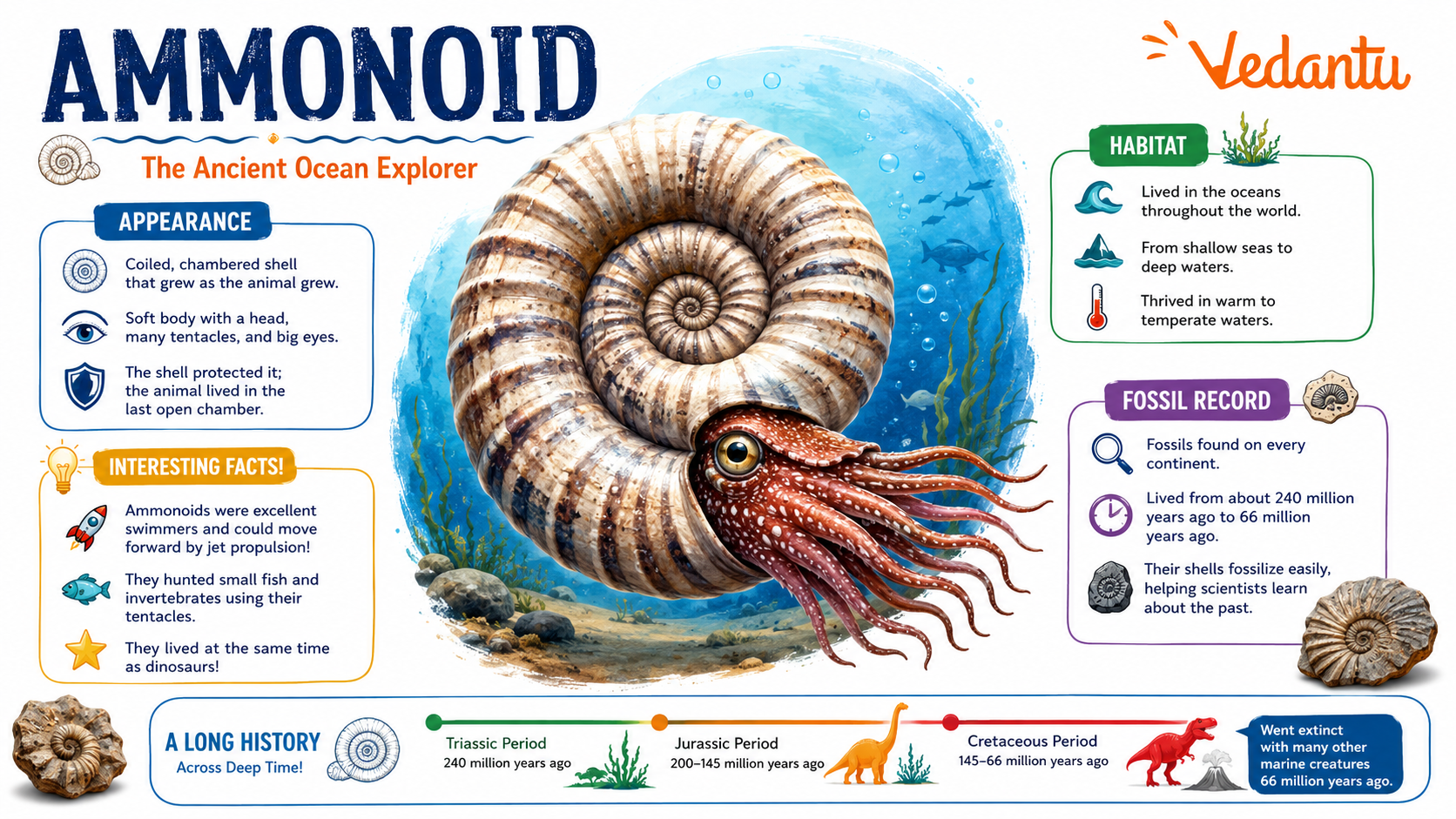
Quick Facts About Ammonoids
| Feature | Details |
|---|---|
| Common Name | Ammonoid |
| Scientific Subclass | Ammonoidea |
| Animal Group | Molluscs (related to squids and octopuses) |
| Time Period | Devonian to Cretaceous (about 400–66 million years ago) |
| Habitat | Ancient oceans worldwide |
| Diet | Carnivorous |
| Special Feature | Coiled, chambered shell |
| Extinction | Disappeared 66 million years ago |
Appearance and Physical Characteristics
- Shell Shape: Mostly spiral (coiled like a ram’s horn).
- Shell Structure: Divided into many small chambers.
- Size: Usually a few centimetres, but some grew over 1 meter wide.
- Body: Soft body with tentacles, similar to squid.
- Color: Shell colors are unknown, but fossils show patterns and ridges.
Ammonoid Habitat and Distribution
The Ammonoid habitat included ancient oceans across the world. Their fossils are found on every continent, even in places that are now dry land.
- Lived in shallow and deep marine waters.
- Found in tropical and temperate seas.
- Floated or swam freely in open oceans.
- Some species may have lived near the sea floor.
Diet and Feeding Habits
The Ammonoid diet was carnivorous. They were active hunters in prehistoric oceans.
Behaviour and Lifestyle
- Probably good swimmers using jet propulsion (like squids).
- Used gas-filled shell chambers to control floating depth.
- May have migrated vertically in water to find food.
- Lived in large numbers in ancient seas.
Ammonoid Life Cycle
- Egg Stage: Likely laid eggs in water.
- Juvenile Stage: Small free-swimming young with tiny shells.
- Growth: As they grew, new shell chambers were added.
- Adult Stage: Mature ammonoids developed complex shell patterns.
- End of Life: Shell sank to ocean floor and later fossilized.
What Made Ammonoids Special?
Importance and Role in Nature
- Used by geologists to determine the age of rocks.
- Help scientists study mass extinction events.
- Provide clues about ancient climate and sea levels.
- Show how life evolved over millions of years.
Amazing Ammonoid Facts
Fun Facts for Kids
- Ammonoids looked like underwater spirals!
- Their fossils are often used in jewellery and decorations.
- They are distant cousins of modern octopuses.
- You can find Ammonoid fossils in many museums.
- Each new shell chamber was like adding a new room to their house.
FAQs on Ammonoid: The Ancient Spiral-Shelled Marine Animal
1. What is an ammonoid?
An ammonoid is an extinct marine animal with a spiral shell that lived millions of years ago in ancient oceans.
- It was a type of marine mollusk, related to modern squid, octopus, and nautilus
- It had a coiled, chambered shell
- It lived during the Paleozoic and Mesozoic eras
- Ammonoids are often found as fossils in sedimentary rocks
2. When did ammonoids live?
Ammonoids lived from about 400 million years ago until they went extinct around 66 million years ago.
- First appeared in the Devonian Period
- Thrived during the Jurassic and Cretaceous periods
- Disappeared in the same mass extinction as the dinosaurs
3. What did ammonoids look like?
Ammonoids looked like tightly coiled shells with many chambers inside.
- Had a spiral-shaped external shell
- Shell was divided into air-filled chambers
- Some had smooth shells, others had ribs or spines
- Resembled a modern nautilus
4. How did ammonoids move in the ocean?
Ammonoids moved by pushing water out of their bodies, similar to modern squid.
- Used a method called jet propulsion
- Controlled floating by adjusting gas in their shell chambers
- Swam in ancient seas as active predators
5. What did ammonoids eat?
Ammonoids were carnivores that ate small sea animals.
- Fed on plankton, tiny fish, and crustaceans
- Used tentacles to catch prey
- Were part of the ancient marine food chain
6. Why are ammonoid fossils important?
Ammonoid fossils help scientists understand Earth’s history and date rocks.
- Used as index fossils to determine rock ages
- Show changes in evolution over time
- Help study ancient oceans and climates
7. How are ammonoids different from ammonites?
Ammonites are a type of ammonoid, but not all ammonoids are ammonites.
- Ammonoid is the larger group name
- Ammonites lived mainly during the Mesozoic Era
- Both had chambered spiral shells
8. Where are ammonoid fossils found?
Ammonoid fossils are found in sedimentary rocks around the world.
- Common in limestone and shale
- Found on every continent
- Often discovered in places that were once ancient seas
9. Why did ammonoids go extinct?
Ammonoids went extinct during the mass extinction event 66 million years ago.
- Likely caused by a large asteroid impact
- Massive climate changes affected ocean life
- Many marine species disappeared at the same time
10. Are ammonoids related to modern animals?
Yes, ammonoids are related to modern cephalopods like squid and octopus.
- Belonged to the class Cephalopoda
- Shared features like tentacles and soft bodies
- Closest living relative is the nautilus
