



Write the following in the place value table.
A.$4375.756$
B.\[0.009\]
C.$15.06$
D.$74.059$
E.$8.38$
F.$3.05$
Answer
 Verified
630.6k+ views
Hint: The place value of a digit depends upon the position of that digit in the number. If the digit is at extreme right then the number is at first position but if it is a decimal number then the number before decimal is considered to be at first position. First of all, you must go through the place value table.
Complete step-by-step answer:
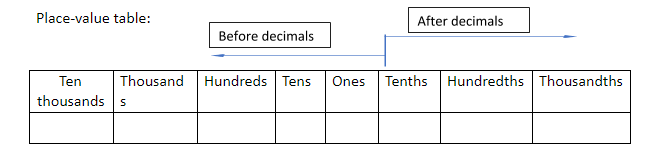
First of all, see the position of the digits in the given number and start before the decimals. The number at the first position starting from right before the decimal is at one’s place so the place value of that number is one.
The number at second position starting from right before the decimal is at tens place so the place value of that number is tens.
The number at third position starting from right before the decimal is at place so the place value of that number is thousands and so on. Look at the place value table.
If the number at first position after decimal, starting from left after decimal then the number is said to be at tenths place and so on. Look at the place value table.
Now, let's start placing the digits of the given numbers in a place value table starting with option A.
The number is 4375.756 in option A. Start from right before decimal 5 comes first so it is placed under ones, 7 comes second so it is placed under tens and so on. Start from left after decimal 7 comes first so it is placed under tenths and so on. This is as shown in table:
A.
The solutions for all other parts are as follow:
B.
C.
D.
E.
.
Note: The value of a digit is obtained by multiplying it with its place value. For example, if the place value of 4 is tens then the value of 4 is $4 \times 10 = 40$.
We can write the numbers in expandable form as follows
$ \Leftrightarrow 4375.756 = 4 \times 1000 + 3 \times 100 + 7 \times 10 + 5 \times 1 + 7 \times \dfrac{1}{{10}} + 5 \times \dfrac{1}{{100}} + 6 \times \dfrac{1}{{1000}}$
Complete step-by-step answer:
First of all, see the position of the digits in the given number and start before the decimals. The number at the first position starting from right before the decimal is at one’s place so the place value of that number is one.
The number at second position starting from right before the decimal is at tens place so the place value of that number is tens.
The number at third position starting from right before the decimal is at place so the place value of that number is thousands and so on. Look at the place value table.
If the number at first position after decimal, starting from left after decimal then the number is said to be at tenths place and so on. Look at the place value table.
Now, let's start placing the digits of the given numbers in a place value table starting with option A.
The number is 4375.756 in option A. Start from right before decimal 5 comes first so it is placed under ones, 7 comes second so it is placed under tens and so on. Start from left after decimal 7 comes first so it is placed under tenths and so on. This is as shown in table:
A.
| Ten thousands | Thousands | Hundreds | Tens | Ones | Tenths | Hundredths | Thousandths |
| 4 | 3 | 7 | 5 | 7 | 5 | 6 |
The solutions for all other parts are as follow:
B.
| Ten thousands | Thousands | Hundreds | Tens | Ones | Tenths | Hundredths | Thousandths |
| 0 | 0 | 0 | 9 |
C.
| Ten thousands | Thousands | Hundreds | Tens | Ones | Tenths | Hundredths | Thousandths |
| 1 | 5 | 0 | 6 |
D.
| Ten thousands | Thousands | Hundreds | Tens | Ones | Tenths | Hundredths | Thousandths |
| 7 | 4 | 0 | 5 | 9 |
E.
| Ten thousands | Thousands | Hundreds | Tens | Ones | Tenths | Hundredths | Thousandths |
| 8 | 3 | 8 |
.
| Ten thousands | Thousands | Hundreds | Tens | Ones | Tenths | Hundredths | Thousandths |
| 3 | 0 | 4 |
Note: The value of a digit is obtained by multiplying it with its place value. For example, if the place value of 4 is tens then the value of 4 is $4 \times 10 = 40$.
We can write the numbers in expandable form as follows
$ \Leftrightarrow 4375.756 = 4 \times 1000 + 3 \times 100 + 7 \times 10 + 5 \times 1 + 7 \times \dfrac{1}{{10}} + 5 \times \dfrac{1}{{100}} + 6 \times \dfrac{1}{{1000}}$

Recently Updated Pages
Master Class 11 English: Engaging Questions & Answers for Success

Master Class 11 Social Science: Engaging Questions & Answers for Success
Master Class 11 Maths: Engaging Questions & Answers for Success
Master Class 11 Biology: Engaging Questions & Answers for Success
Master Class 11 Physics: Engaging Questions & Answers for Success
Master Class 11 Chemistry: Engaging Questions & Answers for Success
Trending doubts
Full Form of IASDMIPSIFSIRSPOLICE class 7 social science CBSE
Write in numerals Ten lakh ninety thousand nine hundred class 7 maths CBSE
How many crores make 10 million class 7 maths CBSE
One lakh eight thousand how can we write it in num class 7 maths CBSE
One lakh eight thousand how can we write it in num class 7 maths CBSE
How many thousands make a crore class 7 maths CBSE