




Which one of the following compounds has bond angle as nearly \[{90^o}\]
(a) \[N{H_3}\]
(b) \[{H_2}S\]
(c) \[{H_2}O\]
(d) \[C{H_4}\]
Answer
 Verified
233.1k+ views
Hint: For the prediction of geometry the concept of hybridization is used. Whereas, for the determination the valence shell electron pair repulsion (VSEPR) theory is used. Due to the presence of unshared electron pairs the shape of the molecule changes along with the bond angle.
Complete step by step solution:To determine the hybridization of any given molecule we can use the following equation:
\[Hybridization(H) = \frac{{V + M - C + A}}{2}\] (Eq.1)
Whereas V=number of valence electrons on the central atom
M= a number of monovalent atoms
C= charge on the cation
A=charge on anion
Now using the above equation will be used to explore the hybridization of the given molecules.
(a) \[N{H_3}\]:
\[Hybridization(H) = \frac{{5 + 3 - 0 + 0}}{2} = \frac{8}{2} = 4\]
The value of 4 will be equal to \[s{p^3}\] hybridization and the geometry will be tetrahedral with the bond angle \[{109^o}\] . But due to the bond pair-lone pair repulsion, the shape of \[N{H_3}\]molecule will be pyramidal with \[{107^o}\]bond angle.
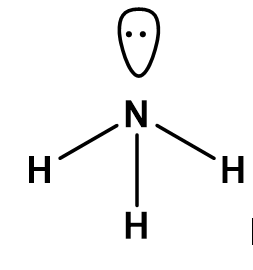
Image: Pyramidal structure of ammonia molecule.
(b) \[{H_2}S\]:
\[Hybridization(H) = \frac{{6 + 2 - 0 + 0}}{2} = \frac{8}{2} = 4\]
The value of 4 will be equal to \[s{p^3}\] hybridization with tetrahedral geometry ( bond angle \[{109^o}\] ). But due to the presence of two lone pair the bond pair-lone pair repulsion will be more, therefore, the shape the shape of \[{H_2}S\]molecule will be V -shaped with \[{90^o}\]bond angle.
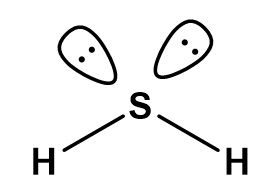
Image: V-shape structure of hydrogen di-sulfide molecule.
(c) \[{H_2}O\]:
\[Hybridization(H) = \frac{{6 + 2 - 0 + 0}}{2} = \frac{8}{2} = 4\]
The value of 4 will be equal to \[s{p^3}\] hybridization with tetrahedral geometry (bond angle \[{109^o}\] ). But due to the presence of two loan pair, the bond pair-loan pair repulsion will be more therefore the shape of \[{H_2}O\]molecule will be V -shaped with \[{104^o}5\prime \]bond angle.
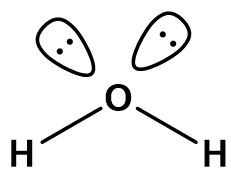
Image: V-shape structure of water molecule.
(d) \[C{H_4}\]:
\[Hybridization(H) = \frac{{6 + 2 - 0 + 0}}{2} = \frac{8}{2} = 4\]
The value of 4 will be equal to \[s{p^3}\] hybridization. Unlike ammonia, hydrogen di-sulfide, and water, the methane molecule does not have any lone pair of electrons. Therefore, methane molecules possess perfect tetrahedral geometry with bond angle \[{109^o}\].
Therefore, from the above discussion, it is quite clear that option (b) will be the correct answer.
Note:The \[{H_2}S\]exist in gaseous form due to the less polar \[S - H\]bond. Whereas water and ammonia exist in a liquid state due to the presence of polar bonds (\[O - H\]and \[N - H\]).
Similar to \[{H_2}S\]the \[C{H_4}\]also exist in gaseous form.
Complete step by step solution:To determine the hybridization of any given molecule we can use the following equation:
\[Hybridization(H) = \frac{{V + M - C + A}}{2}\] (Eq.1)
Whereas V=number of valence electrons on the central atom
M= a number of monovalent atoms
C= charge on the cation
A=charge on anion
Now using the above equation will be used to explore the hybridization of the given molecules.
(a) \[N{H_3}\]:
\[Hybridization(H) = \frac{{5 + 3 - 0 + 0}}{2} = \frac{8}{2} = 4\]
The value of 4 will be equal to \[s{p^3}\] hybridization and the geometry will be tetrahedral with the bond angle \[{109^o}\] . But due to the bond pair-lone pair repulsion, the shape of \[N{H_3}\]molecule will be pyramidal with \[{107^o}\]bond angle.
Image: Pyramidal structure of ammonia molecule.
(b) \[{H_2}S\]:
\[Hybridization(H) = \frac{{6 + 2 - 0 + 0}}{2} = \frac{8}{2} = 4\]
The value of 4 will be equal to \[s{p^3}\] hybridization with tetrahedral geometry ( bond angle \[{109^o}\] ). But due to the presence of two lone pair the bond pair-lone pair repulsion will be more, therefore, the shape the shape of \[{H_2}S\]molecule will be V -shaped with \[{90^o}\]bond angle.
Image: V-shape structure of hydrogen di-sulfide molecule.
(c) \[{H_2}O\]:
\[Hybridization(H) = \frac{{6 + 2 - 0 + 0}}{2} = \frac{8}{2} = 4\]
The value of 4 will be equal to \[s{p^3}\] hybridization with tetrahedral geometry (bond angle \[{109^o}\] ). But due to the presence of two loan pair, the bond pair-loan pair repulsion will be more therefore the shape of \[{H_2}O\]molecule will be V -shaped with \[{104^o}5\prime \]bond angle.
Image: V-shape structure of water molecule.
(d) \[C{H_4}\]:
\[Hybridization(H) = \frac{{6 + 2 - 0 + 0}}{2} = \frac{8}{2} = 4\]
The value of 4 will be equal to \[s{p^3}\] hybridization. Unlike ammonia, hydrogen di-sulfide, and water, the methane molecule does not have any lone pair of electrons. Therefore, methane molecules possess perfect tetrahedral geometry with bond angle \[{109^o}\].
Therefore, from the above discussion, it is quite clear that option (b) will be the correct answer.
Note:The \[{H_2}S\]exist in gaseous form due to the less polar \[S - H\]bond. Whereas water and ammonia exist in a liquid state due to the presence of polar bonds (\[O - H\]and \[N - H\]).
Similar to \[{H_2}S\]the \[C{H_4}\]also exist in gaseous form.
Recently Updated Pages
JEE Main 2023 April 6 Shift 1 Question Paper with Answer Key

JEE Main 2023 April 6 Shift 2 Question Paper with Answer Key
JEE Main 2023 (January 31 Evening Shift) Question Paper with Solutions [PDF]
JEE Main 2023 January 30 Shift 2 Question Paper with Answer Key
JEE Main 2023 January 25 Shift 1 Question Paper with Answer Key
JEE Main 2023 January 24 Shift 2 Question Paper with Answer Key
Trending doubts
JEE Main 2026: Session 2 Registration Open, City Intimation Slip, Exam Dates, Syllabus & Eligibility
JEE Main 2026 Application Login: Direct Link, Registration, Form Fill, and Steps
JEE Main Marking Scheme 2026- Paper-Wise Marks Distribution and Negative Marking Details
Understanding the Angle of Deviation in a Prism
Hybridisation in Chemistry – Concept, Types & Applications
How to Convert a Galvanometer into an Ammeter or Voltmeter
Other Pages
JEE Advanced Marks vs Ranks 2025: Understanding Category-wise Qualifying Marks and Previous Year Cut-offs
Hydrocarbons Class 11 Chemistry Chapter 9 CBSE Notes - 2025-26
Thermodynamics Class 11 Chemistry Chapter 5 CBSE Notes - 2025-26
Equilibrium Class 11 Chemistry Chapter 6 CBSE Notes - 2025-26
Organic Chemistry Some Basic Principles And Techniques Class 11 Chemistry Chapter 8 CBSE Notes - 2025-26
NCERT Solutions For Class 11 Chemistry Chapter 7 Redox Reactions (2025-26)