




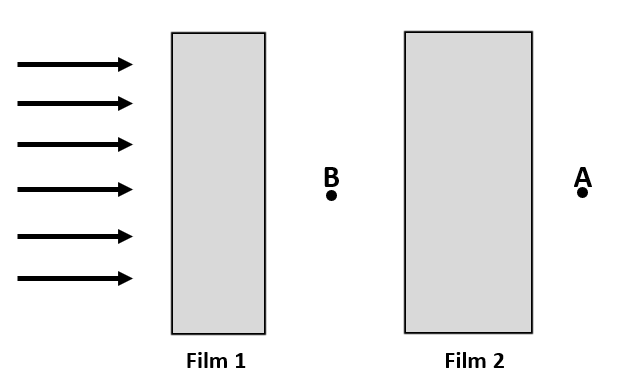
Two thin films of the same material but different thickness are separated by air. Monochromatic light is incident on the first film. When viewed normally from point A, the second film appears dark. From point B, on normal viewing:
(A) the first film will appear bright
(B) the first film will appear dark
(C) the second film will appear bright
(D) the second film will appear dark
Answer
 Verified
596.1k+ views
Hint: The appearance of any film (that is, whether the film appears bright or dark) from any point in the plane depends on the interference pattern of the incident light in the film. If there is constructive interference of this light, then the films will appear bright and if there is destructive interference of this light, then the films will appear dark. We will proceed with the help of the data given to us in the problem.
Complete answer:
We will see the condition given in the problem. This is:
When viewed normally from point A, the second film appears dark. This means there has been a case of destructive interference at any of the films.
If we look at the second film from point B, it doesn’t really matter in which of the films destructive interference occurs. The second film from point B will still look dark, as for an observer at B, the films combined would appear to be producing a destructive interference.
So, the second film would appear dark from point B.
Hence, the second film will appear dark.
Hence, option (D) is the correct option.
Note:
It would be ambiguous to comment on the interference pattern formed on the first film from any of the two points. This is because there is no mention of interference patterns in the films individually. These questions are analytical in nature, so one should have the basic knowledge of the topic to solve problems like these.
Complete answer:
We will see the condition given in the problem. This is:
When viewed normally from point A, the second film appears dark. This means there has been a case of destructive interference at any of the films.
If we look at the second film from point B, it doesn’t really matter in which of the films destructive interference occurs. The second film from point B will still look dark, as for an observer at B, the films combined would appear to be producing a destructive interference.
So, the second film would appear dark from point B.
Hence, the second film will appear dark.
Hence, option (D) is the correct option.
Note:
It would be ambiguous to comment on the interference pattern formed on the first film from any of the two points. This is because there is no mention of interference patterns in the films individually. These questions are analytical in nature, so one should have the basic knowledge of the topic to solve problems like these.
Recently Updated Pages
What is BLO What is the full form of BLO class 8 social science CBSE

Explain the Treaty of Vienna of 1815 class 10 social science CBSE
10 examples of friction in our daily life
Draw a diagram of nephron and explain its structur class 11 biology CBSE
Write structures of the following compounds i 2 Chloro3methylpentane class 11 chemistry CBSE
A Paragraph on Pollution in about 100-150 Words
Trending doubts
Draw a labelled sketch of the human eye class 12 physics CBSE
Which are the Top 10 Largest Countries of the World?
Differentiate between homogeneous and heterogeneous class 12 chemistry CBSE
Draw ray diagrams each showing i myopic eye and ii class 12 physics CBSE
Which is the correct genotypic ratio of mendel dihybrid class 12 biology CBSE
What is the Full Form of PVC, PET, HDPE, LDPE, PP and PS ?