




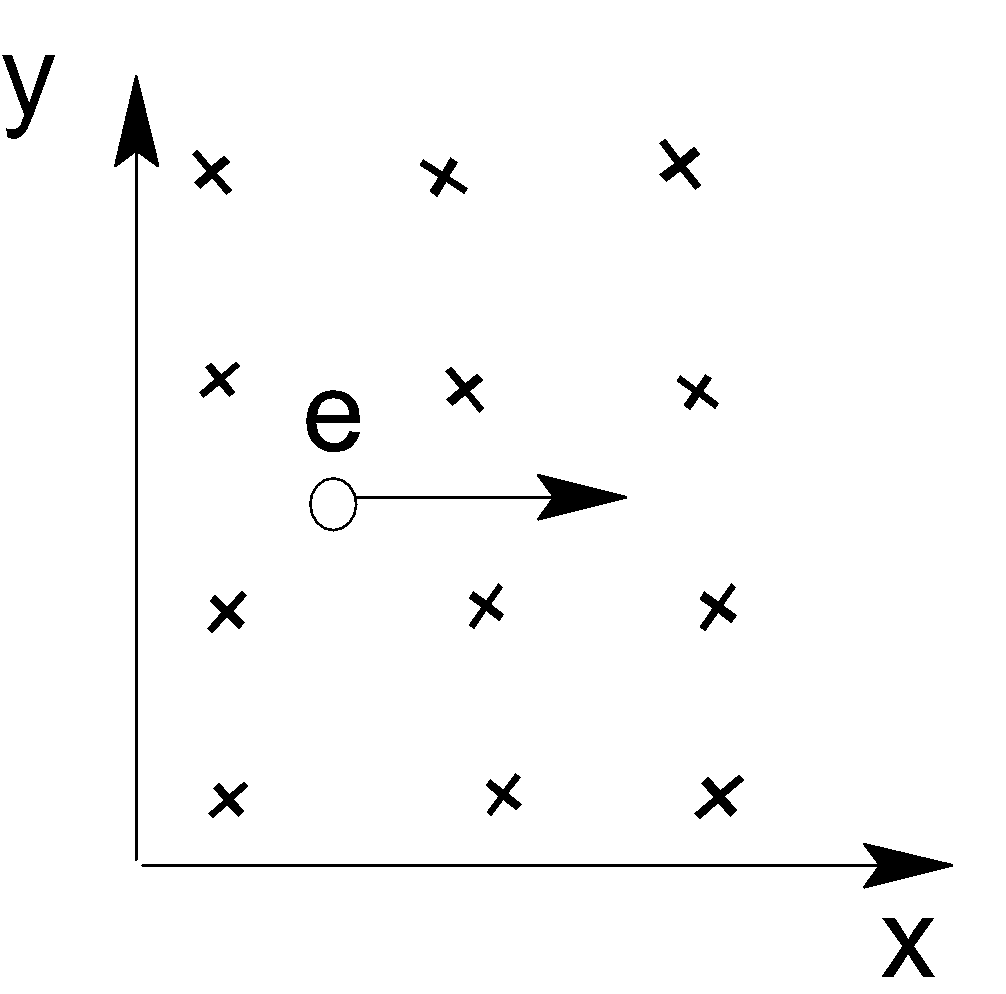
In the given figure, the electron enters into the magnetic field. It deflects in ……direction.
A.$(+)ve$$X-$direction
B.$(-)ve$ $X-$direction
C.$(+)ve$$Y-$direction
D.$(-)ve$$Y-$direction
Answer
 Verified
233.1k+ views
Hint: In the given figure the electron is moving along a positive $x-$direction. And the conventional current moves in the negative $x-$direction. Therefore the deflection of electrons can be determined by Fleming’s left-hand thumb rule.
Complete answer:
In a uniform magnetic field, the magnetic force is always at right angles to the motion of the electron and as a result, the path of the electron in a uniform magnetic field is circular. The magnetic force acting on a charged particle is given by Fleming’s left-hand thumb rule.

Here the direction of the moving electron is along the positive $x-$direction and the direction of the current is along the negative $x-$direction. This is because the direction of conventional current is opposite to the direction of the flow of electrons. Now, according to Fleming’s left-hand thumb rule, the positively charged particle will be deflected in a positive $y-$direction.
But the electron is a negatively charged particle, so it will be reflected in a negative $y-$direction as it feels a force in this direction.
Thus, option (D) is correct.
Additional information: If the magnetic field and velocity are parallel to each other then the charged particle does not experience any magnetic force. Therefore the magnitude of force remains constant in the entire motion if no magnetic field is felt upon it.
Note:when a moving conductor is placed in a magnetic field, a current will be induced in it. The direction of the induced current can be determined by Fleming’s right-hand thumb rule. But when a current carrying is placed in a magnetic field, a magnetic force applies to it, the direction of magnetic force can be determined by Fleming’s left-hand thumb rule.
Complete answer:
In a uniform magnetic field, the magnetic force is always at right angles to the motion of the electron and as a result, the path of the electron in a uniform magnetic field is circular. The magnetic force acting on a charged particle is given by Fleming’s left-hand thumb rule.
Here the direction of the moving electron is along the positive $x-$direction and the direction of the current is along the negative $x-$direction. This is because the direction of conventional current is opposite to the direction of the flow of electrons. Now, according to Fleming’s left-hand thumb rule, the positively charged particle will be deflected in a positive $y-$direction.
But the electron is a negatively charged particle, so it will be reflected in a negative $y-$direction as it feels a force in this direction.
Thus, option (D) is correct.
Additional information: If the magnetic field and velocity are parallel to each other then the charged particle does not experience any magnetic force. Therefore the magnitude of force remains constant in the entire motion if no magnetic field is felt upon it.
Note:when a moving conductor is placed in a magnetic field, a current will be induced in it. The direction of the induced current can be determined by Fleming’s right-hand thumb rule. But when a current carrying is placed in a magnetic field, a magnetic force applies to it, the direction of magnetic force can be determined by Fleming’s left-hand thumb rule.
Recently Updated Pages
JEE Main 2026 Session 2 Registration Open, Exam Dates, Syllabus & Eligibility

JEE Main 2023 April 6 Shift 1 Question Paper with Answer Key
JEE Main 2023 April 6 Shift 2 Question Paper with Answer Key
JEE Main 2023 (January 31 Evening Shift) Question Paper with Solutions [PDF]
JEE Main 2023 January 30 Shift 2 Question Paper with Answer Key
JEE Main 2023 January 25 Shift 1 Question Paper with Answer Key
Trending doubts
Why does capacitor block DC and allow AC class 12 physics JEE_Main
Understanding Average and RMS Value in Electrical Circuits
Ideal and Non-Ideal Solutions Explained for Class 12 Chemistry
Understanding Atomic Structure for Beginners
Understanding Elastic Collisions in Two Dimensions
JEE Main Syllabus 2026: Download Detailed Subject-wise PDF
Other Pages
MOSFET: Definition, Working Principle, Types & Applications
Understanding Collisions: Types and Examples for Students
Happy New Year Wishes 2026 – 100+ Messages, Quotes, Shayari, Images & Status in All Languages
Valentine Week 2026 List | Valentine Week Days, Dates & Meaning
One Day International Cricket- India Vs New Zealand Records and Score
Highest T20 Scores in Cricket: Top Records & Stats 2025