




Electric field due to uniformly charged sphere.
Answer
 Verified
306.9k+ views
Hint: This is the case of solid non-conducting spheres. We will have three cases associated with it . They are : electric fields inside the sphere, on the surface, outside the sphere .
Apply the gauss theorem to find the electric field at the three different places.
Complete step by step solution:
Consider a charged solid sphere of radius $R$ and charge $q$ which is uniformly distributed over the sphere. We will use Gauss Theorem to calculate electric fields. If $\phi $ be the electric flux and $Q$ be the charge then :
${\varepsilon _0}\phi = {Q_{enclosed}}$
Also , electric flux=electric field X area of the enclosed surface : $\phi = EA$
Case I- Inside the sphere $(r < R)$
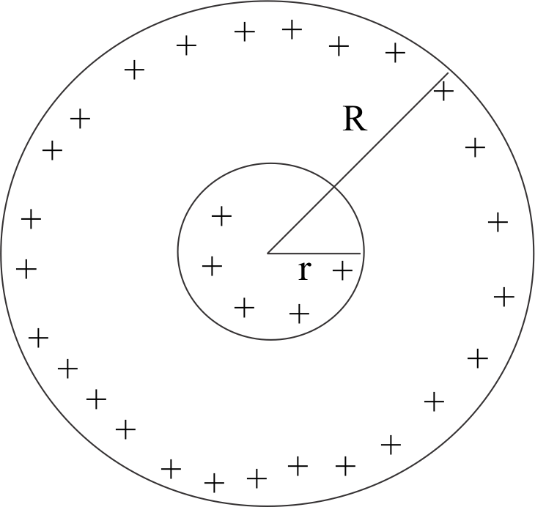
The charge distribution is uniform . Volume density will be the same. Let the charge enclosed by a circle of radius $r$ be $q'$ . Since volume density is same then-
$
\dfrac{{q'}}{{\dfrac{4}{3}\pi {r^3}}} = \dfrac{q}{{\dfrac{4}{3}\pi {R^3}}} \\
q' = q\dfrac{{{r^3}}}{{{R^3}}} \\
$
Applying Gauss Theorem here-
$
\phi = E4\pi {r^2} \\
\dfrac{{{Q_{enclosed}}}}{{{\varepsilon _0}}} = E4\pi {r^2} \\
\dfrac{{q'}}{{{\varepsilon _0}}} = E4\pi {r^2} \\
\dfrac{q}{{{\varepsilon _0}}} \times \dfrac{{{r^3}}}{{{R^3}}} = E4\pi {r^2} \\
E = \dfrac{1}{{4\pi {\varepsilon _0}}} \times \dfrac{{qr}}{{{R^3}}} \\
$
This is the electric field inside the charged sphere .
Case II: On the surface $(r = R)$
In the above case we have calculated the electric field inside the sphere. In that formula we will put $(r = R)$ , so evaluate the electric field on the surface of the sphere .
$
E = \dfrac{1}{{4\pi {\varepsilon _0}}} \times \dfrac{{qr}}{{{R^3}}} \\
E = \dfrac{1}{{4\pi {\varepsilon _0}}} \times \dfrac{{qR}}{{{R^3}}} \\
E = \dfrac{1}{{4\pi {\varepsilon _0}}} \times \dfrac{q}{{{R^2}}} \\
$
This is the electric field on the surface.
Case III: Outside the sphere $(r > R)$
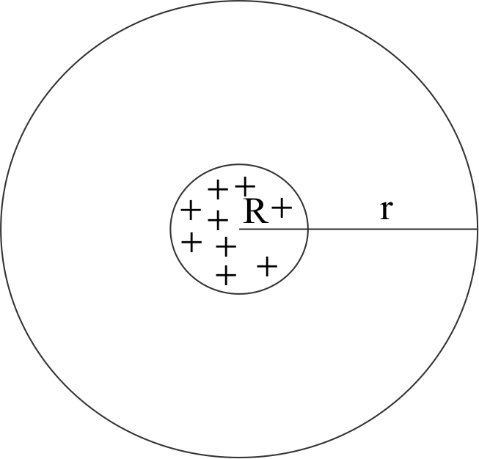
We will apply Gauss theorem in this too.
$
\phi = EA \\
\dfrac{q}{{{\varepsilon _0}}} = E4\pi {r^2} \\
E = \dfrac{1}{{4\pi {\varepsilon _0}}} \times \dfrac{q}{{{r^2}}} \\
$
This is the electric field outside the sphere.
If we plot these variations on a graph we will get the following graph:
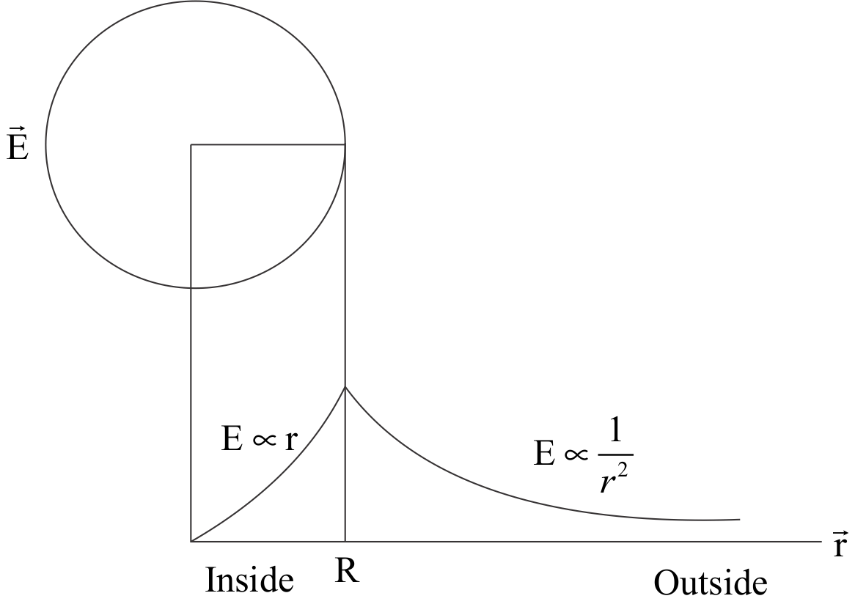
Note: Since this is a solid sphere , it has charge inside it as well and that is why the electric field is non zero. In case of a hollow spherical shell, the electric field inside the shell is zero .
Apply the gauss theorem to find the electric field at the three different places.
Complete step by step solution:
Consider a charged solid sphere of radius $R$ and charge $q$ which is uniformly distributed over the sphere. We will use Gauss Theorem to calculate electric fields. If $\phi $ be the electric flux and $Q$ be the charge then :
${\varepsilon _0}\phi = {Q_{enclosed}}$
Also , electric flux=electric field X area of the enclosed surface : $\phi = EA$
Case I- Inside the sphere $(r < R)$
The charge distribution is uniform . Volume density will be the same. Let the charge enclosed by a circle of radius $r$ be $q'$ . Since volume density is same then-
$
\dfrac{{q'}}{{\dfrac{4}{3}\pi {r^3}}} = \dfrac{q}{{\dfrac{4}{3}\pi {R^3}}} \\
q' = q\dfrac{{{r^3}}}{{{R^3}}} \\
$
Applying Gauss Theorem here-
$
\phi = E4\pi {r^2} \\
\dfrac{{{Q_{enclosed}}}}{{{\varepsilon _0}}} = E4\pi {r^2} \\
\dfrac{{q'}}{{{\varepsilon _0}}} = E4\pi {r^2} \\
\dfrac{q}{{{\varepsilon _0}}} \times \dfrac{{{r^3}}}{{{R^3}}} = E4\pi {r^2} \\
E = \dfrac{1}{{4\pi {\varepsilon _0}}} \times \dfrac{{qr}}{{{R^3}}} \\
$
This is the electric field inside the charged sphere .
Case II: On the surface $(r = R)$
In the above case we have calculated the electric field inside the sphere. In that formula we will put $(r = R)$ , so evaluate the electric field on the surface of the sphere .
$
E = \dfrac{1}{{4\pi {\varepsilon _0}}} \times \dfrac{{qr}}{{{R^3}}} \\
E = \dfrac{1}{{4\pi {\varepsilon _0}}} \times \dfrac{{qR}}{{{R^3}}} \\
E = \dfrac{1}{{4\pi {\varepsilon _0}}} \times \dfrac{q}{{{R^2}}} \\
$
This is the electric field on the surface.
Case III: Outside the sphere $(r > R)$
We will apply Gauss theorem in this too.
$
\phi = EA \\
\dfrac{q}{{{\varepsilon _0}}} = E4\pi {r^2} \\
E = \dfrac{1}{{4\pi {\varepsilon _0}}} \times \dfrac{q}{{{r^2}}} \\
$
This is the electric field outside the sphere.
If we plot these variations on a graph we will get the following graph:
Note: Since this is a solid sphere , it has charge inside it as well and that is why the electric field is non zero. In case of a hollow spherical shell, the electric field inside the shell is zero .
Recently Updated Pages
If the magnetizing field on a ferromagnetic material class 12 physics JEE_Main

A point charge is placed at the corner of a cube The class 12 physics JEE_Main
What changes occur if the monochromatic light used class 12 physics JEE_Main
The unit of specific conductance is A Ohm B Ohmmetre class 12 physics JEE_Main
Which lens is used in magnifying glass A Concave lens class 12 physics JEE_Main
Sir C V Raman won the Nobel Prize in which year A 1928 class 12 physics JEE_Main
Trending doubts
JEE Main 2026: Exam Dates, Session 2 Updates, City Slip, Admit Card & Latest News
Understanding the Electric Field of a Uniformly Charged Ring
Derivation of Equation of Trajectory Explained for Students
Understanding Atomic Structure for Beginners
How to Convert a Galvanometer into an Ammeter or Voltmeter
Hybridisation in Chemistry – Concept, Types & Applications
Other Pages
CBSE Class 12 Physics Question Paper 2026: Download SET-wise PDF with Answer Key & Analysis
JEE Advanced Percentile vs Marks 2026: JEE Main Cutoff, AIR & IIT Admission Guide
Class 12 Physics Formulas: Complete Chapter-wise PDF Guide
What Are Elastic Collisions in One Dimension?
Isoelectronic Species: Definition, Examples & Importance
Understanding Uniform Acceleration in Physics