




Draw the Lewis structure for \[IC{l_4}^ - \] and provide the following information.
A. Total number of valence electrons
B. Number of nonbonding electron pairs
C. Electron geometry
D. Molecular geometry
E. Polarity
Answer
 Verified
233.1k+ views
Hint: VSEPR theory is used to understand the arrangement of electrons. Here the focus is on the arrangements around Iodine in \[IC{l_4}^ - \]. Once the molecular geometry is understood, the Polarity of molecules/species can be calculated.
Lewis’s structure will enable us to determine a stable bonding arrangement for this ion.
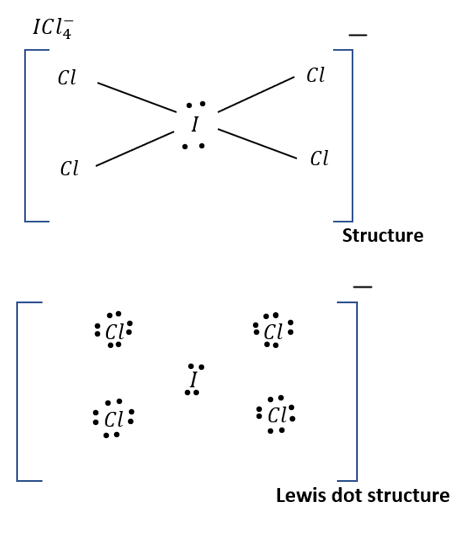
Complete step by step solution:
(a) Total number of valence electrons.
Iodine has 7 valence electrons and chlorine has also 7 electrons in its outermost orbit. One more negative charge on the outside. Hence, total number of valence electrons is:
\[V_e = 7 + 7[4] + 1\\ = 36\]
On the periodic chart, iodine [I] is in Period 3 and may hold more than 8 electrons. The Iodine atom contains 12 valence electrons in the Lewis structure for ICl4-.
(b) Number of nonbonding electron pairs:
As per Lewis structure, chlorine has 6 electrons which does not form bond and iodine has 4 electrons which do not form bond
Therefore, there are 2 non-bonding \[\bar e\] pairs on Iodine & \[3\] non-bonding \[\bar e\] pairs on each chlorine.
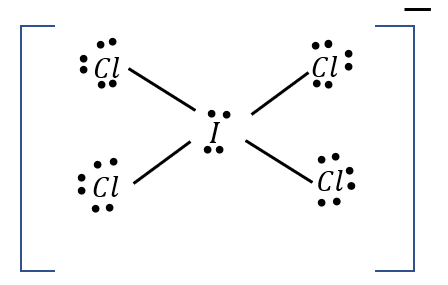
Image: Lewis structure of \[IC{l_4}^ - \]
A total of \[14\] non-bonding \[\bar e\] pairs are present in this .
(c) Electron geometry
It has octahedral electron geometry.
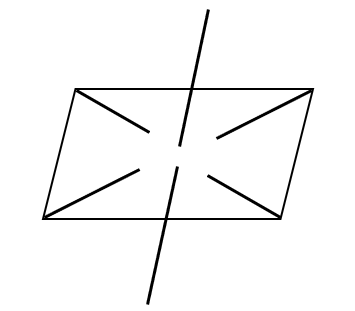
Image: Electron geometry of \[IC{l_4}^ - \]
(d) Molecular geometry
It has square planar geometry, because \[2\]non-bonding \[\bar e\] pairs of Iodine are occupying \[2\]opposite vertices.
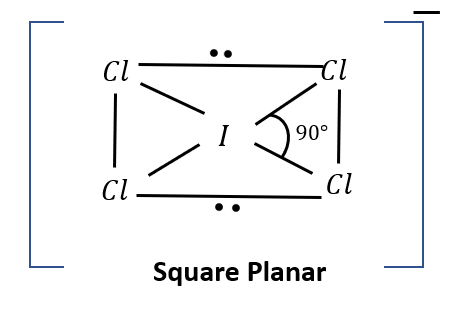
Image: Molecular geometry of \[IC{l_4}^ - \]
[e] Polarity:
It is a non-polar compound because it is a square plane. In \[ICl\] bond, \[Cl\] is the most negative, so it attracts the electrons into chemical bonds.
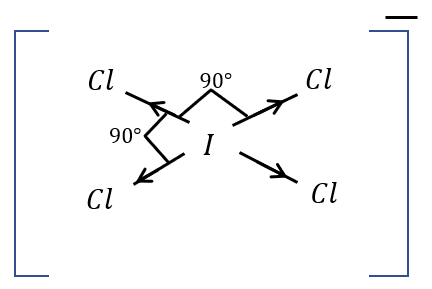
Image: Polarity of \[IC{l_4}^ - \]
There is polarity in each \[I - Cl\] bond. But overall polarity is cancelled out due to geometry.
Note: Iron reacting with hydrochloric acid forms iron chloride where iron is in +2 oxidation state whereas when iron reacts with chlorine it also forms iron chloride but here iron is in +3oxidation state. The reaction between iron and chlorine is a type of redox reaction. The reaction between iron and chlorine is shown below:
$2Fe(s) + 3C{l_2}(g) \to 2FeC{l_3}(s)$
Lewis’s structure will enable us to determine a stable bonding arrangement for this ion.
Complete step by step solution:
(a) Total number of valence electrons.
Iodine has 7 valence electrons and chlorine has also 7 electrons in its outermost orbit. One more negative charge on the outside. Hence, total number of valence electrons is:
\[V_e = 7 + 7[4] + 1\\ = 36\]
On the periodic chart, iodine [I] is in Period 3 and may hold more than 8 electrons. The Iodine atom contains 12 valence electrons in the Lewis structure for ICl4-.
(b) Number of nonbonding electron pairs:
As per Lewis structure, chlorine has 6 electrons which does not form bond and iodine has 4 electrons which do not form bond
Therefore, there are 2 non-bonding \[\bar e\] pairs on Iodine & \[3\] non-bonding \[\bar e\] pairs on each chlorine.
Image: Lewis structure of \[IC{l_4}^ - \]
A total of \[14\] non-bonding \[\bar e\] pairs are present in this .
(c) Electron geometry
It has octahedral electron geometry.
Image: Electron geometry of \[IC{l_4}^ - \]
(d) Molecular geometry
It has square planar geometry, because \[2\]non-bonding \[\bar e\] pairs of Iodine are occupying \[2\]opposite vertices.
Image: Molecular geometry of \[IC{l_4}^ - \]
[e] Polarity:
It is a non-polar compound because it is a square plane. In \[ICl\] bond, \[Cl\] is the most negative, so it attracts the electrons into chemical bonds.
Image: Polarity of \[IC{l_4}^ - \]
There is polarity in each \[I - Cl\] bond. But overall polarity is cancelled out due to geometry.
Note: Iron reacting with hydrochloric acid forms iron chloride where iron is in +2 oxidation state whereas when iron reacts with chlorine it also forms iron chloride but here iron is in +3oxidation state. The reaction between iron and chlorine is a type of redox reaction. The reaction between iron and chlorine is shown below:
$2Fe(s) + 3C{l_2}(g) \to 2FeC{l_3}(s)$
Recently Updated Pages
JEE Main 2023 April 6 Shift 1 Question Paper with Answer Key

JEE Main 2023 April 6 Shift 2 Question Paper with Answer Key
JEE Main 2023 (January 31 Evening Shift) Question Paper with Solutions [PDF]
JEE Main 2023 January 30 Shift 2 Question Paper with Answer Key
JEE Main 2023 January 25 Shift 1 Question Paper with Answer Key
JEE Main 2023 January 24 Shift 2 Question Paper with Answer Key
Trending doubts
JEE Main 2026: Session 2 Registration Open, City Intimation Slip, Exam Dates, Syllabus & Eligibility
JEE Main 2026 Application Login: Direct Link, Registration, Form Fill, and Steps
JEE Main Marking Scheme 2026- Paper-Wise Marks Distribution and Negative Marking Details
Understanding the Angle of Deviation in a Prism
Hybridisation in Chemistry – Concept, Types & Applications
How to Convert a Galvanometer into an Ammeter or Voltmeter
Other Pages
JEE Advanced Marks vs Ranks 2025: Understanding Category-wise Qualifying Marks and Previous Year Cut-offs
Hydrocarbons Class 11 Chemistry Chapter 9 CBSE Notes - 2025-26
Thermodynamics Class 11 Chemistry Chapter 5 CBSE Notes - 2025-26
Equilibrium Class 11 Chemistry Chapter 6 CBSE Notes - 2025-26
Organic Chemistry Some Basic Principles And Techniques Class 11 Chemistry Chapter 8 CBSE Notes - 2025-26
NCERT Solutions For Class 11 Chemistry Chapter 7 Redox Reactions (2025-26)