




A short straight object of height \[100\,cm\] lies before the central axis of a spherical mirror whose focal length has absolute value \[\left| f \right| = 40\,cm\]. The image of the object produced by the mirror is of height \[25\,cm\] and has the same orientation as the object. One may conclude from the information:
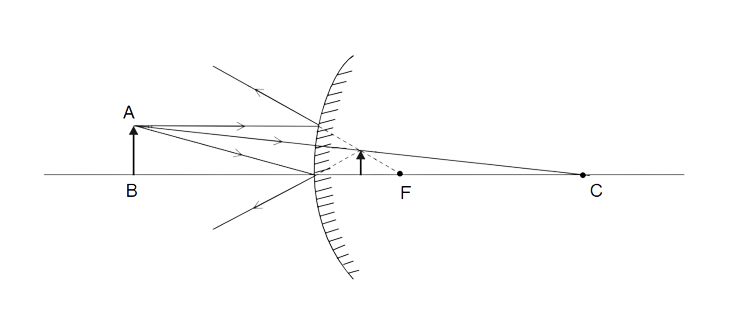
A. image is real, the same side of the concave mirror.
B. image is virtual, opposite side of the convex mirror.
C. image is virtual, opposite side of the concave mirror.
D. image is real, same side of the convex mirror.
Answer
 Verified
233.1k+ views
Hint: In this question, we are given with an object which lies before the central axis of a spherical mirror whose focal length has absolute value \[40cm\] and the image of the object produced by the mirror is of height\[25cm\], we need to find the nature of the image formed by the mirror, we will observe the position of the object and on that basis will find the image.
Complete step by step solution:
Given that the height of the object is \[100cm\]. Also it is given that the height of the image formed by the mirror is \[25cm\], which means the size of the object is reduced by \[25\% \]. Hence we can say the mirror is a convex mirror since a convex mirror bends the image, so the height gets reduced for the image formed. Now since we conclude that the mirror is a convex mirror and the image is upright as in the case of the object so we can say the image formed is virtual.
Therefore we can say option B. is correct, the image is virtual and on the opposite side of the convex mirror.
Note: The height of an image formed by the reflecting surface is always dependent on the position and the nature of the lens through which the light is passed.
Complete step by step solution:
Given that the height of the object is \[100cm\]. Also it is given that the height of the image formed by the mirror is \[25cm\], which means the size of the object is reduced by \[25\% \]. Hence we can say the mirror is a convex mirror since a convex mirror bends the image, so the height gets reduced for the image formed. Now since we conclude that the mirror is a convex mirror and the image is upright as in the case of the object so we can say the image formed is virtual.
Therefore we can say option B. is correct, the image is virtual and on the opposite side of the convex mirror.
Note: The height of an image formed by the reflecting surface is always dependent on the position and the nature of the lens through which the light is passed.
Recently Updated Pages
JEE Main 2026 Session 2 Registration Open, Exam Dates, Syllabus & Eligibility

JEE Main 2023 April 6 Shift 1 Question Paper with Answer Key
JEE Main 2023 April 6 Shift 2 Question Paper with Answer Key
JEE Main 2023 (January 31 Evening Shift) Question Paper with Solutions [PDF]
JEE Main 2023 January 30 Shift 2 Question Paper with Answer Key
JEE Main 2023 January 25 Shift 1 Question Paper with Answer Key
Trending doubts
Why does capacitor block DC and allow AC class 12 physics JEE_Main
Understanding Average and RMS Value in Electrical Circuits
Ideal and Non-Ideal Solutions Explained for Class 12 Chemistry
Understanding Atomic Structure for Beginners
Understanding Elastic Collisions in Two Dimensions
JEE Main Syllabus 2026: Download Detailed Subject-wise PDF
Other Pages
MOSFET: Definition, Working Principle, Types & Applications
Understanding Collisions: Types and Examples for Students
Happy New Year Wishes 2026 – 100+ Messages, Quotes, Shayari, Images & Status in All Languages
Valentine Week 2026 List | Valentine Week Days, Dates & Meaning
One Day International Cricket- India Vs New Zealand Records and Score
Highest T20 Scores in Cricket: Top Records & Stats 2025