




A circuit contains two capacitors in parallel wired in series to a resistor and source as shown above. The capacitors are initially uncharged. Which of the following describes the current I through and voltage $V_c$ across the Capacitor $C_1$ after the circuit reaches steady state?
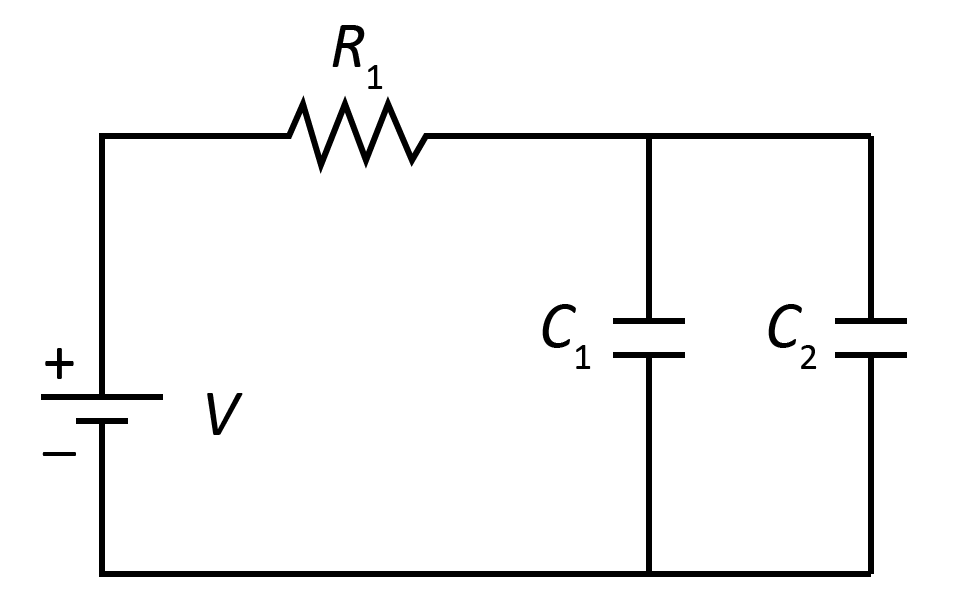
A) I=0 , ${V_c}$=0
B) I=0,${V_c}$=V
C) I=0, ${V_c}$=V/2
D) I=V/R, ${V_c}$=0
E) I=V/R, ${V_c}$=V
Answer
 Verified
264.9k+ views
Hint: Experimentally the time taken for a capacitor to get completely charged is equal to t=RC where t is the time constant in charging of the capacitor in C-R circuit, R is the resistance of the resistor in series and C is the capacitance of the capacitor. From this we can conclude that adding a resistance in series will increase the time taken by the capacitor to get fully charged.
Complete step by step answer:
A capacitor is a charge storing device. It is connected to a resistor initially and charged through a battery. The charging process is time dependent and it takes some time depending on the RC value of the circuit for the capacitor to reach maximum charge. But since we are leaving the capacitor connected for a long time, we assume that it is storing its maximum charge.
A capacitor connected across a DC supply keeps on charging till the potential across the battery becomes equal to the potential difference across the capacitor. In steady state after some time the current in the circuit will numerically be equal to zero. Hence we will use Kirchhoff’s law of voltage to see in steady state the potential difference across the capacitor.
Therefore, I=0, ${V_c}$=V and the correct option is (B).
Note: In an RC circuit, if the source is DC, the current then decreases from its initial value of I to zero as the voltage of the capacitor reaches the same value as the emf in case of transient period i.e. for a very short time in microseconds. As we know capacitors block the DC current, meaning the circuit will act as an open circuit.
Complete step by step answer:
A capacitor is a charge storing device. It is connected to a resistor initially and charged through a battery. The charging process is time dependent and it takes some time depending on the RC value of the circuit for the capacitor to reach maximum charge. But since we are leaving the capacitor connected for a long time, we assume that it is storing its maximum charge.
A capacitor connected across a DC supply keeps on charging till the potential across the battery becomes equal to the potential difference across the capacitor. In steady state after some time the current in the circuit will numerically be equal to zero. Hence we will use Kirchhoff’s law of voltage to see in steady state the potential difference across the capacitor.
Therefore, I=0, ${V_c}$=V and the correct option is (B).
Note: In an RC circuit, if the source is DC, the current then decreases from its initial value of I to zero as the voltage of the capacitor reaches the same value as the emf in case of transient period i.e. for a very short time in microseconds. As we know capacitors block the DC current, meaning the circuit will act as an open circuit.
Recently Updated Pages
JEE Main 2025-26 Experimental Skills Mock Test – Free Practice

JEE Main 2025-26 Electronic Devices Mock Test: Free Practice Online
JEE Main 2025-26 Mock Tests: Free Practice Papers & Solutions
JEE Main 2025-26: Magnetic Effects of Current & Magnetism Mock Test
JEE Main 2025-26 Atoms and Nuclei Mock Test – Free Practice Online
JEE Main Mock Test 2025-26: Experimental Skills Chapter Online Practice
Trending doubts
JEE Main 2026: Exam Dates, Session 2 Updates, City Slip, Admit Card & Latest News
JEE Main Participating Colleges 2026 - A Complete List of Top Colleges
Kinematics Mock Test for JEE Main 2025-26: Practice & Ace the Exam
Kinematics Mock Test for JEE Main 2025-26: Comprehensive Practice
Hybridisation in Chemistry – Concept, Types & Applications
Understanding the Electric Field of a Uniformly Charged Ring
Other Pages
CBSE Class 12 Physics Question Paper 2026: Download SET-wise PDF with Answer Key & Analysis
JEE Advanced 2026 Notification Out with Exam Date, Registration (Extended), Syllabus and More
JEE Advanced Percentile vs Marks 2026: JEE Main Cutoff, AIR & IIT Admission Guide
JEE Advanced Marks vs Rank 2025 - Predict Your IIT Rank Based on Score
JEE Advanced Weightage Chapter Wise 2026 for Physics, Chemistry, and Mathematics
Derivation of Equation of Trajectory Explained for Students