









Plasmodium vivax Life Cycle and Stages Explained with Diagrams for NEET
The concept of Plasmodium vivax is essential in biology and helps explain real-world biological processes and exam-level questions effectively. Understanding its life cycle, morphology, and economic importance is crucial for NEET and other entrance exams.
Understanding Plasmodium Vivax
Plasmodium vivax refers to a protozoan parasite from the phylum Apicomplexa that causes benign tertian malaria in humans. This concept is important in areas like parasitology, human health and disease, and cell biology. Plasmodium vivax is one of the most common malaria-causing species and is frequently tested for its life cycle, infection mechanisms, pathogenicity, and differences from other Plasmodium species in NEET exams.
Plasmodium Vivax in NEET – Key Points
- Plasmodium vivax is a malaria-causing protozoan.
- Classified under phylum Apicomplexa, kingdom Protista.
- Transmitted to humans by the female Anopheles mosquito.
- Its life cycle includes both sexual (in mosquito) and asexual (in human) phases.
- Hypnozoites are dormant liver-stage forms unique to P. vivax.
Classification of Plasmodium Vivax
| Rank | Classification |
|---|---|
| Domain | Eukarya |
| Kingdom | Protista |
| Subkingdom | Protozoa |
| Infrakingdom | Alveolata |
| Phylum | Apicomplexa |
| Class | Aconoidasida |
| Order | Haemosporida |
| Family | Plasmodiidae |
| Genus | Plasmodium |
| Species | P. vivax |
Morphology and Stages of Plasmodium Vivax
- Sporozoite: Elongated, 15 µm; infective form found in mosquito’s salivary glands.
- Schizont: Liver stages (40-80 µm) and erythrocytic (7-8 µm); multinucleated, release merozoites.
- Trophozoite: Immature are ring-shaped; mature are amoeboid and have hemozoin pigment.
- Gametocyte: 7-14 µm; form sexual stages in RBCs, appear oval or round.
- Zygote & Ookinete: Fertilization in mosquito midgut forming a motile, elongated ookinete.
- Oocyst: Spherical, produces many sporozoites in mosquito’s gut wall.
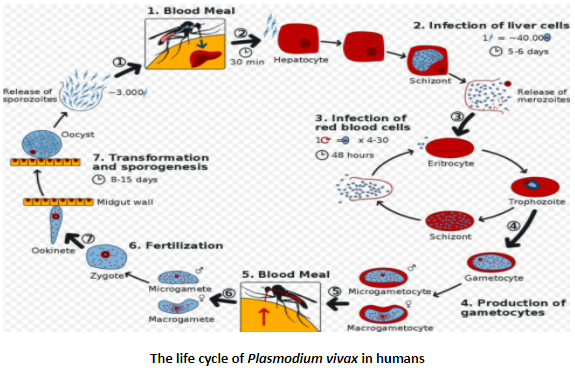
Life Cycle of Plasmodium Vivax – Stepwise Explanation
- Sporozoites are injected into humans by an infected female Anopheles mosquito.
- Sporozoites enter the liver and multiply (exo-erythrocytic schizogony), forming liver schizonts.
- Hypnozoites may form as dormant stages (unique to P. vivax), causing relapses.
- Liver cell rupture releases merozoites into the bloodstream.
- Merozoites invade RBCs, cycle through ring, trophozoite, and schizont stages (erythrocytic schizogony).
- RBCs burst, releasing more merozoites and toxic hemozoin (causing malaria symptoms).
- Some merozoites differentiate into gametocytes (male and female forms).
- When another female Anopheles mosquito bites, it ingests gametocytes.
- In the mosquito midgut, gametocytes fuse (fertilization), forming a zygote & then the motile ookinete.
- Ookinete penetrates gut wall, develops into an oocyst.
- Oocyst releases sporozoites which migrate to the salivary glands, ready to infect the next human host.
Pathogenicity (How Plasmodium Vivax Causes Malaria)
Plasmodium vivax primarily infects liver cells and red blood cells. The cyclic rupture of RBCs releases hemozoin pigment and toxins, causing periodic fever, chills, sweating, and anemia. The dormant hypnozoite form can cause relapses weeks or months after the initial infection. P. vivax malaria is less severe than P. falciparum but may persist longer due to repeated relapses.
Economic and Health Importance
- Public Health Burden: Causes millions of malaria cases annually, mainly in tropical regions.
- Workforce Impact: Reduces productivity due to illness and absenteeism.
- Healthcare Costs: Significant investment in diagnosis, treatment, and vector control.
- Relapse Risk: Hypnozoite stage makes eradication and treatment more difficult.
Common Mistakes to Avoid
- Confusing sporozoites (infective form) with merozoites (RBC-infecting).
- Ignoring the unique hypnozoite stage of P. vivax.
- Mixing up pathogenic differences between P. vivax and P. falciparum.
- Incorrect diagram labelling (especially for MCQs).
Practice Questions
- Draw and label the life cycle of Plasmodium vivax. Highlight the stages occurring in humans and mosquitoes.
- Explain the significance of the hypnozoite stage in P. vivax.
- Name all the asexual and sexual stages of Plasmodium vivax found in humans.
- List the main differences between P. vivax and P. falciparum malaria.
Real-World Applications
The concept of Plasmodium vivax is used in fields like medicine, vaccine development, drug research, public health planning, and entomology. Understanding its life cycle helps control malaria transmission and develop targeted treatments. Vedantu helps students master such biology topics for academic and practical success.
In this article, we explored Plasmodium vivax, its life cycle, morphology, and real-life significance. Understanding these high-yield points prepares you for NEET and related exams. Keep reviewing diagrams and practicing with Vedantu for better confidence and top results.
Explore Related Topics
- Plasmodium vivax – In-depth facts and structure illustrations.
- Plasmodium life cycle – Comparison of all human malaria species.
- Protozoal diseases – Broader protozoan infection context.
- Common diseases in humans – Malaria – Human health focus.
- Immunity – Immune responses to malaria.
- Pathogen – Key terms for NEET MCQs.
- Parasitism – Sociobiological context for parasite-host relationships.
- Protozoa – NEET-level taxonomy links.
- Animal kingdom – Five-kingdom classification review.
- Microbiology – Pathogen and parasite context.
FAQs on Plasmodium vivax Notes – Classification, Life Cycle & Key Points for NEET
1. What is Plasmodium vivax in NEET?
Plasmodium vivax is a protozoan parasite responsible for causing malaria in humans. It is classified under the phylum Apicomplexa and transmitted by the female Anopheles mosquito. Understanding its life cycle, morphology, and infection stages is crucial for NEET biology preparations.
2. How to easily remember Plasmodium vivax life cycle and stages?
Remember the two-host life cycle involving humans (asexual reproduction) and mosquitoes (sexual reproduction). Focus on key stages: sporozoite (infective stage), schizont (liver and blood), merozoite (invades RBC), trophozoite, gametocyte, zygote, ookinete, and oocyst. Use mnemonic aids linking liver stages, blood stages, and mosquito stages for clarity.
3. What are the main morphological features of Plasmodium vivax?
Key morphological features of Plasmodium vivax include:
- Sporozoites: elongated, ~15 µm, found in mosquito salivary glands
- Schizonts: liver schizonts (40-80 µm), blood schizonts (~7-8 µm), multinucleate
- Trophozoites: ring-shaped (immature), amoeboid with brown pigment (mature)
- Gametocytes: 7-14 µm, sexual stage in RBCs
- Presence of haemozoin pigment from hemoglobin digestion
4. Which host(s) are involved in the P. vivax cycle for NEET?
The life cycle of Plasmodium vivax involves two hosts:
1. Human host – site of asexual reproduction (liver and RBC stages)
2. Females of Anopheles mosquito – site of sexual reproduction (gametocyte fertilization, sporogonic cycle)
This dual-host cycle is vital for understanding transmission and pathogenesis.
5. What is the economic importance of Plasmodium vivax?
Plasmodium vivax contributes significantly to economic losses due to:
- High morbidity causing work absenteeism
- Increased healthcare costs for malaria treatment
- Burden on public health infrastructure, especially in endemic regions
- Delay in economic development owing to recurrent malaria episodes
6. Why do students often confuse the life cycle stages (sporozoite vs. merozoite) in MCQs?
Confusion arises because both sporozoite and merozoite are infective forms but differ in timing:
- Sporozoite: infective stage injected by mosquito into human bloodstream; initiates liver infection
- Merozoite: released after liver schizogony; infects RBCs
Clear distinction requires remembering host entry points and targets for each stage.
7. Is the hypnozoite stage unique to P. vivax compared to other malaria parasites?
Yes, the hypnozoite is a dormant liver stage unique mainly to Plasmodium vivax (and P. ovale), which can remain inactive for weeks or years. This stage causes relapse by reactivating and producing merozoites, leading to recurrent malaria episodes. Understanding hypnozoites is important for treatment strategies.
8. How can I avoid diagram labelling mistakes in P. vivax-based MCQs?
To avoid mistakes in diagram labelling:
- Memorize distinct shapes and sizes of each stage (e.g., sporozoites elongated, gametocytes round)
- Associate lifecycle stages with their respective hosts: liver stages (schizonts), blood stages (trophozoites, schizonts, gametocytes), mosquito stages (zygote, ookinete, oocyst)
- Practice labelled diagrams repeatedly
- Use mnemonics correlating terms and visuals for better retention.
9. Why is P. vivax less fatal than P. falciparum in exam explanations?
Plasmodium vivax typically causes benign tertian malaria with milder symptoms due to:
- Preference for infecting young RBCs, causing less severe anemia
- Less cytoadherence and vascular obstruction compared to P. falciparum
- Absence of cerebral malaria manifestation
Understanding this difference helps in distinguishing pathogenicity and clinical severity.
10. What are common silly mistakes in Plasmodium vivax NEET questions?
Common errors include:
- Mixing up hosts of sexual and asexual stages
- Confusing sporozoite with merozoite stages
- Forgetting the hypnozoite dormant phase unique to P. vivax
- Incorrectly labelling stages in diagrams
- Misidentifying species-specific features, especially between P. vivax and P. falciparum
Careful revision and diagram practice reduce these mistakes.
11. What are the stages of the life cycle of Plasmodium vivax?
The main life cycle stages of Plasmodium vivax are:
1. Sporozoite: infective form injected by mosquito
2. Liver Stage (exo-erythrocytic schizogony): sporozoites infect liver cells, forming schizonts
3. Merozoite: released from liver, infects RBCs
4. Trophozoite: immature ring forms inside RBCs
5. Schizont: multiplies to release more merozoites
6. Gametocytes: sexual forms in RBCs
7. Fertilisation in mosquito gut forming zygote, ookinete
8. Oocyst: forms on mosquito gut, producing sporozoites
9. Sporozoites: migrate to salivary glands, ready to infect next human host.
12. What is the difference between P. vivax and P. falciparum?
Key differences between Plasmodium vivax and Plasmodium falciparum include:
- P. vivax infects young RBCs; P. falciparum infects RBCs of all ages
- P. vivax causes benign tertian malaria; P. falciparum causes malignant and often fatal malaria
- Hypnozoite stage present only in P. vivax
- Morphologically, P. falciparum trophozoites have multiple rings per RBC; P. vivax has larger trophozoites with Schüffner’s dots
- P. falciparum gametocytes are crescent-shaped; P. vivax gametocytes are round
